
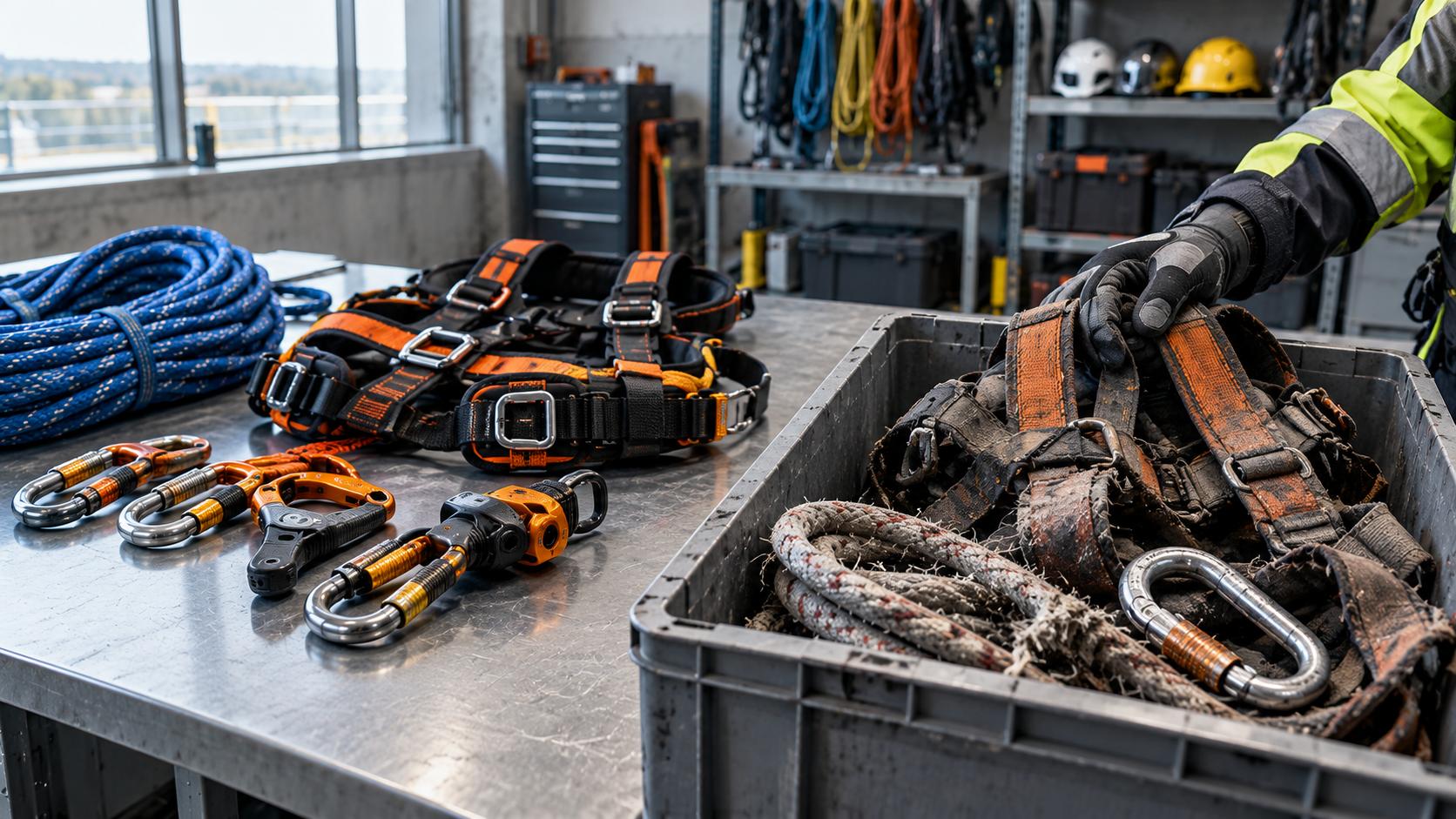
When to retire a harness, rope or karabiner – signs of wear on rope access equipment that are easy to miss
A harness that travels with a crew from site to site for several seasons usually does not change from one day to the next. The webbing fades a little, the karabiner picks up scratches, the rope becomes stiffer in a few places. Each of these changes looks harmless on its own. The problem is that equipment protecting against falls loses its protective properties gradually and often without a clear signal, and the moment when it needs to be retired is easy to miss.
This guide is for people who work at height every day and for their supervisors. We show what to look at for each group of equipment, how factors that are not immediately visible work, and when withdrawing rope access equipment from use is the only sensible decision.
Why equipment wear is so easy to overlook
In everyday work, equipment is rarely loaded the way it is when arresting a fall. That is why it still “works” even when its protective properties are already clearly weakened. The rope holds the technician during descent, the karabiner gate closes, the buckle holds. The weakness only shows under a high load, which is exactly when the equipment is supposed to save a person.
On top of that comes habit. Someone who puts on the same harness every day stops noticing slow changes. That is why, in addition to the pre-use check, a periodic inspection is needed, carried out by a competent person according to the manufacturer’s instructions. The Polish Central Institute for Labour Protection – National Research Institute (CIOP-PIB) describes this system as two levels of supervision: before each use and periodically, at least once a year.
Three situations in which the decision is simple
The Central Institute for Labour Protection identifies three basic cases in which a harness should be withdrawn from use. The same logic works for all fall protection equipment:
- The equipment has been subjected to a heavy load, for example it has arrested a fall.
- Disqualifying damage has been found, that is damage which, according to the manufacturer’s criteria, rules out further use.
- The service life specified by the manufacturer has expired.
The first and third points require no visual assessment at all. Either the equipment was involved in arresting a fall or it was not. Either the date has passed or it has not. The second point is the hardest, because it requires knowing where to look for damage and how to recognise it.
Harnesses – what to look at
Webbing and stitching
Webbing is inspected along its entire length, bending it and checking both sides. Warning signs are cuts and nicks on the edges, abrasion, fuzzing, melting, hard or glazed spots, discolouration and stains from paints or chemicals. Load-bearing stitching is particularly important: broken, worn or pulled threads are a reason for retirement, even if the rest of the harness looks fine.
Buckles and attachment points
Connecting and adjusting buckles must fasten properly and hold their adjustment. Cracks, deformation, corrosion and sharp edges take a harness out of service. Petzl points to the attachment points of a harness as the place where wear is most often visible, because that is where karabiners and devices work. Wear in these places grows faster than on the other components.
What you cannot see
CIOP-PIB points out that a harness loses its protective properties during use, and the rate of this process depends on the conditions and the way it is used. Webbing weakened by UV radiation or chemicals may show no trace that is easy to catch with the eye. This is one of the reasons why the service life given in the manufacturer’s instructions is a limit, not a suggestion.
Ropes, lanyards and slings
Sheath
The rope is inspected metre by metre, running it through the hands. On the sheath you look for cuts, melted spots, places that are heavily fuzzed or worn down to the core, and traces of contact with chemicals. An exposed core means the rope is unfit for work. Watch out for paints and solvents: on construction sites and during structural renovation, contact with them happens more often than one might think.
Core
The core cannot be seen, but it can be felt. That is why the rope is also checked by touch, looking for places that are unusually hard, soft or flattened, and for changes in diameter. Such a spot may indicate damage to the core with an intact sheath. This is one of the signs of rope wear that are easiest to miss during a quick inspection.
Terminations and sewn ends
Sewn rope terminations, safety lanyards and cow’s tails are checked in the same way as harness stitching. Worn or damaged stitching covers, abrasion at the eyes and signs of overloading require a decision by a competent person.
Karabiners and connectors
Gate and lock
A karabiner has two tasks: to close by itself and not to open by accident. CIOP-PIB, in its materials on self-inspection of connectors, states that a gate that does not return to the closed position on its own or a lock that does not work are disqualifying, and equipment with such a symptom must be withdrawn without exception. The most common causes are heavy contamination, for example with paint, corrosion of the gate pivot, deformation of the gate or body and damage to the spring.
Body
When inspecting the body, you look for cracks, deformation, material loss, burrs and sharp edges. In studies of used connectors described by CIOP-PIB, the most common defects were corrosion, deformation, material loss, cracks and contamination. A separate issue is rope grooves: a deep groove on a karabiner through which the rope often runs creates an edge that can damage the sheath. Manufacturers point out that karabiners wear precisely from the rope repeatedly running over them.
Descenders, rope clamps and retractable fall arresters
Descenders and rope clamps have surfaces over which the rope runs and moving cams or teeth. Their wear shows as abrasion, grooves, worn or clogged cam teeth, play on the axles and weakening springs. A device that no longer grips the rope reliably or behaves differently from usual should not go back to work before it has been assessed.
Retractable fall arresters and other devices of complex design are a separate category. The user and the person carrying out the inspection check what the instructions allow: the housing, the cable or webbing, the connectors, the fall indicator and the operation of the brake. The internal mechanism can often be checked only by the manufacturer or its authorised service centre. If the instructions say so, there is no room for improvisation here.
Helmets
A helmet is inspected from the outside and the inside. Cracks, deep scratches, deformation of the shell, a damaged harness, a torn or worn chin strap and a buckle that does not work take a helmet out of service. After a heavy impact, a helmet is set aside for assessment according to the manufacturer’s instructions, even if no marks are visible on it, because damage to the shell and harness is not always visible. The service life of a helmet also follows from the manufacturer’s instructions, which is why it is worth checking the date of manufacture marked on the helmet.
UV, chemicals, dust and temperature – wear that comes from the environment
The hardest wear to catch is wear that arises not from work but from conditions. CIOP-PIB lists among the factors that can cause a harness to lose its protective performance:
- high temperature and infrared radiation,
- ultraviolet radiation,
- molten metal splashes,
- dust,
- aggressive chemicals.
The institute also counts heavy mechanical loads, contamination with aggressive chemicals and dust, and open flame among the most destructive factors.
In practice, this means a few simple rules. Equipment should not lie in the sun on a roof or in a hot car. After work in dust, with paints or chemicals, it has to be cleaned according to the manufacturer’s recommendations and carefully inspected. Contact with an acid, alkali, fuel or solvent is a situation in which equipment is set aside for assessment. Special requirements also apply to work in potentially explosive atmospheres, which we discuss in the article on how to select rope access equipment for work in an explosion hazard zone.
Equipment after a fall
This is a rule with no exceptions at user level: equipment that has been involved in arresting a person’s fall is withdrawn from use regardless of whether any damage is visible on it. CIOP-PIB stresses that changes after overloading may be imperceptible during a visual inspection and at the same time significantly affect protective performance. This applies to harnesses, cow’s tails, energy absorbers, karabiners and the other components of the system.
Such equipment is handed over for assessment to a competent person, for example the manufacturer’s service centre, and what happens next follows from the product’s instructions. In many cases this means permanent retirement. Equipment is treated the same way after another unusual load, after the equipment itself has fallen from height or after an event whose course no one is sure of.
From the supervisor’s point of view, it is important that reporting such an event is not a problem for the worker. If a technician fears the consequences, it is easier to keep quiet about a fall and put the harness back on the shelf.
Service life – the date counts, not the appearance
The Polish regulation on general OHS rules states plainly that personal protective equipment is replaced in accordance with the manufacturer’s instructions or when it loses its protective properties. The service life of equipment is therefore set by the manufacturer, not by the user.
The values differ between products and manufacturers. CIOP-PIB states that in practice the service life of harnesses made of polyamide or polyester webbing is most often five years. Petzl sets the maximum lifetime of textile and plastic products at 10 years from the date of manufacture and gives no limit for metal products. The same manufacturer notes, however, that an exceptional event, sharp edges, extreme temperatures or chemicals can force the retirement of equipment even after a single use.
Two things are worth remembering. First, the date of manufacture is not the date of purchase, so equipment bought recently may have been in a warehouse for a long time. Second, an illegible label from which the date and number cannot be read is in itself a serious obstacle to assessing whether the equipment can continue in service.
The equipment record card – the memory the equipment does not have
A harness does not remember that it arrested a fall two months ago. A rope will not show that it lay in a puddle of solvent. Only the documentation stores this history. The regulations require the condition of PPE to be periodically checked and documented, and an equipment record card is the simplest way to do this.
A well-kept card contains at least: identification of the item (manufacturer, model, serial or batch number, date of manufacture), the date of purchase and first use, the person or team using it, the results of successive inspections and any unusual events. Petzl’s inspection form uses five states: good condition, to monitor, action required, do not use and retire, not applicable, and recommends keeping an inspection log to preserve the history of each product.
The card also matters when entering a site. A facility manager or plant manager may ask not only for the technicians’ IRATA certificates, but also for proof that the equipment is serviceable and inspected. We described the parties’ obligations in more detail in our guide to what a rope access company must meet under Polish OHS regulations.
What to do with equipment you have doubts about
In work at height the rule is simple: if you are not sure, the equipment does not go to work. In practice the following sequence works well:
- Set the equipment aside and mark it so that no one takes it by mistake. Ideally in a separate, labelled place.
- Write down what happened: what event, what symptoms, when.
- Check the manufacturer’s instructions: retirement criteria, the possibility of repair, service requirements.
- Hand the equipment over for assessment to a competent person or, where the instructions require it, to the manufacturer or an authorised service centre.
- Destroy permanently retired equipment in a way that prevents reuse, in line with the rules adopted in the company, and record this on the card.
Repairs of protective equipment are possible only when the manufacturer permits them and only according to its procedure. Re-stitching webbing at home or straightening karabiners is not a repair, but a way of hiding the problem.
Conclusions
Retiring rope access equipment rarely results from a single spectacular defect. More often it is the sum of small changes, the influence of the environment and a history that no one recorded. Three situations require no discussion: equipment after arresting a fall, equipment past the date specified by the manufacturer and equipment with disqualifying damage. Everything in between requires a careful pre-use check, a reliable equipment record card and a regular periodic inspection.
A daily check will catch obvious damage, but it will not replace a thorough check according to the manufacturer’s procedure. If no one in your crew has inspected the equipment in this way for a long time, or it is hard to establish when the last inspection took place, it is worth starting by listing the equipment and booking an inspection of rope access equipment and PPE, before an inspection or an incident at height does it for you.

Author
Piotr Lankiewicz
Specialist in height work and rope access techniques. Owner of a company providing services in the most inaccessible locations nationwide. He prioritizes punctuality, strict health and safety standards, and solutions that save time and costs where the use of heavy machinery is impractical or not cost-effective.