What an Industrial Climbing Company Must Meet Under Polish OHS Regulations – A Guide for Property Managers
You need to commission facade cleaning or a roof inspection. A company has sent you a quote, the price seems reasonable, the schedule works. But before you sign the contract – one question: what will you do if an accident occurs during the work? Who is responsible for ensuring that workers were properly trained? That the insurance policy covers exactly this type of work? That the company was even authorised to carry out operations on your property?
As a property manager or facility manager, you are the coordinating party for work carried out on the premises. This is not merely a formality – it is a real responsibility imposed on the entity managing the property under Polish law. Below you will find specific information on what you can and should require from an industrial climbing company before allowing their crew onto the roof.
Legal Basis – Where to Start
Work at height (above 1 metre) is governed primarily by the Polish Regulation on General OHS Requirements (1997). Section 105 defines work at height as work performed on a surface located at least 1 metre above floor or ground level. Sections 106-110 specify the employer’s obligations regarding worker safety: the use of collective and personal protective measures, risk assessment, and provision of appropriate equipment.
Alongside this, Article 207 of the Polish Labour Code places on the employer the obligation to protect the health and life of workers by ensuring safe and hygienic working conditions. It is the employer – meaning the industrial climbing company, not you – who is responsible for their workers. However, you, as the commissioning party, are required to cooperate and coordinate the safe execution of work on the premises you manage.
In practice, this means: before a company starts work, you must be certain it meets the formal requirements. You cannot delegate this responsibility entirely to the contractor – if you allowed a company without the appropriate documents to begin work, part of the risk falls on your side.
What a Company Must Have Before Entering the Site
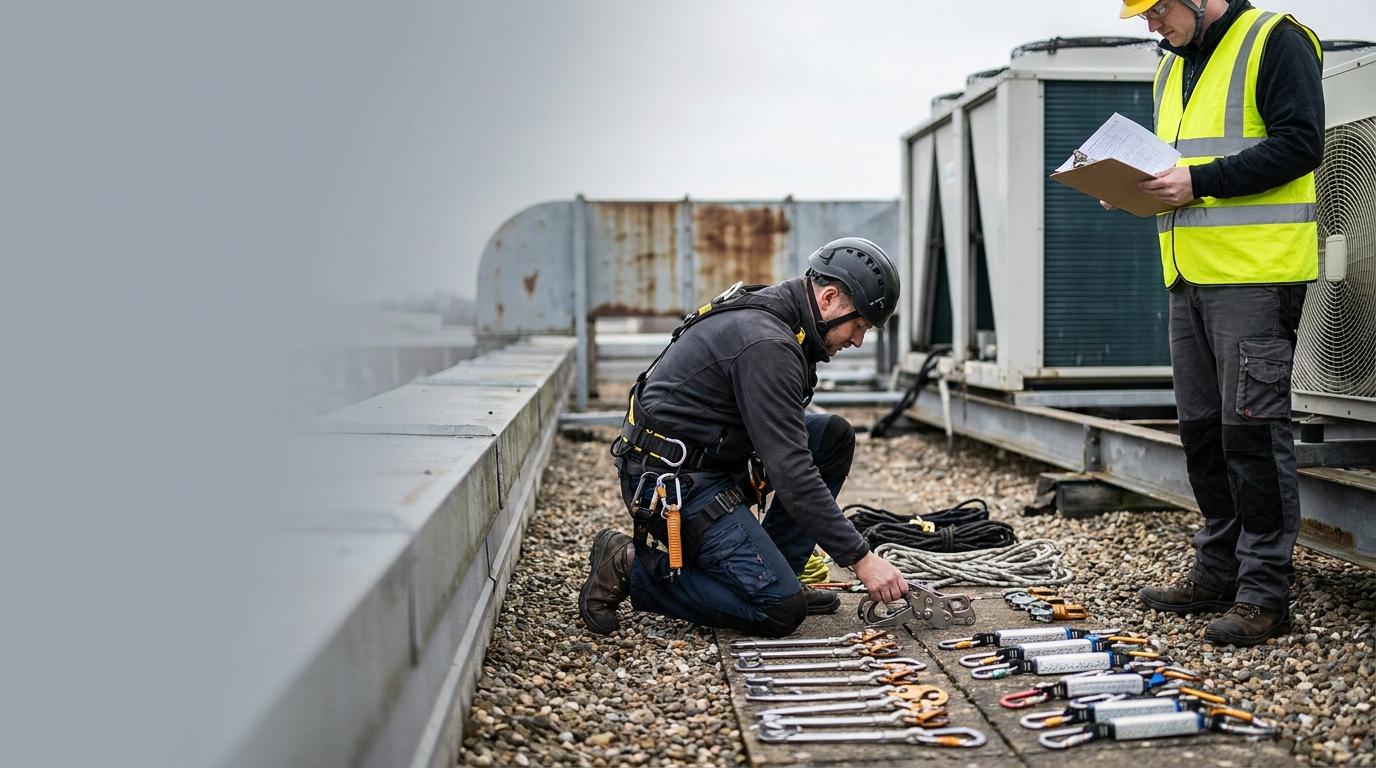
Below is a list of documents and qualifications that every reputable industrial climbing company is able to present on request. If a company refuses or “doesn’t have them to hand” – that is a warning sign.
- OHS training for workers: Every worker carrying out rope access work at height must hold current OHS training – both induction and periodic. A general “workplace OHS” training is not sufficient – it must relate specifically to work at height and rope access techniques.
- Work-at-height qualifications: Poland does not have a single mandatory state-issued certificate for industrial rope access, but the industry standard is the IRATA certificate (Industrial Rope Access Trade Association). Confirmation of IRATA or equivalent qualifications demonstrates that workers were trained and examined to a unified standard. You can find more details in the article: IRATA certificate – why you should require it from a rope access company.
- Public liability insurance covering work at height: This is one of the key documents. The policy must state that its scope covers work at height using rope access or climbing methods. A general public liability policy for a construction company often does not cover such work. Request the current policy and check validity dates and scope of cover.
Work Plan and Safe Work Method Statement (SWMS)
For more complex work – particularly near traffic routes, on multi-storey facades, or when work is being carried out simultaneously with other crews on the site – the industrial climbing company should prepare a Safe Work Method Statement (SWMS).
A SWMS is a document describing: the scope and sequence of work, methods for protecting workers and third parties, the equipment and techniques to be used, planned anchor points, and procedures for emergency situations. Its preparation is required in the case of particularly hazardous work (as defined in the Polish Regulation on General OHS Requirements).
Even if a SWMS is not formally required for a given job – its existence demonstrates that the company takes work planning seriously. You can request such a document or ask about the work plan before signing the contract.
Your Obligations as the Coordinating Party
The role of a property manager does not end at signing the contract. As the entity managing the site on which work is being carried out, you have specific obligations:
- Informing about hazards on the site: If the building has unstable facade elements, unmarked installation points, damaged roof sections, or other hazards – the company must be informed before entering the site. Concealing such information shifts responsibility onto you.
- Ensuring access: Access to the roof, technical shafts, hatches – you should arrange this before work begins. Failure to provide access at the agreed time is your responsibility as the commissioning party.
- Coordinating with other contractors: If other crews are working on the site at the same time, you must ensure coordination so that operations do not conflict with each other or create additional risks.
Your Right to Review and Oversight
As a property manager, you have every right to request documents from the contractor – both before signing the contract and during the work. You can request access to OHS training records, the insurance policy, IRATA certificates, or other qualifications. You also have the right to suspend work if you identify a breach of safety rules – failure to use protective equipment, working without safeguarding, or the presence of unauthorised persons in the work zone.
Suspending work is not obstruction – it is your obligation as the person coordinating work on the site.
Verification Checklist Before Signing the Contract
- Current public liability insurance policy – check the scope (work at height / rope access) and validity dates
- Worker qualification certificates – IRATA or equivalent; ask about the specific individuals who will be carrying out the work
- OHS training records – current, dedicated to work at height
- References or portfolio – similar properties, similar scope of work
- Work plan or SWMS – especially for complex jobs
- Scope of liability in the contract – a clear clause stating who is responsible for damages and how work is documented upon completion
- Site survey – did the company inspect the building before quoting? A quote without a site visit is a warning sign
- Names of workers entering the site – you may require a named list of persons authorised to carry out the work
If you want to know how to identify a company that does not meet these requirements – already at the quote and first contact stage – read the article on red flags when choosing an industrial climbing company. And if you are interested in how IRATA qualification verification works in practice, you will find more information on the page IRATA certificate – why it is worth requiring.
Have questions about a specific property or type of work? Contact us – we will carry out a site survey and explain what documents and conditions apply in your situation.
Author
Piotr Lankiewicz
Specialist in height work and rope access techniques. Owner of a company providing services in the most inaccessible locations nationwide. He prioritizes punctuality, strict health and safety standards, and solutions that save time and costs where the use of heavy machinery is impractical or not cost-effective.