

Gutter Cleaning and Bird Protection Systems with Rope Access
Dark streaks appeared on the facade of an office building – running from the cornice downward, roughly where the gutters end. The property manager had ordered a facade wash the previous season, but the problem came back within a few weeks. The cause was not the facade – it was the gutters, which had been partially blocked for some time. During heavy rainfall, water overflowed the edges, ran down the facade and left deposits. On top of that, pigeons had been regularly nesting on the cornices above the gutters, leaving droppings and nest debris. Washing a facade without fixing the gutters and installing bird protection is work that will need repeating in six months.
Table of Contents
- Why service gutters and bird deterrent systems together?
- Signs of blocked gutters: streaks, overflow, facade dampness
- Gutter cleaning in buildings without easy access
- Installing spikes, netting and bird deterrent systems
- How to choose a protection system without damaging the facade?
- When to combine gutter cleaning with a roof or facade inspection?
- How does the job unfold step by step?
- How often should gutters be cleaned in tall buildings?
This is a scenario that occurs in many office, residential and industrial buildings. Gutter cleaning and bird deterrent system installation are separate services, but combining them into a single intervention has clear operational and economic logic.
Why service gutters and bird deterrent systems together?
Both problems share the same concentration points: cornices, parapets, roof edges and gutters. Birds nest wherever there is shelter – a gutter is an ideal location. Nest debris, feathers and droppings block outlets and accelerate corrosion. Cleaning a gutter without installing deterrents produces a result that disappears with the next nesting season.
Combining both scopes into a single service visit means:
- One anchor setup and one organisation of rope access work instead of two separate interventions
- Deterrents are installed on a clean gutter – giving better contact with the substrate and longer-lasting fixings
- A single closure of the zone below the building
- One work report and one invoice
For a property manager, this is a matter of organisation: one tender, one contractor, one date. Instead of coordinating two different companies at two different times.
Signs of blocked gutters: streaks, overflow, facade dampness
A blocked gutter is not always directly visible – particularly in buildings where roofs and gutters are out of sight from ground level. Symptoms appear indirectly:
- Dark streaks on the facade below cornices or beneath gutter runs – the result of water overflowing during rainfall
- Lime deposits or rusty discolouration on the facade – indicating persistent dampness from a specific point
- Grass and weeds growing from gutters – visible from outside, indicating accumulated organic matter and years of neglect
- Water overflow during heavy downpours – water falls directly from the gutter edge instead of flowing along the gutter to the downpipe
- Dampness on walls or ceilings at the top floor – can be caused by water backing up under the roof covering when outlets are blocked
- Flooding at the base or plinth – blocked downpipes direct water straight onto the wall or against the foundations instead of into the drainage system
Each of these signals should trigger a gutter inspection. The longer the problem is left unaddressed, the higher the costs – not only for gutter replacement, but also for facade repairs and potentially insulation.
Gutter cleaning in buildings without easy access
In single-family homes up to three storeys, a ladder is sufficient. In office buildings, apartment blocks above four floors, industrial halls with gutters at eight metres height, and buildings with difficult surroundings – a ladder is not enough.
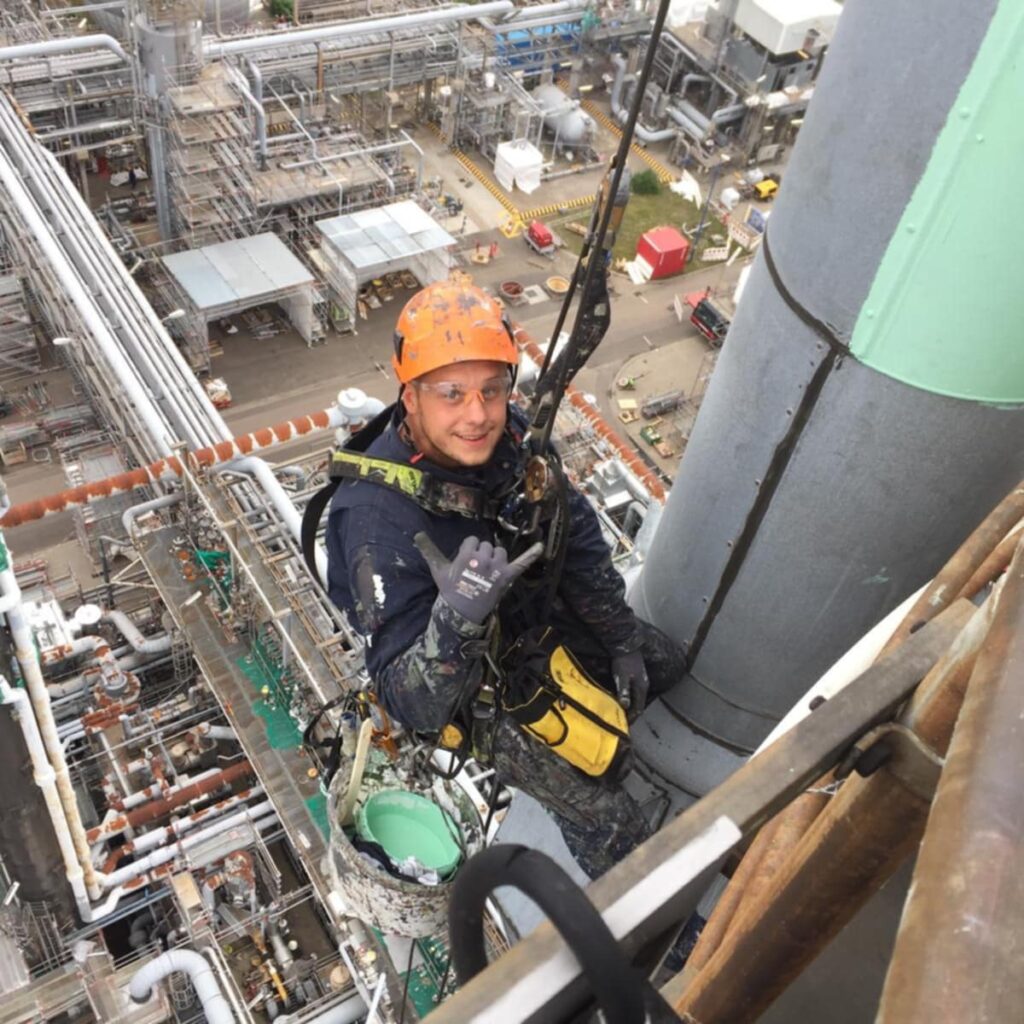
Rope access solves the accessibility problem without the need to erect scaffolding or hire an aerial lift. Operatives anchoring from the roof can work along the full length of the gutter, reach hard-to-access sections above lower roofs, parapets and around technical obstacles.
Scope of gutter cleaning with rope access:
- Removal of organic deposits: leaves, moss, bird nest debris, soil
- Clearing outlets and gratings – checking that water flows freely into the drainage system
- Assessment of gutter condition: cracks, corrosion, loose fixings, incorrect fall
- Flushing gutters with water – verifying clear flow after mechanical cleaning
- Condition report with any repair recommendations
For buildings with gutters at significant height, the cost of rope access is many times lower than erecting and hiring scaffolding around the entire building. We describe the gutter cleaning at height service in detail on the service page.
Installing spikes, netting and bird deterrent systems
Bird protection is not a single product – it is a category of solutions with varying applications, durability and cost. Selecting the right system depends on the bird species, the location and manner of nesting, and the nature of the facade or gutter.
Bird spikes – steel or plastic, installed on cornices, parapets, beams and roof edges. Effective against pigeons that perch on horizontal surfaces. Spikes physically prevent landing without harming the birds. The most widely used solution in urban construction.
Bird netting – the solution for locations where birds not only perch but actively nest in recesses: under eaves, behind gutters, in facade niches, on deep-set window sills. Netting blocks access to the space without damaging the surface. It requires precise fixing to ensure there are no gaps through which birds can squeeze.
Reflective tape and optical systems – low cost, limited effectiveness; birds quickly become accustomed to them. May work as a supplement, not as a standalone solution for serious infestations.
Electric deterrent systems – a gentle electric pulse on landing; used on listed buildings and facades where spikes would be aesthetically unacceptable. Require connection to a power supply and regular inspection.
Acoustic and visual systems – used on large surfaces, e.g. green roofs, terraces and open spaces; less useful for gutters and cornices.
The choice of system should be preceded by an assessment of the extent of the problem: where birds are present, how intensively, and which species. Installing spikes where birds are nesting in a deep recess will not solve the problem. Installing netting where birds simply perch on an edge is overkill.
The detailed scope of bird deterrent system installation – spikes, netting and electric deterrent systems – is described on the service page.
How to choose a protection system without damaging the facade?
The facade is not just a backdrop – it is a finishing element of the building, and repairs after damage are costly. Incorrect installation of bird deterrents can lead to micro-cracks in the render, adhesive failure, corrosion of fixings and water ingress through gaps.
Principles of safe installation:
- Matching the fixing to the substrate material – spikes are fixed differently into concrete, brick, metal gutters or PVC
- Using washers and sealants – for fixings that penetrate the facade, to prevent water entering at the point of the hole
- Avoiding aggressive adhesives on mineral or historic render – some mounting adhesives damage the surface during removal
- Checking chemical compatibility on aluminium, coated sheet metal or plastic facades – an aggressive sealant may react with the material
- Coordinating with any planned facade maintenance programme – if the facade is scheduled for painting or washing, it is worth installing deterrents after those works
For listed buildings or facades covered by heritage protection, it may be necessary to obtain an opinion or approval from the conservation authority for the installation of a specific system. This should be established before placing the order, not on the day of the job.
When to combine gutter cleaning with a roof or facade inspection?
An operative working at the gutters is already on the roof or at the facade. This is the moment when a visual inspection of elements that are difficult to assess from ground level or from windows can be carried out efficiently.
Scopes worth considering alongside gutter cleaning:
- Assessment of roof covering condition – visible cracks, membrane detachment, damage to flashings, condition of parapets and expansion joints
- Inspection of downpipe outlets and joints – the locations where leaks most frequently occur
- Assessment of facade condition at cornices and eaves – streaks, render detachment, cracks, water ingress points
- Condition of seals and joints around windows on the top floor – often overlooked in standard inspections
- Inspection of roof installations – condition of soil pipes, chimney bases, service penetrations through the roof covering
Not every one of these tasks requires a separate order and a separate crew. With rope access work, an additional inspection is a matter of the operative’s time, not a separate mobilisation. Following gutter cleaning, it is also possible to commission facade washing and maintenance – particularly where streaks have left marks on the building face.
How does the job unfold step by step?
For a property manager, what matters is not only what will be done, but how it will look in practice: when the car park needs to be closed, how long the entrance will be inaccessible, and what is required on their side.
Stage 1: Enquiry and quote. Description of the building, estimated gutter length, information about the bird problem (if applicable), roof access. An initial quote is possible on this basis. For buildings above a few storeys, it is worth including photographs.
Stage 2: Scope agreement. Is this gutter cleaning only, or cleaning with deterrent installation? Should a roof inspection be carried out at the same time? The scope affects the working time and cost – this is agreed before arrival.
Stage 3: Zone preparation. Closing or marking the zone below the gutters – where operatives will be working and where debris may fall. For large buildings this may include part of the car park or pavement.
Stage 4: Work at height. Anchoring, descent alongside the gutters, mechanical cleaning, flushing, installation of deterrents (if in scope). The crew works from the roof downward along the full length of the gutter.
Stage 5: Report and zone clearance. On completion – assessment of gutter condition, any observations about the facade and roof, information on deterrent installation and service requirements. The zone is cleared.
How often should gutters be cleaned in tall buildings?
Frequency depends on several factors: the building’s surroundings, the presence of birds and vegetation, rainfall intensity in the given location, and the condition of any existing deterrents.
General guidelines:
- Buildings near deciduous trees – at least twice a year: spring (after seeds and blossom fall) and autumn (after leaf fall)
- Buildings with a pigeon or other nesting bird problem – at least once a year or after the nesting season, before debris blocks the outlets
- Buildings without vegetation or bird issues – once a year as a routine check; every two years if previous checks showed no problems
- Buildings with installed bird deterrent systems – annual inspection to assess the condition of the deterrents and any new access points birds may have found
Regular gutter maintenance costs less than a one-off intervention after years of neglect – where replacement of gutter sections, clearing of vertical downpipes blocked with hardened organic deposits, and facade repairs at the cornices are often necessary.
Neglected gutters are one of the most common reasons why the facade of an office building or apartment block requires re-washing just a few months after the previous intervention. We describe streak removal and facade restoration in the section on facade washing and maintenance.
If you want to assess the condition of the gutters on your building or enquire about bird deterrent installation – call us or send photographs. An initial quote is possible based on a description and photographic documentation, without a site visit. The scope of the service and rope access options are described on the gutter cleaning at height service page.
Author
Piotr Lankiewicz
Specialist in height work and rope access techniques. Owner of a company providing services in the most inaccessible locations nationwide. He prioritizes punctuality, strict health and safety standards, and solutions that save time and costs where the use of heavy machinery is impractical or not cost-effective.