

Renovating port crane coatings without stopping cargo handling – how to plan the work in an operating terminal
Quayside cranes work according to the schedule of ship calls, not according to a maintenance calendar. Every day the equipment is out of service means rescheduled operations, additional vessel waiting costs and tension in relations with shipowners. At the same time, corrosion on a structure working in salt aerosol will not wait for a quieter season – with every month there are more corrosion spots, and the scope of the later repair grows.
The person responsible for maintenance at the terminal therefore faces a specific question: how to renovate the coatings of a crane without stopping cargo handling, or while keeping downtime to an absolute minimum. This article does not describe the choice of paint system or surface preparation technology – we covered those subjects in the article on how to protect a port crane working in humidity and salinity. Here we focus on organisation: how to fit the work into the rhythm of the terminal, whom to involve and which decisions need to be made before the crew even sets foot on the quay.
Why a standard renovation schedule does not work in a port
In a production plant, planning work on an overhead crane is usually based on predictable stoppages – weekends, shift changes, process breaks. A cargo terminal works differently. The work windows are set by ship traffic, which shifts because of weather, delays in previous ports or changes on the shipowner’s side. A plan agreed two weeks in advance can become outdated within a single day.
On top of this come factors specific to the quay:
- wind – both limiting the operation of the crane itself and determining whether work at height and coating application can be carried out,
- humidity and condensation – which shorten the daily window in which painting is possible at all,
- intensive traffic of vehicles and cargo under the structure – requiring zones to be separated and secured,
- port access procedures – passes, induction training, arrangements with site security.
The schedule for renovating a crane in an operating terminal therefore has to be flexible by design. Instead of one block of a shutdown lasting several weeks, it works better to divide the work into short, self-contained stages that can be moved depending on the situation on the quay.
Three models of organising the work
In practice, the renovation of port crane coatings can be planned in three ways. The choice depends on the condition of the structure, the number of cranes available at the terminal and the extent to which operations can be shifted to the remaining cranes.
Model 1 – work in the windows between ship calls
The crane operates normally, and the crew goes up on the structure in the breaks between serving successive vessels. Each window is a closed stage: preparing a separated section of the surface, applying a coat and securing the zone before the crane is handed back for operation. This model interferes least with operations, but it requires very good communication with the terminal dispatcher and acceptance that the whole job will take longer.
Model 2 – rotation of cranes
If the terminal has several cranes, they can be taken out of service one after another, with operations shifted to the others. The crew then works continuously on one crane for several days, and the terminal retains its handling capacity, albeit reduced. The key here is agreeing the periods in which the terminal can operate with fewer cranes – usually when the schedule of ship calls is lighter.
Model 3 – a short full shutdown
With extensive corrosion, when work in short windows would be inefficient, it is sometimes more sensible to have one planned shutdown of the crane for as short a time as possible, with the crew working in parallel on several zones of the structure. Rope access makes it possible to spread technicians over many levels at the same time, without waiting for lifts to be repositioned or scaffolding to be erected, which genuinely shortens the shutdown time.
| Model | Impact on cargo handling | Completion time | When it works |
|---|---|---|---|
| Windows between ship calls | minimal | longest | localised corrosion, one crane at the terminal |
| Rotation of cranes | reduced handling capacity | medium | several cranes, a period of lighter traffic |
| Short full shutdown | crane temporarily unavailable | shortest | extensive corrosion, need for comprehensive renovation |
Who needs to be involved before the start
Renovating a crane in a port is rarely a matter for the maintenance department alone. Before a date is decided, it is worth bringing to one table the people who could later block the work if they are not involved in time:
- the dispatcher or operations planner – knows the schedule of ship calls and when the crane can realistically be taken out of service,
- the terminal’s OHS service – approves the procedures for work at height, designates zones, issues permits to work,
- site security – responsible for passes, lists of people and vehicles, rules for entering the site,
- electrical and mechanical services – responsible for isolating the power supply and securing the crane against accidental start-up,
- the person accepting the work – who will assess the quality and sign the reports for each stage.
Good practice is to appoint one contact person on the terminal side who has the authority to make quick decisions, for example to move a stage when a ship arrives early. Without such a person, the crew loses time waiting for agreements, and the terminal loses time to prolonged work.
Taking the crane out of service – a procedure that must not be cut short
Every time the crew goes up on the structure, the crane must be reliably shut down and secured against start-up. In an operating terminal, the pressure to let the crane work “just for a moment” is high, which is why the procedure must be clearly described before work begins:
- confirmation by the dispatcher that the crane is not needed in the given window,
- isolation and securing of the power supply by authorised services, with tagging and lock-out,
- securing the motion mechanisms, including the crane’s travel along the rails,
- separating and marking the zone under the structure,
- written handover of the crane to the crew,
- at the end of the stage – a check that no equipment or materials have been left on the structure, and written return of the crane to service.
The details of this procedure depend on the regulations of the particular terminal and the documentation of the crane. What matters is that they are agreed and written down before the first ascent, not worked out on the spot on the quay.
Work zones and traffic under the structure
Under a port crane there is traffic that cannot be stopped completely: terminal tractors, straddle carriers, lorries and sometimes trains. Work at height means a risk of tools or materials falling, and surface preparation and painting mean a risk of dust and contamination of cargo or vehicles.
That is why the work plan should include:
- a map of the zones closed to traffic during each stage,
- designated detours and signage visible to drivers of terminal vehicles,
- how tools are secured against falling (lanyards, containers, safety nets),
- covers protecting cargo and equipment under the structure against dust and paint spatter,
- rules for stopping work in stronger wind before covers and equipment become a hazard.
Mechanical surface preparation, which Rope Tech uses as standard, makes dust easier to control than abrasive blasting and allows work to be carried out in smaller sections that are easier to separate. This matters precisely where there is traffic under the structure that cannot be stopped.
The weather window on the quay
Coating application requires a suitable surface temperature, air humidity and a margin of surface temperature above the dew point – the specific values are set out in the technical data sheet of the chosen paint system. On the quay these conditions change faster than inland: morning condensation can delay the start by several hours, and evening cooling shortens the working day.
Practical conclusions for the schedule:
- plan stages so that each one can be completed within a realistic window of a few hours,
- measure the conditions before each application and record them in the work log,
- prepare an alternative for days when painting is not possible – for example preparatory work in sheltered zones,
- take seasonality into account: part of the scope is worth scheduling for the period when conditions are more stable.
Rope access in an operating terminal – when it gives an advantage
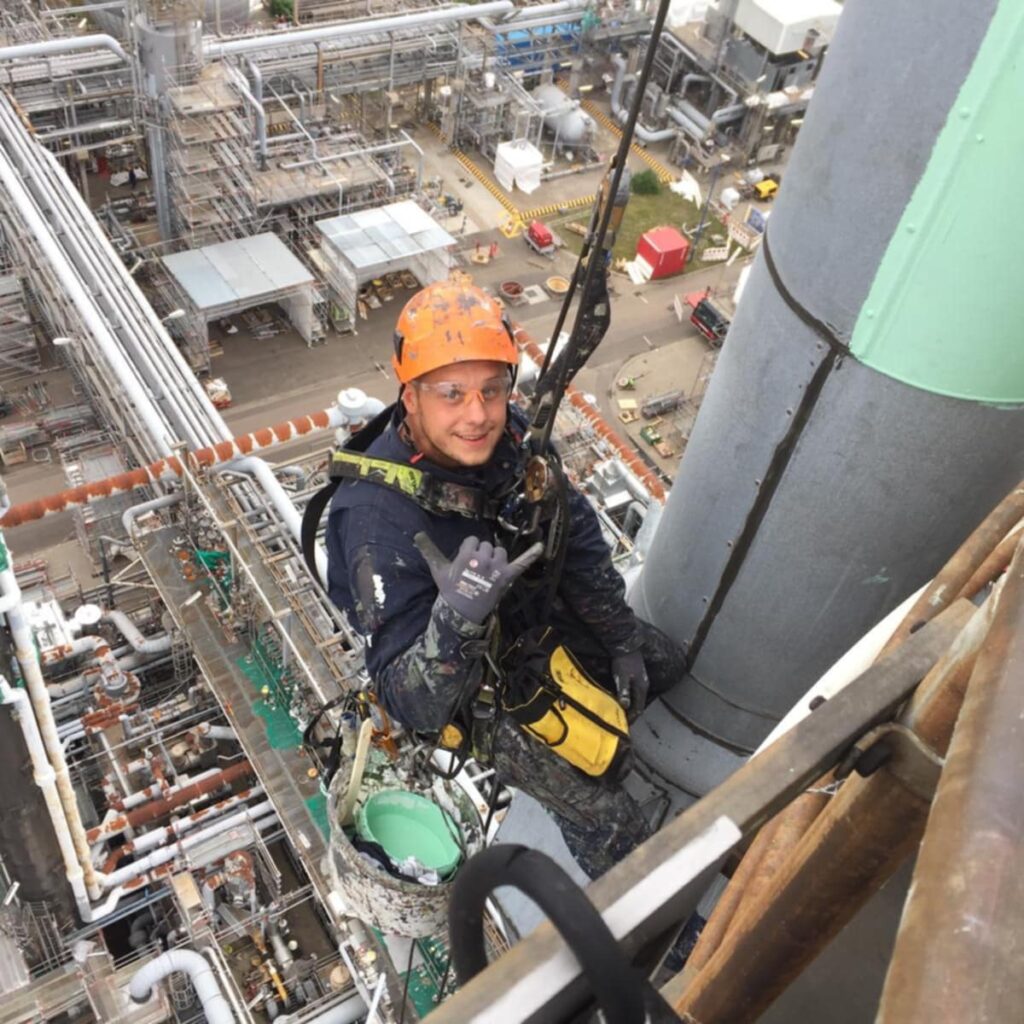
On port cranes, access to many parts of the structure requires work at great height, above the quay or above the water. Lifts need stable ground and space to set up, and their presence on the quay further restricts traffic. Scaffolding on the boom or the pylon means long assembly and taking the crane out of service for the entire time it is in place.
Rope access makes it possible to get onto the structure quickly, without equipment blocking the area under the crane, and to get off it just as quickly when the terminal needs the crane. It is precisely this mobility that makes the model of working in short windows feasible at all. This does not mean that rope always wins – for some parts of the structure or large horizontal surfaces, a combination of methods is sometimes better. The decision is best made after a site visit, not on the basis of a general assumption.
When choosing a contractor for work at height in a port, it is worth checking above all their experience of working on operating equipment.
Communication during execution
The most common source of problems when renovating in an operating terminal is not technology, but a lack of information flow. A simple communication rhythm works well:
- a short daily briefing with the dispatcher – confirming the windows for the next 24 hours,
- a clear channel for sudden changes – one phone number at which someone on the crew’s side can immediately decide to come off the structure,
- a work log – the scope completed, weather conditions, comments and photos from each stage,
- a weekly summary – progress against the plan, risks for the following week, decisions to be made.
This way the terminal knows the condition of every section of the structure, and the final acceptance is based on documentation collected as the work progresses, not on reconstruction from memory.
Red flags in a renovation plan
- the schedule assumes continuous work without taking weather windows and the schedule of ship calls into account,
- no described procedure for taking the crane out of service and returning it to operation,
- no map of zones and no plan for traffic under the structure,
- the contractor does not provide for a work log or for measuring conditions before application,
- there is no one on the terminal side with the authority to make quick decisions,
- the assumption that “we’ll work it out somehow” without written rules for stopping and resuming work.
None of these points on its own has to stop the project, but taken together they almost always end in a prolonged shutdown of the crane or a coating applied under the wrong conditions.
How to prepare for the conversation with the contractor
Before inviting contractors for a site visit, it is worth having basic information ready on how the terminal can make the crane available:
- which model of organising the work is possible at all – windows, rotation or a short shutdown,
- what the typical lengths of the windows between ship calls are,
- whether the terminal has periods of lighter traffic,
- which access procedures and induction training apply to outside personnel,
- who will be the contact person and the person accepting the work on the terminal side.
This information allows the contractor to propose a realistic schedule rather than a theoretical plan that falls apart after the first ship is rescheduled. We write in detail about what should go into the request for quotation for painting a crane in a separate article in this series.
Summary
Renovating port crane coatings without stopping cargo handling is possible, but it requires a different approach than a renovation in a production plant. Instead of one long shutdown, it works better to divide the work into short, self-contained stages matched to the schedule of ship calls and the weather windows. The key elements are: choosing the model of organising the work, early involvement of the dispatcher, OHS and terminal security, a written procedure for taking the crane out of service and returning it, a plan of zones under the structure and a simple daily rhythm of communication.
Under these conditions rope access gives a real advantage – getting on and off the structure quickly without equipment blocking the quay – but the method should always be decided by a site visit. A well-prepared plan means that the terminal retains its handling capacity and the coating is applied under conditions that give it a chance of full durability.
We also work in Pomerania: rope access services in Gdańsk.
Author
Piotr Lankiewicz
Specialist in height work and rope access techniques. Owner of a company providing services in the most inaccessible locations nationwide. He prioritizes punctuality, strict health and safety standards, and solutions that save time and costs where the use of heavy machinery is impractical or not cost-effective.