
Anti-corrosion work schedule – how to plan the job to minimise downtime costs
An anti-corrosion renovation of a chimney can rarely be carried out without any impact on the operation of the facility. Scaffolding, work at height, solvent odours or the need to temporarily restrict access to part of the installation – all of this has to be reconciled with ongoing production. For the person responsible for maintenance, the greatest risk is not the renovation itself, but a poorly planned schedule that extends downtime or clashes with critical moments in the plant’s operation. A well-planned anti-corrosion work schedule is one of the simplest ways to limit downtime costs – not by speeding up the work itself, but by spreading it sensibly over time and stages.
Why the schedule determines the cost of downtime more than the pace of work
Intuitively, it seems that the faster the contractor finishes the work, the lower the cost of downtime will be. In practice, when the work starts and how it is spread relative to the facility’s operating cycle has a greater impact than exactly how many days it takes. A renovation started at the peak of the production season, clashing with a planned inspection of another installation or requiring restricted access at a critical moment, generates indirect costs far higher than the labour and materials themselves. That is why the anti-corrosion work schedule is best treated as part of the plant’s operational planning, not solely as a matter for the contractor.
Stages of planning an anti-corrosion work schedule for a chimney
Initial inspection and determining the real scope of work
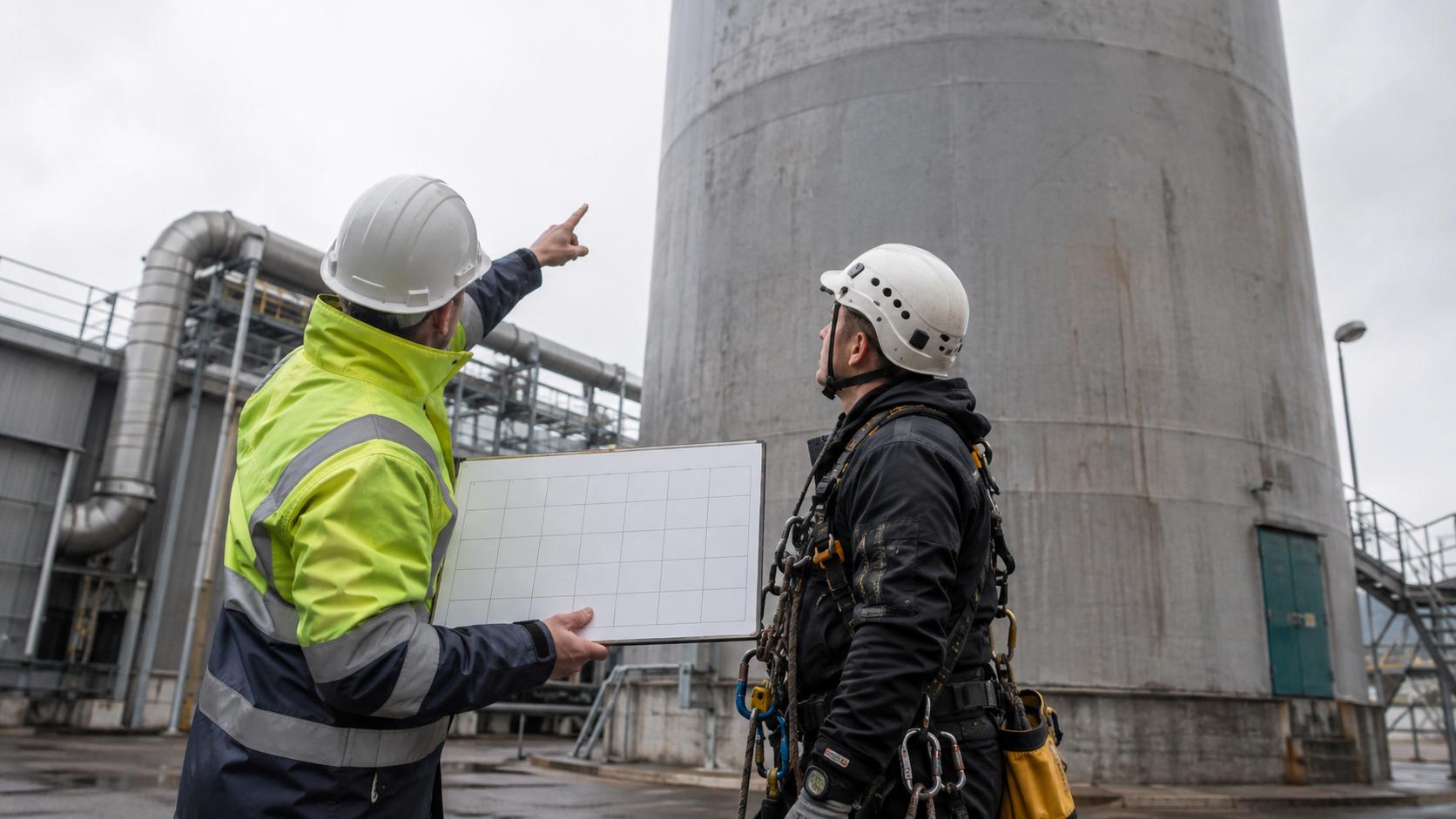
Before any schedule is drawn up, a reliable assessment of the chimney’s technical condition is needed – ideally in the form of photographic documentation covering the entire height of the structure, including places not visible from ground level. Without this stage, the schedule is based on estimates rather than the actual extent of the damage, which later leads to the work being extended during execution – the worst possible scenario from the point of view of downtime planning.
Dividing the work into stages and zones
An industrial chimney rarely needs to be protected in its entirety all at once. Good practice is to divide the work into stages – for example by height (base, shaft, top of the chimney) or by the intensity of the damage (zones requiring complete replacement of the coating and zones requiring only local renovation). Such a division makes it possible to plan the work so that the activities most disruptive to the facility – those requiring restricted access or work near installations – last as short a time as possible, while the remaining stages can be carried out in parallel with the plant’s normal operation.
Setting time windows that fit the facility’s operation
Every plant has its periods of lower production intensity, planned maintenance shutdowns of other installations or seasonal drops in load. Synchronising the anti-corrosion work schedule with such a time window makes it possible to carry out the renovation without generating additional downtime, because the work takes place at a time that would in any case be partly used for other maintenance activities. This requires agreeing the date with the contractor in advance – the earlier the schedule is set, the easier it is to fit it to the facility’s time window instead of reacting to an ad hoc need.
Coordination with other work carried out on the site
Work at height on a chimney often coincides with other maintenance activities – inspection of installations, electrical work, checks of other structural elements. A lack of coordination between crews leads to situations in which two groups of workers get in each other’s way, which extends the completion time of both tasks. The anti-corrosion work schedule should be set in agreement with the people responsible for the other work planned in the same area of the facility.
A time reserve for unforeseen circumstances
Even the best-prepared schedule should include a margin for situations that cannot be fully foreseen at the planning stage – the condition of the substrate revealed only after the old coating has been removed, the need for additional cleaning or for adjusting the scope of work after a closer inspection. A schedule without any time reserve looks good on paper, but in practice the first deviation from the plan usually leads to a cascading delay of subsequent stages.
How to minimise downtime during execution
An access method that does not restrict traffic on the plant site
One of the factors with the greatest impact on downtime is the way the contractor gains access to the chimney. Traditional scaffolding requires time for assembly and dismantling, occupies space around the structure and often restricts access to neighbouring parts of the installation for the entire duration of the work. The industrial rope access method, used among other things for painting chimneys, makes it possible to start work practically as soon as the working zone has been prepared, without the stage of building a temporary structure, which genuinely shortens the time during which the facility is in any way restricted in its normal operation.
Working in parallel stages where possible
Where the nature of the damage and work safety allow, some tasks – for example cleaning and preparing the substrate in one zone of the chimney while painting in another, already prepared zone – can be carried out in parallel. This shortens the total completion time without increasing the risk to the quality of the work, provided that the crew has enough technicians to run several stages at the same time.
The contractor’s flexibility when the time window changes
It happens that the planned time window has to be moved – because of a change in the production plan, a breakdown of another installation or weather conditions preventing painting. It is worth asking the contractor already when setting the schedule how flexibly they approach such changes and whether they have the resources to move the date quickly without losing their place in the queue of jobs.
When it is worth calling in additional technical support
With a tight schedule, when the time window for the work is short and the extent of the damage to the chimney is greater than initially assumed, the support of additional height technicians can help meet the agreed deadline without extending downtime. This kind of flexible support for crews at height makes it possible to shorten the duration of a stage without compromising on the quality of workmanship, which in anti-corrosion work translates directly into the durability of the result.
Checklist – what to ask before setting the schedule
- Does the schedule reflect the real scope of work established on the basis of an inspection rather than a preliminary estimate?
- Has the work been divided into stages that limit the duration of the activities most disruptive to the facility?
- Is the completion date synchronised with a time window of lower plant activity?
- Has the schedule been coordinated with other maintenance work planned for the same period?
- Does the schedule include a time reserve for unforeseen circumstances?
- Does the contractor’s access method make it possible to limit the duration of disruption on the plant site?
- Does the contractor have the resources to respond flexibly to a change of date?
Typical mistakes in planning an anti-corrosion work schedule
The most common mistake is setting the date of the work without a prior inspection, solely on the basis of a general impression of the condition of the structure – which almost always ends with the scope of work being extended during execution and downtime running beyond the plan. The second common problem is a lack of communication between the maintenance department and the contractor about the facility’s real time windows – a schedule set solely from the perspective of the contractor’s availability, without taking the plant’s operating cycle into account, leads to clashes with production even when the painting work itself is well executed. The third mistake is the lack of a time reserve, which means that every deviation from the plan, however small, translates into a real increase in downtime costs.
Communication with the facility team during execution
The schedule itself, even if well prepared at the planning stage, is not enough if the two parties do not keep in regular contact during execution. Short, regular updates on the status of the work – for example information on which stage has been completed, what is planned for the next working day and whether there have been any deviations from the original scope – allow the person responsible for maintenance to react in advance, instead of learning about schedule changes only when they start to clash with other activities on the site.
In practice, it works well to appoint one contact person on the contractor’s side and one on the plant’s side, responsible for day-to-day arrangements – this eliminates situations in which information about a change of date or scope reaches the decision-maker late because it circulates between several people instead of going directly to them.
Documenting the progress of work against the schedule
For longer projects, it is worth keeping simple documentation of the progress of work against the original schedule – not only for settling accounts with the contractor, but also as useful material for planning the next renovation of the same chimney in the future. Information on which stages went according to plan, where delays occurred and why, makes it possible to take these risk factors into account in the new schedule right away at the next renovation, instead of repeating the same planning mistakes.
Criteria for choosing a contractor with regard to meeting the schedule
When choosing a company for anti-corrosion work, it is worth asking not only about the price and scope of services, but directly about their approach to planning and meeting the schedule – how the contractor responds to unforeseen circumstances, whether they present a schedule divided into stages, whether they communicate progress regularly, and what their staffing resources look like when the work needs to be accelerated compared with the original plan. The answers to these questions usually say more about a contractor’s reliability than the price offer itself, and they have a direct bearing on whether the real cost of the facility’s downtime will be in line with expectations.
Summary
Effectively planning an anti-corrosion work schedule for a chimney is a process that starts long before the first day of work at height – from a reliable inspection, through division into stages, to synchronising the date with the facility’s operating cycle. Downtime costs are reduced not by haste, but by a well-thought-out sequence of activities, the choice of an access method that limits disruption and open communication with the contractor about the real possibilities of meeting the deadline. A plant that treats the schedule as part of operational planning rather than a formality to be settled at the last minute usually goes through an anti-corrosion renovation of its chimney without major disruption to ongoing production.
It is also worth remembering that a good schedule does not end on the day the last coat of coating is applied. Agreeing with the contractor the date of acceptance of the work, verification of the quality of workmanship and handover of the as-built documentation should be part of the same plan, not something settled only after the work is finished. Closing this stage in an orderly way makes it easier to settle the project against the original assumptions and lays the foundation for planning the next renovation of the same structure in the future – taking into account the experience gathered during the current project.
Ultimately, a good anti-corrosion work schedule is not a document created once at the start of the cooperation with the contractor, but a tool that both parties return to throughout the project – updating it as new information arrives about the condition of the structure, the weather or changes in the plant’s production plan. This approach, although it requires more attention at the start, is in practice the most effective way of limiting downtime costs resulting from unplanned disruptions.
Author
Piotr Lankiewicz
Specialist in height work and rope access techniques. Owner of a company providing services in the most inaccessible locations nationwide. He prioritizes punctuality, strict health and safety standards, and solutions that save time and costs where the use of heavy machinery is impractical or not cost-effective.