
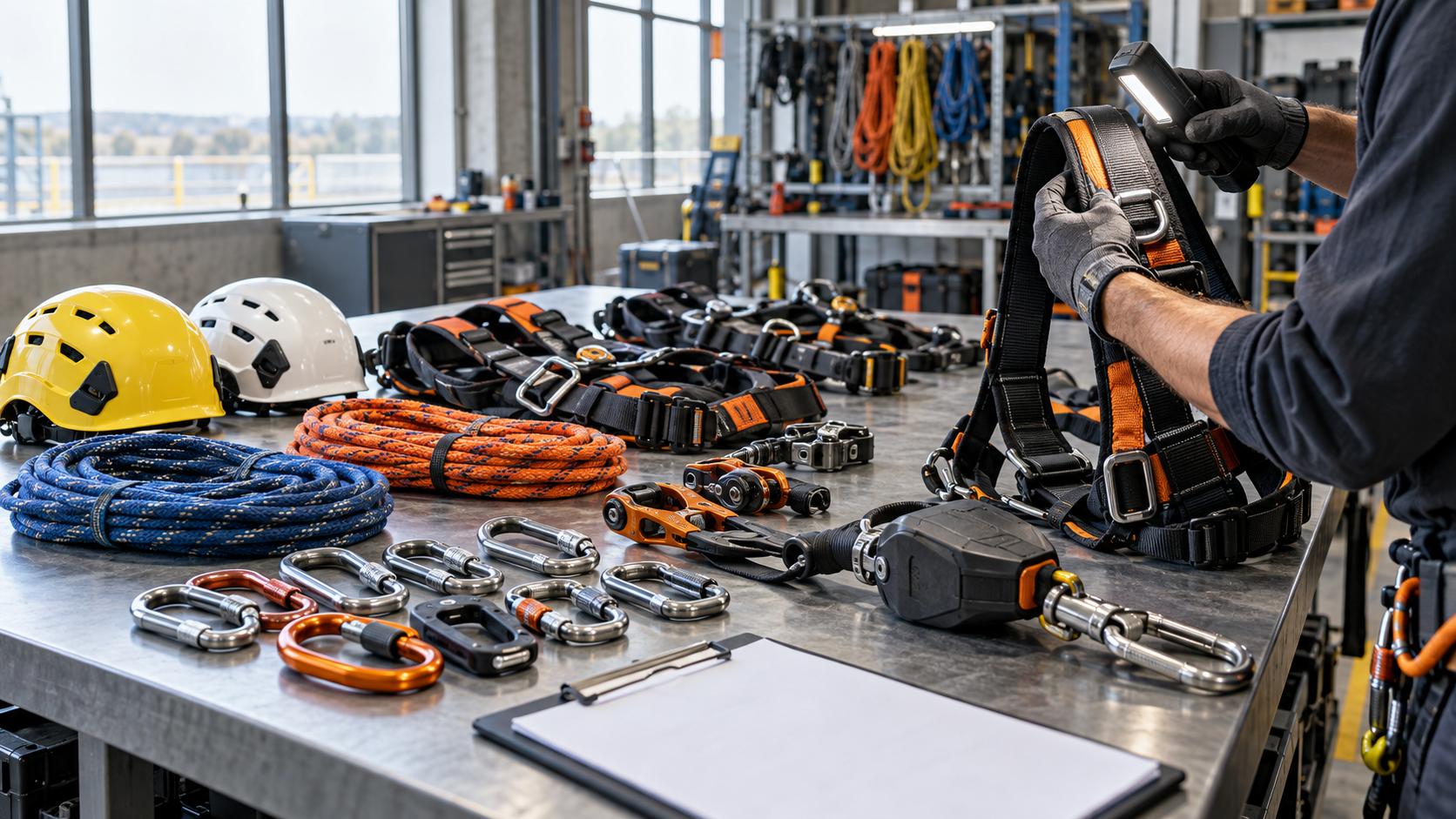
Inspection of equipment for work at height – what a PPE inspection covers and how often to carry it out
On a construction site, in a plant or before entering a client’s site, a question comes up that does not always have a quick answer: when was this equipment last checked, and where is the proof? The harness looks fine, the rope has no visible cuts, the karabiners close. But a daily glance before work is something different from a periodic inspection of equipment for work at height, and in the event of an inspection or an accident it is the latter that counts.
In this article we approach the subject from the perspective of the person responsible for the equipment: the employer, the OHS service, the manager of a work-at-height or construction company and the facility maintenance department. We explain where the obligation to inspect PPE comes from, how often to carry it out, what an inspection of personal protective equipment covers, what should remain in the documentation and when equipment has to be withdrawn.
Why equipment inspection is an obligation, not good practice
Equipment protecting against falls from height works like an insurance policy: most of the time it does nothing, and in a single moment it has to work flawlessly. That is why its condition cannot be a matter of impression. Polish regulations and standards arrange this into a fairly clear system of responsibility.
What the regulations say
The Polish Labour Code requires the employer to provide employees with personal protective equipment free of charge and to inform them how to use it (Article 2376). The same chapter goes further: the employer may not allow an employee to work without the protective equipment provided for the given workstation and must ensure that the equipment used has the proper protective and functional properties, as well as ensure its maintenance and repair (Article 2379).
The regulation on general occupational health and safety rules is more specific. Its Annex No. 2, which sets out detailed rules for the use of personal protective equipment, states that PPE is replaced in accordance with the manufacturer’s instructions for the given item or when it loses its protective properties, and that its condition is periodically checked and documented. The same annex requires the OHS instruction for the workstation to specify how personal protective equipment is used, checked and maintained, and the use itself to follow the manufacturer’s instructions.
Two words in this provision matter most in practice: “periodically” and “documented”. The inspection must be repeated and must leave a record that can be shown to an inspector, an auditor or the coordinator of work on site. We described the broader picture of the parties’ obligations in work at height in our guide to what a rope access company must meet under Polish OHS regulations.
Where the PN-EN 365 standard and the manufacturer’s instructions fit in
The PN-EN 365 standard concerns equipment protecting against falls from height and sets out general requirements for instructions for use, maintenance, periodic examination, repair, marking and packaging. Put simply, it is what obliges the manufacturer to state in the instructions how the equipment is to be checked, how it is to be cared for and when it is to be inspected.
That is why, in practice, the most important document for an inspection is the instructions for the specific product. In them the manufacturer gives the service life, the inspection procedure, the withdrawal criteria and any reservations, for example that a particular device may be checked only by its authorised service centre. An inspection that ignores the manufacturer’s instructions is an assessment “by eye”, not an equipment inspection.
Three levels of equipment checks – who is responsible for what
The most common misunderstanding is lumping different types of checks together. In fact, each of them has a different person carrying it out and a different purpose.
- Pre-use check – carried out by the user, who has been appropriately trained. It is meant to catch obvious damage before the equipment goes to work. It takes a few minutes and does not replace a thorough inspection.
- Periodic inspection – carried out by a competent person prepared for this task. According to materials from the Central Institute for Labour Protection – National Research Institute (CIOP-PIB), this may be a specially trained person in the workplace or the manufacturer, for example its authorised service centre. It is a thorough check according to the manufacturer’s procedure, concluded with an entry in the documentation.
- Check after an exceptional event – after arresting a fall, an unusual load, contact with chemicals or another event that may have affected the condition of the equipment. The equipment is then taken out of use until a decision is made in accordance with the manufacturer’s instructions.
CIOP-PIB describes this system directly as two levels of supervision run by the employer: immediately before each use and periodically. The pre-use check does not replace the periodic inspection, and the periodic inspection does not release the user from the daily check. Both elements have to work at the same time.
How often to inspect PPE
The starting point is the rule: a periodic inspection at least once a year. This is how CIOP-PIB describes it in its materials on the inspection of fall protection equipment (“periodically, at least once a year”), and equipment manufacturers, for example Petzl, recommend a detailed inspection by a competent person at least every 12 months and additionally after every exceptional event.
Once a year, however, is a minimum, not a goal. It is worth inspecting more often when:
- the manufacturer’s instructions for the given product provide for a shorter interval,
- the equipment is used intensively, every day and by many people,
- the conditions are harsh: concrete and steel edges, dust, paints, chemicals, high temperature, strong sunlight,
- it follows from the occupational risk assessment for the given workstation,
- the client or site operator requires a current inspection before the crew is allowed in.
A practical tip for the person responsible for the equipment pool: instead of tracking dates for each item separately, set a fixed inspection date for the whole pool and additionally check the items that have been involved in an exceptional event in the meantime. This makes it easier to keep the records in order and prevents any harness from “sitting out” its due date.
What equipment the inspection covers
An inspection of equipment for work at height covers everything that forms a system protecting against falls or enabling work in suspension. Each group has its typical weak points.
Harnesses and safety harnesses
Full body harnesses for fall arrest, work positioning belts and sit harnesses used in rope access. Webbing and stitching, connecting and adjusting buckles, attachment points and plastic components are checked. Petzl points to harness attachment points as the place where wear is most often visible, so they require particular attention.
Ropes, lanyards and slings
Low-stretch kernmantle ropes, safety lanyards, cow’s tails, loops and slings. The rope is inspected visually and by touch along its entire length: the sheath for cuts, glazing, abrasion and traces of chemicals, and the core for unusually hard or soft spots.
Karabiners and connectors
The body, gate, spring and gate lock. Inspectors look for cracks, deformation, material loss, corrosion, rope grooves and sharp edges. They also check whether the gate returns to the closed position on its own and whether the lock works. CIOP-PIB research on used connectors showed that the most common defects are precisely corrosion, deformation, material loss, cracks and contamination.
Descenders and rope clamps
Moving parts, cams, axles, springs and the surfaces over which the rope runs. Wear often only becomes visible after the device has been thoroughly cleaned, which is why the inspection cannot be limited to checking whether it “works”.
Retractable and self-belay devices
Retractable type fall arresters, guided type fall arresters on a flexible anchor line and energy absorbers. This is equipment of a more complex design. Some activities can be carried out as part of the periodic inspection, but the manufacturer’s instructions may reserve the inspection of the internal mechanism or servicing to the manufacturer or an authorised body. An honest inspection states this clearly rather than promising a check that cannot be carried out without opening the device.
Helmets
Industrial safety helmets and climbing helmets: shell, harness, chin strap, buckle and date of manufacture. A helmet with a cracked or deformed shell, a damaged harness or one that has suffered a heavy impact is set aside for assessment according to the manufacturer’s instructions instead of going back to work.
If the equipment is used in potentially explosive atmospheres, the inspection must take into account additional requirements concerning materials and documentation. More on this in the article on how to select rope access equipment for work in an explosion hazard zone.
What the inspection looks like step by step
A good inspection follows a repeatable sequence. This way every item is assessed in the same way, and the result can later be reconstructed from the documentation.
- Identifying the item. Reading the marking: manufacturer, model, serial or batch number, date of manufacture, standard designations and CE mark. Equipment without legible identification is a problem from the start, because it cannot be linked to its instructions or history.
- Checking the service life. The service life is determined solely on the basis of the manufacturer’s documentation. For harnesses made of polyamide or polyester webbing, CIOP-PIB indicates that in practice it is most often five years, and some manufacturers, for example Petzl, give a maximum of 10 years from the date of manufacture for textile and plastic products. The date of manufacture is not the date of purchase.
- Verifying the history. Has the equipment arrested a fall, been overloaded, come into contact with chemicals, been repaired? This is where an up-to-date equipment record card helps.
- Visual and tactile inspection. Textile, metal and plastic components, each according to the manufacturer’s criteria.
- Checking function. Gates, locks, cams, springs, locking mechanisms. Everything that is supposed to move must move correctly and return to the right position.
- Decision and record. Each item receives an unambiguous result, which goes into the documentation.
What should remain after the inspection – documentation
Since the regulation requires the condition of PPE to be periodically checked and documented, an inspection without a record has no evidential value for the employer. Good inspection documentation makes it possible to answer an inspector’s questions without searching through drawers. At a minimum it should make it possible to establish:
- which item was checked (identification, serial or batch number, date of manufacture),
- when and by whom the inspection was carried out,
- what the result was for each item separately,
- which equipment was withdrawn and why,
- when the next inspection is due.
Manufacturers suggest how to describe the result. Petzl’s inspection form provides for five states: good condition, condition to monitor, action required, do not use and retire, not applicable. Whatever scale is adopted, it is important that the result is unambiguous. An entry such as “equipment in satisfactory condition” tells nothing to the worker who takes a harness from the store in the morning.
Inspection records are also an argument when entering a site. A facility manager or general contractor may ask a subcontractor not only for the technicians’ certificates but also for confirmation of the condition of the equipment. People’s qualifications and the condition of the equipment are two separate things, as we discuss in more detail in the article on why it is worth requiring an IRATA certificate from a work-at-height company.
When equipment goes for withdrawal
CIOP-PIB identifies three basic situations in which a harness should be withdrawn from use: when it has been subjected to a heavy load, when disqualifying damage has been found and when the period specified by the manufacturer during which it may be used has expired. In practice this logic applies to all fall protection equipment.
The most important rule is: equipment that has been involved in arresting a fall is withdrawn from use regardless of whether any damage is visible on it. Changes after such a load may be invisible during a visual inspection and yet reduce its protective performance. What happens next – permanent withdrawal or assessment by a competent person or the manufacturer’s service centre – follows from the product’s instructions.
Typical reasons for withdrawal also include:
- cuts, glazing and abrasion of webbing or the rope sheath, damaged stitching,
- traces of contact with aggressive chemicals,
- cracks, deformation and deep grooves in metal components,
- a karabiner gate that does not close by itself, or a lock that does not work,
- illegible marking that makes it impossible to establish the date of manufacture and service life,
- missing instructions and history, when it is not certain what the equipment has been through.
We discuss the signs of wear in detail, group by group, in a separate guide on when to retire a harness, rope or karabiner. It is worth remembering that withdrawal does not always mean scrapping straight away. Sometimes the equipment waits for its history to be clarified, for consultation with the manufacturer or for servicing. During this time it must be physically separated and marked so that no one takes it to work.
How to prepare equipment and documents for inspection
The inspection goes faster and gives a fuller picture when the equipment owner has things in order. Before booking an inspection, it is worth:
- Listing the equipment. Type and number of items: how many harnesses, how many ropes and of what length, how many karabiners, devices, retractable fall arresters, helmets.
- Collecting the manufacturers’ instructions. If the paper copies have been lost, most manufacturers make instructions and inspection procedures available on their websites.
- Finding the existing records. Equipment record cards, reports from previous inspections, the dates on which equipment was issued to employees.
- Gathering information on events. Has any item arrested a fall, been overloaded, come into contact with chemicals or high temperature?
- Cleaning the equipment in accordance with the manufacturer’s recommendations. Dirt, especially paint and dust, can hide damage.
With such a list, a PPE inspection can be planned concretely, and its result can be translated straight into purchasing decisions: how much equipment needs to be replaced and when.
The most common situations in which inspection stops being a formality
On paper, an annual inspection looks like routine. In practice, there are moments when its absence quickly becomes costly:
- Entering a site with documentation requirements. A production plant or site operator asks for confirmation of the condition of the equipment, and work stops until a current record appears.
- A National Labour Inspectorate (PIP) inspection or a client audit. The question about periodic PPE checks and their documentation follows directly from the regulations, so it is hard to brush aside.
- An incident at height. After an accident or near miss, the history of the equipment and its inspections is among the first things to be checked.
- Equipment rotating between crews. When harnesses and ropes circulate between teams, no one knows what has happened to them. An inspection puts this in order.
- Equipment kept in the store “as a spare”. Equipment lying in a store for years also ages. Some manufacturers count the maximum life of a product from the date of manufacture rather than from first use, so a harness that seems new may be close to the end of its service life.
It is also worth remembering the distinction we describe in the article on fall protection and protective equipment for work above an overhead crane: whether the crew has the right set of equipment for a given job is one question. Whether that equipment is serviceable and has documented inspections is another.
Summary
Inspection of equipment for work at height is an employer’s obligation under the Polish Labour Code and the regulation on general OHS rules: the condition of PPE is to be periodically checked and documented, and the equipment replaced in accordance with the manufacturer’s instructions or after it loses its protective properties. The minimum is a periodic inspection once a year, carried out by a competent person according to the manufacturer’s instructions, supplemented by a pre-use check and an additional assessment after every exceptional event.
Most problems arise not from wear of the equipment itself, but from the lack of a clear system: who checks, when, against what and where it is recorded. If in your company the answer to any of these questions is “I don’t know”, a good first step is to list the equipment and set an inspection date. We have described the scope of the inspection and how to order it on the page dedicated to inspections of rope access equipment and PPE.
Author
Piotr Lankiewicz
Specialist in height work and rope access techniques. Owner of a company providing services in the most inaccessible locations nationwide. He prioritizes punctuality, strict health and safety standards, and solutions that save time and costs where the use of heavy machinery is impractical or not cost-effective.