How to Select Rope Access Equipment for Work in an Explosion Hazard Zone
You have a plant with designated ATEX zones, up-to-date explosion protection documentation, and a contractor who claims they have “already worked in such conditions.” But when you ask about the equipment, you hear: “We have professional equipment, certified in accordance with standards.” That is not an answer to your question. Certification according to rope access standards is not the same as ATEX certification. These two categories may conflict with each other, or they may complement each other if the equipment is selected consciously.
This article explains which elements of rope access equipment require ATEX certification, what risks result from incorrect material selection, and what the required equipment documentation should look like.
Which Equipment Components Must Have ATEX Certification?
Not every element of a rope access kit is equally important from the ATEX perspective. When assessing risk, two hazard mechanisms must be distinguished: mechanical sparking, such as metal striking metal or metal striking concrete, and electrostatic discharge, meaning charge accumulation on materials with high resistivity.
Elements that require ATEX certification or material selection compliant with Ex requirements include:
Descenders and rope ascenders: metal components must be made of non-sparking materials or have ATEX certification in a category appropriate to the zone.
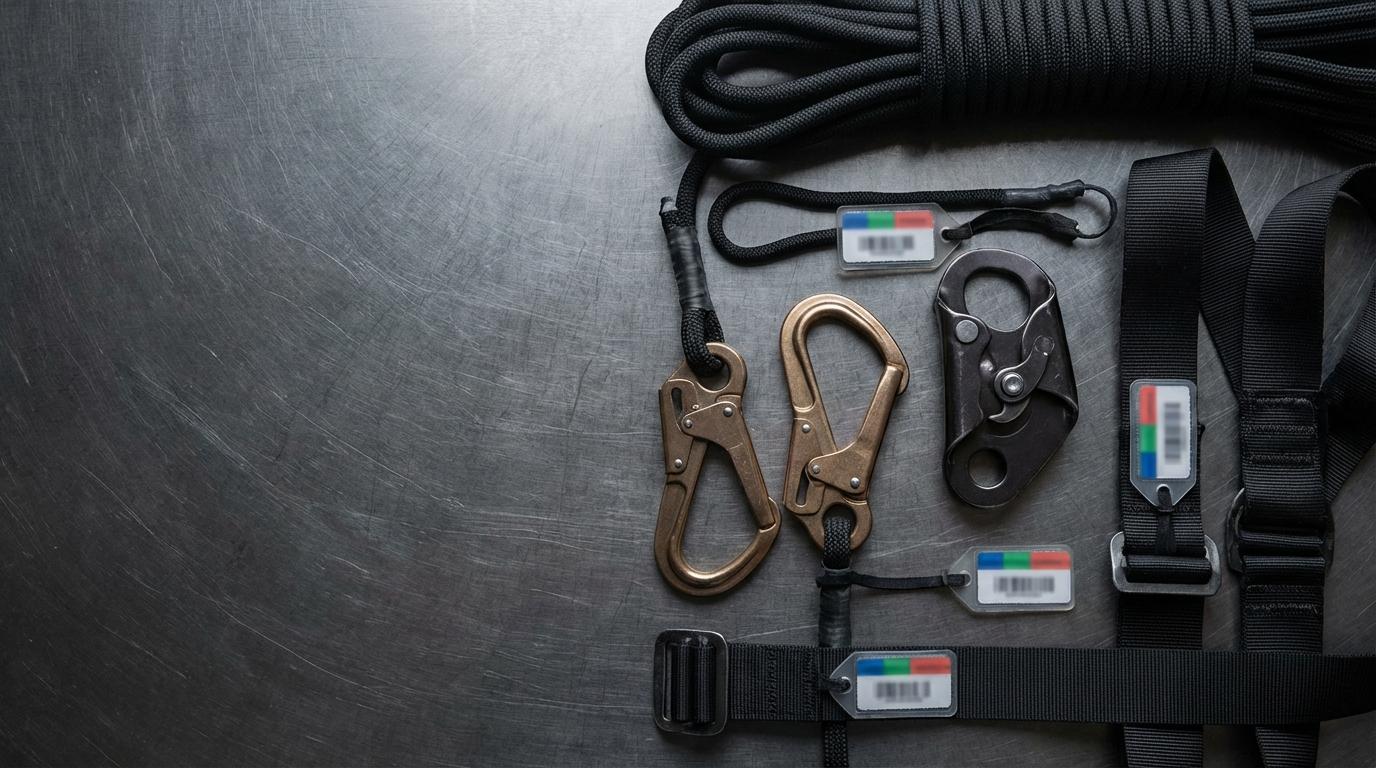
Carabiners and connectors: standard aluminium carabiners may spark on impact. In Zones 0, 1, 20, and 21, carabiners made of beryllium bronze or steel with an anti-spark coating are used.
Harnesses and lanyards: these require anti-static certification, especially in dust zones, such as Zones 20, 21, and 22.
Ropes: this element is often overlooked in ATEX analyses, yet it is significant because of electrostatic risk.
Personal lighting: torches and headlamps must have ATEX certification in a category appropriate to the zone. Standard LED equipment does not qualify for work in hazardous zones.
Communication devices: phones, two-way radios, and other electronic devices without ATEX certification must not be brought into the zone.
In Zones 2 and 22, which represent the lowest hazard level, the requirements are less restrictive. Some elements of standard rope access equipment may be acceptable after a risk assessment. In Zones 0, 1, 20, and 21, there is no room for compromise.
Ropes, Harnesses, and Descenders: Materials and Electrostatic Discharge
Electrostatics in ATEX zones is a topic that is often underestimated, even by experienced technicians. Synthetic ropes, such as standard polyamide or polyester ropes used in industrial rope access, may accumulate electrostatic charges as a result of friction against surfaces or simply through the technician’s movement along the rope. Under the right conditions, such as a dry environment and the presence of dust with low minimum ignition energy, an electrostatic spark from a charged rope may initiate ignition.
Specifications required for ropes used in dust zones, such as Zones 20, 21, and 22, include:
•rope resistivity below the threshold value specified in EN ISO 6945 or ATEX standards for ropes;
•the possibility of discharging accumulated charge through a grounded element;
•no materials with high triboelectric properties in the outer sheath.
Some manufacturers of rope access equipment offer ropes with a conductive core or anti-static treatments. These are not standard products. Their availability and price differ from standard working ropes. A contractor who says they “use good ropes” should be able to indicate a specific model and confirm its electrostatic parameters.
Harnesses and work clothing form a separate category. ESD, or electrostatic discharge, anti-static clothing is standard in many industrial plants, but not every ESD garment meets ATEX requirements for Zones 20 and 21. Manufacturers of specialist workwear specify in their documentation which ATEX zone classes the product is certified for.
Non-Sparking Tools: Overview of Available Solutions
Tools for work at height in ATEX zones are still a relatively non-standardized category in Poland. Several types of solutions are available on the European market.
Beryllium bronze tools are most commonly used in gas zones, such as Zones 0, 1, and 2. Beryllium bronze is hard, corrosion-resistant, and does not spark on impact. It is used to manufacture wrenches, hammers, chisels, scrapers, and basic hand tools. Its disadvantages are higher price and limited availability in smaller sizes.
These tools are essential for preparing surfaces for anti-corrosion painting in places where using a grinder or standard wire brush could trigger an explosion.
Copper and brass alloy tools are an alternative to beryllium bronze and are used where non-sparking requirements are important but slightly lower hardness is acceptable. They are mainly used in Zones 1 and 2.
Anti-static plastic tools are used in dust zones, such as Zones 20, 21, and 22. They are made of materials with controlled resistivity, so they do not spark mechanically or electrostatically. Their limitation is lower mechanical strength than metal tools.
ATEX-certified industrial vacuum cleaners are available from several manufacturers and are marked as Category II 2D or II 1D. They have intrinsically safe motors, HEPA filters for retaining explosive dusts, and a tank grounding system. They differ significantly from standard industrial vacuum cleaners, both in price and technical specification.
Equipment Documentation Required by the Plant Operator
Before allowing a contractor with a set of equipment into an ATEX zone, you have the right and obligation to check the documentation. The contractor should provide:
•a CE declaration of conformity for each ATEX-certified device or tool, indicating the category, for example II 1G Ex ia IIC T4 for equipment intended for gas Zones 0 and 1;
•an instruction manual in Polish, which is a statutory requirement for equipment used at industrial facilities in Poland;
•a protocol of the most recent equipment inspection, as ATEX devices require inspections at shorter intervals than standard equipment, with frequency depending on the category and conditions of use;
•the serial number and production date of each item, enabling verification of certification validity;
•confirmation that the equipment has not been used outside the scope of certification, which is particularly important when purchasing used equipment.
The absence of any of these documents should stop the work from being carried out. Responsibility for allowing a contractor with unsuitable equipment into the zone lies with the facility manager, not with the contractor.
If you are planning rope access work in an explosion hazard zone and want to check whether we have equipment suitable for your zone classification, ask about the scope of certification before scheduling the work. We will present the equipment documentation without unnecessary formalities.
Author
Piotr Lankiewicz
Specialist in height work and rope access techniques. Owner of a company providing services in the most inaccessible locations nationwide. He prioritizes punctuality, strict health and safety standards, and solutions that save time and costs where the use of heavy machinery is impractical or not cost-effective.