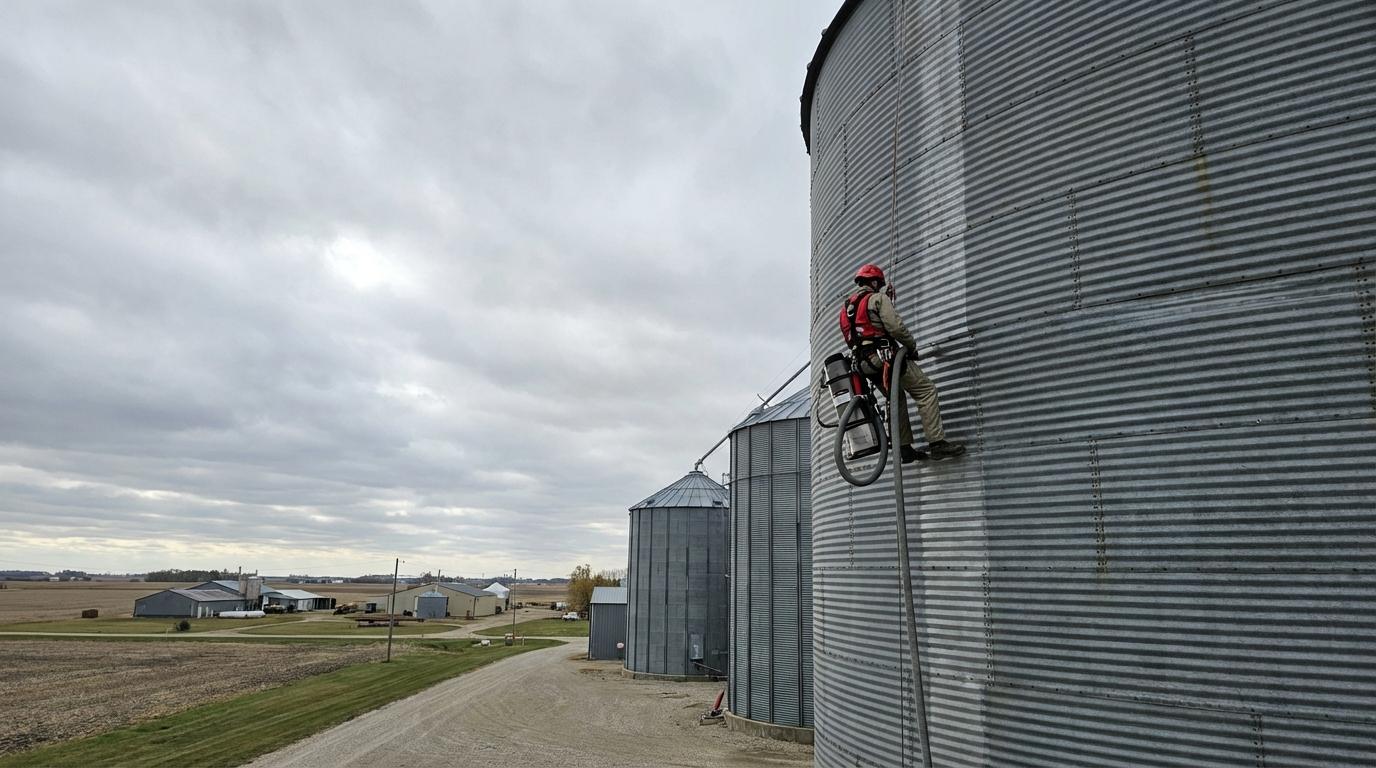
Cleaning Grain Silos in an Explosion Hazard Zone
Anyone who has worked with agricultural facilities or in the food industry knows that grain dust is not an aesthetic problem. It is an explosive material. All it takes is the right concentration, an ignition source, and an enclosed space, and the conditions for an explosion are in place. In the history of this industry, such explosions have more than once resulted in casualties and the complete destruction of a facility. Cleaning grain silos may look like a routine task. But if it is not carried out in accordance with ATEX procedures, it is one of the riskier tasks you can commission at your facility.
Below you will find specific information on why grain dust is dangerous, how zones inside a silo are classified, and what is required for cleaning work to be performed safely.
Why Grain Dust Is Explosive
Grain dust, regardless of the type of grain, is a combustible material with a relatively low minimum ignition energy. When suspended in air, it can form an explosive atmosphere even at relatively low concentrations. The explosion parameters of grain dusts are well documented: maximum explosion pressure can exceed 8 bar, and the rate of pressure rise classifies these dusts as materials with high explosive strength.
Importantly, a grain dust explosion is often not a single event. The primary explosion lifts dust that has accumulated on structures, beams, and in recesses, creating another cloud, which then triggers a secondary explosion that is many times stronger. It is these secondary explosions that are responsible for the catastrophic consequences of incidents in silos and grain elevators.
That is why regular cleaning of internal structures, not only the bottom of the silo but the entire space, including upper sections, trusses, ladders, and mechanical components, is one of the basic preventive measures. Accumulated dust is material ready for a secondary explosion.
ATEX Zone Classification Inside a Grain Silo
According to EN 60079-10-2 and ATEX guidelines for dusts, the space inside a grain silo is classified as follows:
•Zone 20: the inside of the silo, pneumatic conveyors, and the interior of the tank during filling and emptying. A dust cloud may be present continuously or for long periods. This is the highest hazard level for dusts.
•Zone 21: the immediate surroundings of filling openings, screens, and other points where dust escapes during normal operation. A dust cloud appears occasionally during normal operation.
•Zone 22: areas where dust may appear only in the event of a failure or rare operations, such as the external surroundings of a filling chamber in a sealed system.
Cleaning work inside a silo is generally carried out in Zone 20. This means the highest requirements for equipment and procedures.
Selection of Rope Access Equipment and Cleaning Tools for Zones 20/21
Rope access equipment used inside a silo in Zone 20 must have ATEX Category 1D certification, meaning equipment intended for Zone 20, or at least Category 2D certification for Zone 21. Certification covers both the materials used and the absence of mechanical sparking.
The most important equipment requirements in the context of dusts are as follows.
Ropes and webbing should be made of low-resistivity materials or equipped with elements that dissipate electrostatic charge. Synthetic ropes with high resistivity may accumulate charge and become a source of electrostatic sparks.
Descenders and carabiners must be made of non-sparking materials or coated with anti-spark coatings. Standard aluminium alloys may spark on impact.
Harnesses and work clothing should include certified anti-static clothing without metal elements that could cause sparking.
Cleaning tools must be non-sparking. Hand tools such as brushes, spatulas, and scrapers made of beryllium bronze or anti-static plastics are available on the market. Industrial vacuum cleaners for work in Zone 20 must have ATEX Category II 1D certification and be equipped with dust-retaining filters and a grounding system. Standard industrial vacuum cleaners, even high-end models, do not qualify for work in this zone.
Work Procedure: From Preparation to Completion
Safe grain silo cleaning requires several stages before the actual work begins.
Stage 1 – Shutdown and isolation: before anyone enters the silo, the installation must be completely shut down, mechanically locked, and marked according to the LOTO procedure, meaning lockout/tagout. It is particularly critical to prevent conveyors, fans, and mechanical drives from being started while people are working inside.
Stage 2 – Ventilation: the silo must be ventilated before entry. Ventilation should reduce the dust concentration below 25% of the lower explosive limit. In silos after long-term storage, several hours of ventilation may be necessary.
Stage 3 – Atmosphere testing: before an entry permit is issued, the dust concentration and oxygen content in the silo atmosphere must be measured. The measurement is performed by an authorized person using a certified detector. The results are documented in the entry protocol.
Stage 4 – Issuing the permit to work: the permit to work is signed by the facility manager and the work supervisor. The document defines the working time, team composition, equipment, emergency procedures, and evacuation conditions.
Stage 5 – Cleaning work: work is carried out from top to bottom to avoid re-contaminating cleaned surfaces. Dust is collected using a wet method, such as professional low-pressure washing, or with an ATEX-certified vacuum cleaner. Compressed air must never be used, as it lifts dust and increases its concentration. The supervisor remains outside throughout the work, maintaining communication with the team inside.
Stage 6 – Post-completion documentation: the protocol includes the list of workers, the equipment used, the duration of the work, atmosphere measurement results before and after, a description of the completed scope, and the signatures of the responsible persons.
When to Plan Cleaning
The optimal time for cleaning grain silos is after emptying and before the next filling, most often in spring or early autumn before the purchasing season. Do not wait with cleaning until the silo is full or until transshipment has just finished. At that point, dust concentration is at its highest, and the work schedule conflicts with the facility’s operation.
If you are planning silo cleaning before the harvest season or during the off-season and want to discuss the scope and ATEX requirements for your facility, contact us in advance. Work in Zones 20/21 requires proper preparation and should not be planned from one day to the next.
Author
Piotr Lankiewicz
Specialist in height work and rope access techniques. Owner of a company providing services in the most inaccessible locations nationwide. He prioritizes punctuality, strict health and safety standards, and solutions that save time and costs where the use of heavy machinery is impractical or not cost-effective.