Cleaning a Food Production Hall Before a BRC/IFS Audit
A BRC or IFS audit is already in the calendar. The date has been known for months. And yet, one week before the inspection, it turns out that the roof structure is covered with a greasy film, organic deposits are visible on the beams, and in one of the ceiling recesses there are signs of rodent activity. A standard cleaning company cannot reach these places from floor level or with a typical ladder. The audit result may affect certification and, as a consequence, contracts with customers.
This article explains what BRC and IFS auditors look for in terms of cleanliness, which non-conformities appear most often, and how rope access solves the problem of zones that standard equipment cannot reach.
What Is a BRC/IFS Audit and Why Does Structural Cleanliness Matter?
The BRC Global Standard for Food Safety and IFS Food are certification systems used by food production plants as proof of compliance with food safety requirements. Today, BRC or IFS certification is required by many retail chains and export customers. Without it, access to these markets is impossible or significantly more difficult.
The audit covers the entire organization: production processes, personnel hygiene, allergen management, monitoring systems, but also the technical and sanitary condition of production rooms. The section concerning the production environment, section 4 in BRC and section 4 in IFS, directly covers the cleanliness and technical condition of structures, installations, ceilings, and hard-to-reach areas.
Auditors do not limit their assessment to floors and walls. They look upward: at ceiling beams, trusses, technical installations under the roof, ventilation ducts, and suspended elements. These are exactly the places where deposits accumulate, because no one cleans them regularly when specialist access equipment is required.
The Most Common Non-Conformities Detected by Auditors
Based on work carried out in food production halls, several categories of non-conformities can be identified as those most often leading to audit findings.
Greasy deposits on beams and trusses: in halls where thermal processing takes place, such as frying, baking, or cooking, or where animal fats are used, oil mist rises and settles on cold surfaces of steel structures. Over time, it forms a compact, sticky layer that is difficult to remove and creates both a biological hazard, as a breeding ground for microorganisms, and a physical hazard, due to the risk of fat dripping onto the production line.
Corrosion and flaking paint coating: corroding steel or peeling paint on elements above the production line creates a direct risk of product contamination with foreign particles. Auditors classify this as a major or critical non-conformity, depending on the distance from the product.
Insect and bird nests: spaces between beams and the roof, unused installation ducts, and ceiling recesses are often colonized by insects and birds. The presence of nests, droppings, or the animals themselves in a production hall is a non-conformity that may put certification at risk.
Dust and organic deposits on installations: electrical cables, process pipes, and cooling installations suspended under the ceiling collect dust, which over time becomes a substrate for mould and microorganisms. Areas with moisture condensation are particularly problematic.
How Rope Access Makes It Possible to Clean Inaccessible Areas
Standard hall-cleaning methods, such as mops, scrubber-dryers, and pressure washers operated from floor level, do not reach ceiling structures. Scissor lifts and telescopic platforms can move between machines, but they have limited horizontal reach and are not suitable for work in narrow bays between beams or directly next to installations under the roof.
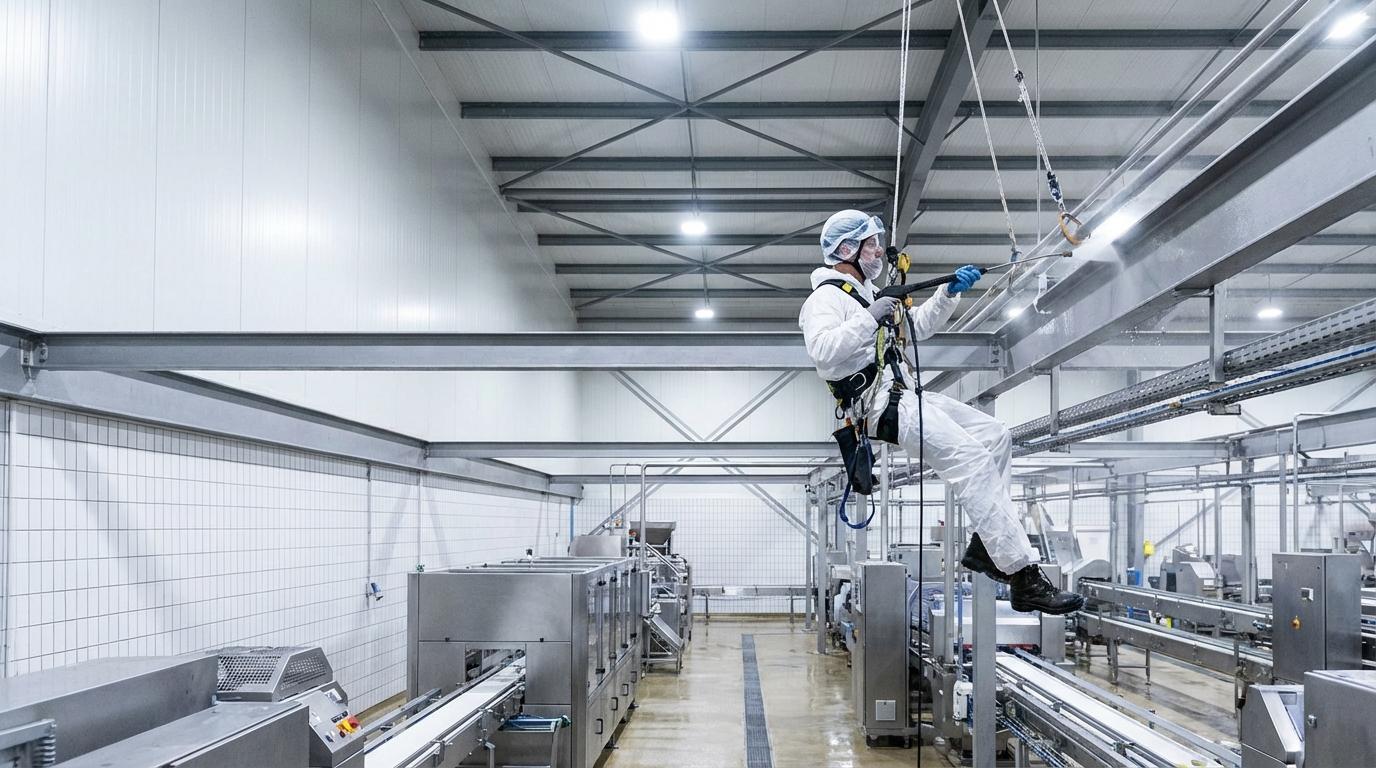
Rope access allows technicians to work directly next to every structural element, regardless of its location. A technician suspended on a fall protection system can reach spaces between beams, internal surfaces of trusses, elements suspended under the roof, and places inaccessible to lifts because of the layout of machines or installations.
In practice, cleaning work using rope access in a food production hall looks as follows:
•the work is planned during production downtime or a night shift, without the need to stop the entire plant;
•the area below the work is excluded from production and protected against contamination with tarpaulins or screens;
•washing is carried out using agents approved for food plants and compliant with HACCP;
•after completion, the area is cleaned of remaining washing agents and is ready for acceptance by sanitary supervision.
This method allows selective cleaning, meaning only those zones that require intervention can be cleaned, without having to close the entire hall.
Post-Work Documentation: A HACCP-Compliant Protocol
For plants certified to BRC or IFS standards, carrying out the work itself is not enough. The auditor will ask for evidence that cleaning was performed according to procedures. Documentation after rope access cleaning should include:
•a work scope protocol describing the cleaned surfaces and their location, such as hall zone and structural elements, the washing method, and the agents used, including trade names, working concentrations, and exposure time;
•safety data sheets for cleaning agents and confirmation that they are approved for use in food production plants;
•occupational health and safety documentation, including a permit to work and a list of workers with valid work-at-height qualifications;
•photographic documentation before and after the work, if requested by the client;
•a statement confirming compliance of the work with the facility’s hygiene procedures, signed by the work supervisor.
This documentation package allows you to demonstrate to the auditor that cleaning of hard-to-reach areas is performed systematically, with control over the agents used and with appropriate supervision. Lack of documentation, even when the work has been done properly, is a potential audit deviation.
When to Plan Cleaning Before an Audit
Do not leave structural cleaning until the last week before the audit. At that stage, you already have many other preparation tasks to complete. The optimal time is four to six weeks before the planned inspection. This is early enough to remove non-conformities and still have time for any supplementary work if, after cleaning, it turns out that one of the zones requires additional intervention, such as anti-corrosion painting or coating repair.
If you are planning a BRC or IFS audit and want to commission hall cleaning using rope access, contact us in advance. We provide complete post-work documentation compliant with food safety management system requirements. Schedule a site visit and assess the scope of work before entering the date into your timetable.
Author
Piotr Lankiewicz
Specialist in height work and rope access techniques. Owner of a company providing services in the most inaccessible locations nationwide. He prioritizes punctuality, strict health and safety standards, and solutions that save time and costs where the use of heavy machinery is impractical or not cost-effective.