Wet abrasive blasting of overhead cranes – an alternative to traditional sandblasting
Sandblasting effectively removes rust from a steel structure, but it generates so much dust that in many running plants it becomes organisationally impossible to carry out without stopping production within a radius of several dozen metres. When a hall does not have that luxury – because production runs non-stop, dust-sensitive machines stand nearby or it is simply impossible to build a sufficiently tight enclosure – the natural question is whether there is a method that is just as effective but less invasive for the surroundings. The answer is often wet abrasive blasting.
This article explains what wet abrasive blasting of overhead cranes involves, how it differs from the traditional dry sandblasting described in the previous article of this series, and what specific limitations of its own it has that are worth knowing before making a decision.
What wet abrasive blasting involves
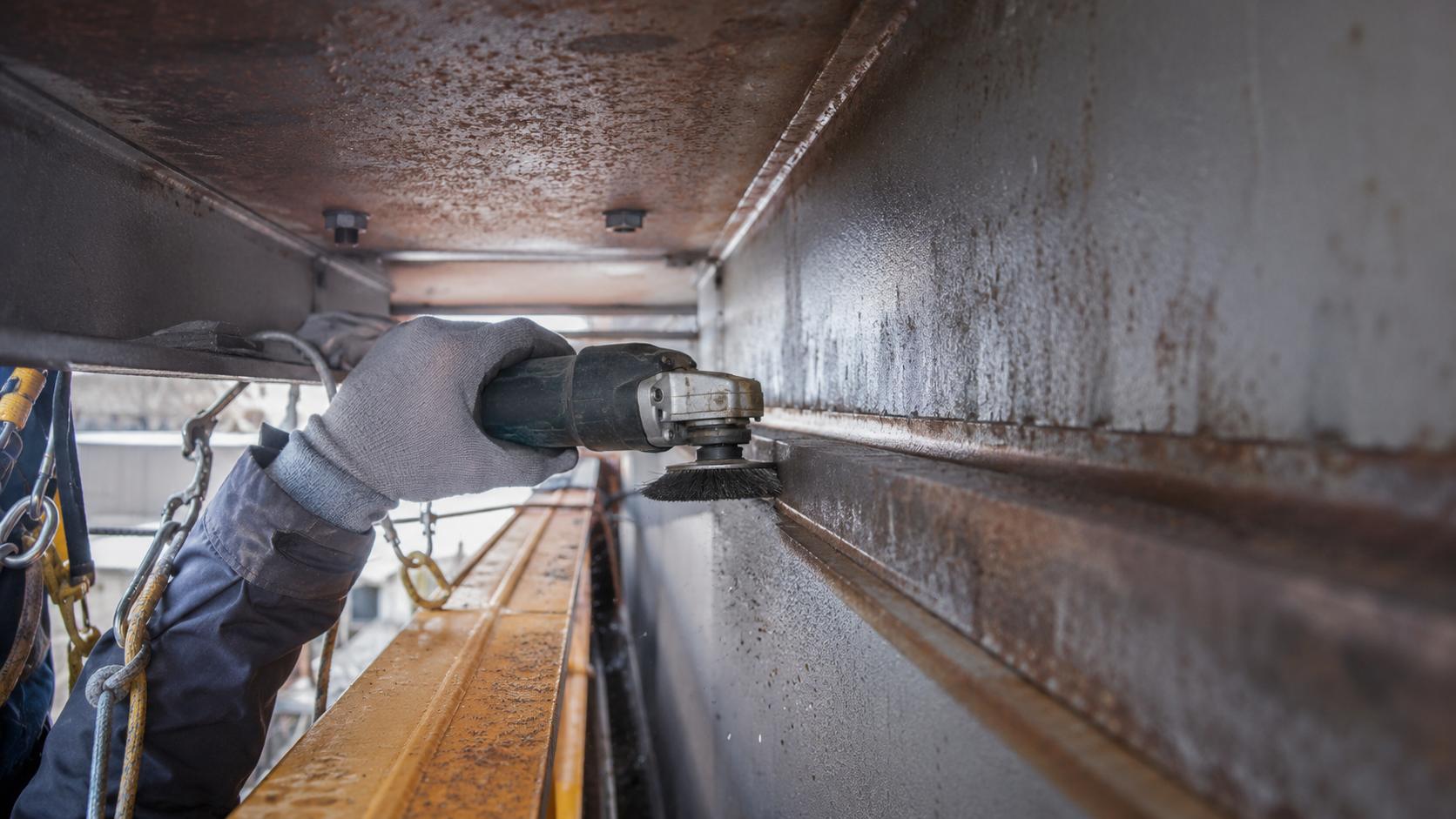
Wet abrasive blasting, also known as wet blast cleaning, combines high-pressure water with an abrasive material. The water has a dual function here – it is the carrier that transports the abrasive to the surface and the element that binds the dust which, in the dry method, would float freely in the air.
In terms of surface cleanliness, the end result is similar to traditional sandblasting – the corrosion layer and old paint are effectively removed and the metal is exposed with an appropriate roughness profile that ensures adhesion of the new anti-corrosion coating. The difference lies not in the end result on the structure itself, but in what happens to the contaminants generated during the process.
The main advantage – a drastic reduction in dust
It is precisely the reduction in dust that explains why wet abrasive blasting is gaining importance for work in running plants. Instead of floating in the air and settling on machines, products and sensors within a radius of over ten metres, the contaminants fall as wet sludge practically at the work location and can be collected far more effectively than dry dust.
This translates directly into how the work is organised:
- less need to tightly cover distant workstations and machines, because the range over which contaminants spread is much smaller,
- the possibility of working closer to active production areas than with dry sandblasting,
- lower risk for nearby workers associated with inhaling dust,
- often lower requirements for cordoning off the hall compared with traditional sandblasting, although basic protection of the work zone is still necessary.
Limitations of wet abrasive blasting you need to know about
Wet abrasive blasting is not universally better than dry sandblasting – it has its own set of challenges that must be taken into account in planning.
The first and most important is the risk of rapid secondary corrosion, known in the industry as “flash rust”. Metal cleaned by the wet method stays damp, and the freshly exposed, chemically active steel surface starts to corrode again much faster than after dry sandblasting – sometimes within a few hours if humidity and temperature conditions are unfavourable. This means that the time window between cleaning and applying the first coat of anti-corrosion coating must be shorter and more precisely planned than with the dry method, and it is sometimes necessary to use special corrosion inhibitors applied directly after cleaning if painting cannot follow immediately.
The second challenge is managing the water used in the process. Water running off the structure carries the washed-off contaminants with it – remnants of old paint, rust, abrasive particles – and must be collected rather than simply running onto the hall floor or into the drains. This requires a suitable collection system and, depending on the composition of the coating being removed, sometimes also treatment of the water before it is discharged.
The third factor is humidity in the hall during and after the work – in rooms with moisture-sensitive equipment (electrical switchrooms, some production lines) it is necessary to plan carefully how to limit the spread of moisture beyond the work zone itself.
When wet abrasive blasting works best
Wet abrasive blasting of overhead cranes is a good choice above all in situations where limiting dust takes priority over other factors:
- plants where production cannot be stopped even for a few hours and dry sandblasting would require too wide an area to be taken out of use,
- halls with dust-sensitive processes in the immediate vicinity of the crane, for example in food, pharmaceutical or electronics plants,
- situations where the plant wants to limit the risk of air contamination throughout the hall, not just in the immediate work zone,
- structures with a moderate degree of corrosion, where the effectiveness of the wet method is sufficient and the speed of dry sandblasting is not a priority.
Wet abrasive blasting and rope access
As with traditional sandblasting, working with rope access simplifies the logistics of wet abrasive blasting above a running hall – the technician reaches the structure directly without building scaffolding or bringing in a lift, which limits the area occupied under the crane and makes it easier to collect run-off water at the same time within a designated, narrower zone.
An additional advantage is flexibility in responding to weather and production conditions – if humidity conditions change during the day or work needs to be interrupted, the crew can come off the structure quickly without leaving partly dismantled auxiliary infrastructure behind.
Comparison with traditional sandblasting and mechanical cleaning
Compared with dry sandblasting, wet abrasive blasting wins in terms of the amount of dust generated and the possibility of working closer to active production areas, but it requires more rigorous planning of the time between cleaning and painting because of the risk of flash rust, as well as a solution for collecting the water.
Compared with mechanical cleaning – the third method, described in the next article of this series – wet abrasive blasting is usually more effective on larger surfaces and with deeper corrosion, but it requires more logistical preparation related to water, whereas mechanical cleaning does not generate this kind of waste.
How to prepare the plant for wet abrasive blasting
Practical steps worth taking before work starts:
- agree with the contractor how process water will be collected and discharged, taking into account the specifics of the hall floor and drainage,
- protect electrical and moisture-sensitive equipment within the work radius,
- plan the schedule so that painting can follow as soon as possible after cleaning of a given section of the structure is completed,
- agree with the contractor whether temporary anti-corrosion protection will be needed in the event of a delay between cleaning and painting,
- check that the temperature and humidity in the hall on the day of work fall within the recommended range for the planned coating.
Planning both stages comprehensively – cleaning and coating application – as one coherent process rather than two separate orders is particularly important here precisely because of the risk of flash rust. It is worth settling this already at the quotation stage for anti-corrosion protection of overhead cranes, so that the contractor plans the logistics of both phases together.
When wet abrasive blasting is not the best choice
There are situations in which it is worth considering another method:
- the hall has no technical means of collecting and discharging process water in a way that is safe for the surroundings,
- there is electrical equipment in the immediate vicinity that cannot be effectively protected against moisture,
- temperature conditions (for example work at low temperatures) make it harder to control the risk of flash rust and extend drying time,
- the contamination is very localised and mobilising a full wet blasting set would be disproportionate to the scope of work.
Equipment used for wet abrasive blasting
Wet abrasive blasting requires a different set of equipment than dry sandblasting – units that produce high water pressure, a system for metering abrasive into the water stream, and hoses and nozzles designed for work under pressure. When working at height using rope access, there is an additional logistical challenge – the hose supplying water and abrasive has to be routed along the rope path in a way that neither restricts the technician’s freedom of movement nor exposes them to additional load.
Well-planned equipment logistics also include a place to set up the unit in or in front of the hall, access to a water source with suitable pressure and flow, and space for temporarily storing the collected process water before it is discharged or disposed of. It is worth discussing these logistical issues with the contractor before signing the order, because they have a direct impact on where and how the equipment will be set up on the plant site.
The effect of the season on wet abrasive blasting
The risk of flash rust and the overall effectiveness of wet abrasive blasting are closely linked to the air temperature and humidity in the hall. In colder seasons, at lower temperatures, surface drying time increases and the risk of additional moisture condensing on freshly cleaned metal rises, which in turn shortens the time window available for applying the anti-corrosion coating. In warmer months, with higher temperatures and lower relative humidity, the surface usually dries faster, which makes it easier to plan the next stage.
This does not mean that wet abrasive blasting is suitable only for summer work – in many halls, temperature and humidity are controlled regardless of the season outside. It is worth, however, having the contractor assess the conditions in the specific hall on the day of the planned work rather than assuming in advance that conditions will be favourable.
Wet abrasive blasting and the requirements of the coating system
Not every paint system is suited to application on a surface prepared by the wet method – some coatings require a completely dry substrate, while others are designed for application on damp or slightly moist metal. The choice of coating system should be settled before cleaning begins, so that it does not turn out after the fact that the chosen surface preparation method does not match the planned paint.
This is another argument for treating cleaning and painting as one coherently planned process rather than two independent stages ordered separately – the decision on the cleaning method should also follow from the requirements of the coating system, not just from the conditions in the hall.
Surface quality check before painting
Once wet abrasive blasting is complete, before the crew moves on to applying the anti-corrosion coating, it is worth confirming a few things about the condition of the surface: whether the metal is dry enough, whether the first signs of flash rust have already appeared and whether the surface roughness meets the requirements of the selected paint system. This is a short visual check that an experienced technician routinely carries out before applying the first coat of primer.
If the first traces of secondary corrosion appear on the surface before the crew has had time to apply the coating, it is sometimes necessary to repeat part of the cleaning at that spot – which is why it is so important that the work schedule genuinely allows for the short time between cleaning and painting, rather than assuming it only on paper.
Conclusions
Wet abrasive blasting of overhead cranes is a real, proven alternative to traditional sandblasting, especially where limiting dust is an operational priority for the plant. Its effectiveness in removing corrosion is similar to that of the dry method, but it requires a different kind of preparation – managing process water and closely watching the time between cleaning and painting because of the risk of rapid secondary corrosion. The choice between dry sandblasting, wet abrasive blasting and mechanical cleaning should follow from a real assessment of the conditions in the specific hall, not from automatically choosing the method regarded as “standard”.
Author
Piotr Lankiewicz
Specialist in height work and rope access techniques. Owner of a company providing services in the most inaccessible locations nationwide. He prioritizes punctuality, strict health and safety standards, and solutions that save time and costs where the use of heavy machinery is impractical or not cost-effective.