Mechanical cleaning of overhead cranes – a solution for work in confined spaces
Not every part of an overhead crane is suitable for sandblasting or wet abrasive blasting. Recesses between girders, areas around electrical installations, tight spaces by the crane trolley or isolated spots of corrosion on a large surface that is otherwise in good condition – these are situations in which mobilising a full abrasive blasting set is disproportionate to the scale of the problem or simply physically impossible. That is where mechanical cleaning comes in.
This article, the last of three in this series describing methods of cleaning overhead cranes, explains what mechanical cleaning involves, when it works better than sandblasting and wet abrasive blasting, and when it is the only realistic solution because of the working conditions.
What mechanical cleaning involves
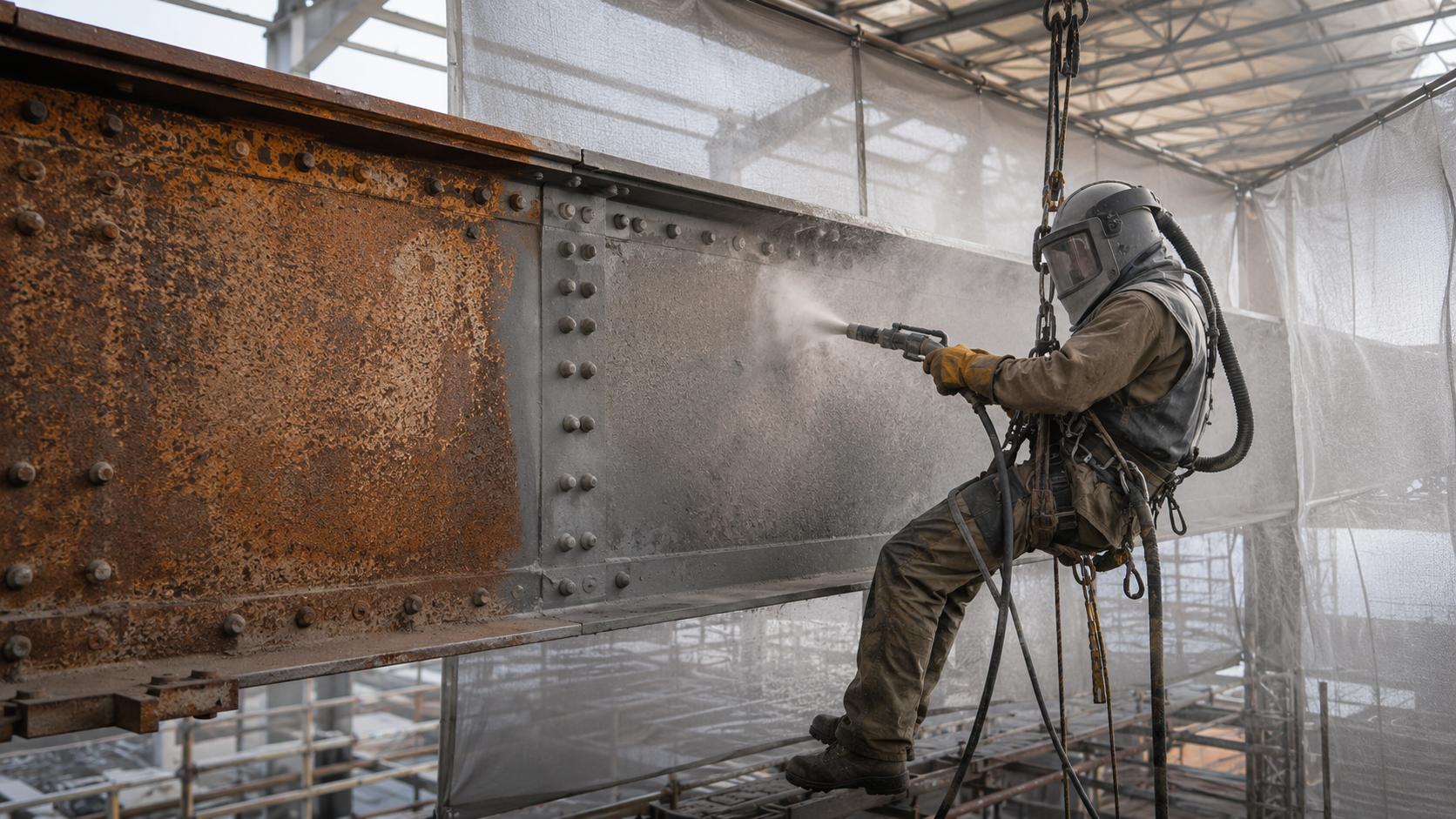
Mechanical cleaning means removing rust and old coatings with electric or pneumatic tools – angle grinders with abrasive discs, wire brushes (manual and power-driven) and, for deeper, localised material loss, also milling cutters or needle scalers. Unlike sandblasting and wet abrasive blasting, which act on the surface with a stream of abrasive material, here the tool is in direct mechanical contact with the metal.
The result is a surface cleaned to a degree of cleanliness referred to in the anti-corrosion industry as St2 or St3 – thorough hand and power tool cleaning that removes loose mill scale, rust and old coatings, but is as a rule less uniform than the grades achieved by abrasive blasting methods. For many applications, especially spot repairs, this degree of cleanliness is entirely sufficient.
When mechanical cleaning is the only realistic choice
There are situations in which sandblasting and wet abrasive blasting are simply out of the question, regardless of the plant’s preferences:
- a very restricted working space – tight structural recesses, areas around installations, places where an abrasive stream cannot be directed safely without the risk of damaging adjacent components,
- proximity to electrical installations or moisture-sensitive equipment, where the use of water (wet abrasive blasting) is ruled out for safety reasons,
- plants where even the limited amount of dust generated by dry sandblasting is unacceptable because very sensitive production processes are nearby,
- no possibility of collecting process water or abrasive waste in a given area of the hall.
Under these conditions mechanical cleaning, although slower, remains the only method that can be carried out safely and in compliance with regulations without stopping neighbouring processes.
When mechanical cleaning is a deliberate choice rather than a necessity
Apart from situations forced by the conditions in the hall, mechanical cleaning can also be a rational choice in its own right:
- for spot repairs – isolated spots of corrosion on a structure that is otherwise in good condition, where mobilising sandblasting equipment would be disproportionate to the scope of work,
- for maintenance work carried out cyclically, where the aim is to maintain the condition of the structure rather than fully renovate the anti-corrosion coating,
- when the plant prefers the solution that generates the least waste to collect and dispose of – mechanical cleaning produces dust and particles, but in much smaller quantities than sandblasting a large surface,
- for work requiring high precision, for example right next to components that must not be disturbed.
Limitations of mechanical cleaning
This method also has clear limits worth knowing about before making a decision:
Above all, it is slower than sandblasting or wet abrasive blasting on large surfaces – what an abrasive stream cleans in a quarter of an hour can take hours with a grinder or wire brush. With extensive corrosion across the whole crane structure, mechanical cleaning is often simply not worthwhile in terms of time.
The degree of surface cleanliness achieved is usually lower and less uniform than with abrasive blasting methods, which, for some coating systems with higher substrate preparation requirements, may limit the durability of the final anti-corrosion protection. It is worth consulting the contractor about this when selecting the specific paint system.
Working with rotary tools also generates vibration and noise, which during longer working sessions matters for the ergonomics of a technician working at height and for the comfort of employees nearby if the work is carried out during the hall’s operating hours.
Safety during mechanical cleaning at height
Working with rotary tools at height, suspended on a rope, requires extra attention in several areas:
- stable, secure positioning of the technician relative to the surface being worked on, so that tool kickback does not upset their balance,
- securing the tool itself with a lanyard, in line with the general principle of securing equipment against falling,
- protecting the eyes and face against chips of metal and old coating, which scatter more intensively when working with a disc or wire brush than with blasting methods,
- checking the condition of discs and brushes before each use – a worn or damaged tool at height is a hazard both to the technician and to people below.
This is an area where the crew’s experience in rope access work is particularly important – handling rotary tools in a suspended position, without the stable support of working from the ground, requires a different technique than working with the same tools on a solid surface.
Mechanical cleaning compared with sandblasting and wet abrasive blasting
Looking at all three methods together, the choice between them is rarely a matter of taste – it follows above all from the conditions of the specific hall and the scale of the problem. Sandblasting works well on large surfaces with extensive corrosion, where adequate shielding against dust can be provided. Wet abrasive blasting is a good choice when limiting dust is the priority and the hall allows process water to be collected. Mechanical cleaning wins where space is limited, installations sensitive to water or dust are nearby and the scope of work is localised rather than a full renovation.
An experienced contractor does not propose one method by default, but assesses the specific crane and the conditions in the hall, and often combines methods within a single job – for example mechanical cleaning in tight recesses while larger, open surfaces are sandblasted.
How to prepare for mechanical cleaning of an overhead crane
Practical steps on the plant’s side:
- determine together with the contractor whether the problem is localised or covers the entire structure – this decides whether the method is justified,
- protect the area under the work against falling chips, as with other cleaning methods,
- agree an acceptable noise level during the hall’s working hours if the work is to be carried out while production is running,
- discuss with the contractor what degree of surface cleanliness is required for the planned coating system and whether mechanical cleaning will achieve it.
Choosing the right method and coating system is part of the overall planning of anti-corrosion work, which is worth settling already at the quotation stage for painting overhead cranes – so that the chosen cleaning method really matches the conditions in the specific hall rather than being a copy of the solution from the previous job.
Types of tools and matching them to the stage of work
Mechanical cleaning is not a single, uniform technique – it covers several tools with different uses, which an experienced crew matches to the specific stage and type of contamination.
- wire brushes, manual or grinder-driven – for removing loose rust, surface dirt and poorly adhering remnants of old coating,
- abrasive and flap discs – for more intensive removal of mill scale and more firmly adhering corrosion, with the possibility of controlling the depth of treatment,
- needle scalers – for spot removal of thick, hard layers of corrosion or old coating in places where a disc could excessively damage the structure of the metal,
- angle grinders with a suitable attachment – for smoothing edges and transitions between the cleaned area and the rest of the surface, so that the new coating has an even substrate.
The choice of a particular tool for a given part of the structure affects both the pace of work and the quality of the final surface preparation – which is why the contractor should be able to explain which tool they will use in a given place and why, rather than using one tool universally across the whole structure.
A staged approach for larger scopes of work
Although mechanical cleaning is mainly associated with spot repairs, it is also used on larger sections of a structure when the conditions in the hall rule out abrasive blasting methods. In such situations it makes sense to divide the work into stages – cleaning and protecting one section of the structure before the crew moves on to the next, instead of leaving a large area of cleaned metal exposed to corrosion for a longer time.
Such a staged approach also requires closer coordination with the plant, because the work extends over more days, which means a longer presence of the crew in the hall and the need to keep the work zone secured for the whole of that period, not just for a single day.
When it is worth combining mechanical cleaning with other methods
In practice, experienced contractors rarely stick rigidly to one method across the whole structure. A typical approach is to use sandblasting or wet abrasive blasting on the large, open surfaces of the crane, while using mechanical cleaning in tight recesses, around installations or at hard-to-reach structural joints where an abrasive stream cannot be safely directed.
Such a combined approach makes it possible to use the strengths of each method – the speed and effectiveness of abrasive blasting where conditions allow it, and the precision and safety of mechanical cleaning where space or the proximity of sensitive installations requires it. It is worth asking the contractor already at the quotation stage whether they plan such a combined approach or intend to use one method across the whole structure regardless of the varying conditions in its individual sections.
Surface quality check after mechanical cleaning
After mechanical cleaning is completed, it is worth carrying out a short visual check of the uniformity of the cleaned surface before the anti-corrosion coating is applied. The aim is to check whether any areas remain with poorly adhering but still present corrosion – such spots are easy to miss when working with a rotary tool, especially in hard-to-reach corners of the structure where visibility is limited.
It is also worth making sure that the transitions between the cleaned area and the remaining, undisturbed surface are properly smoothed – sharp boundaries between metal and old coating are often where new paint detaches first if the transition has not been properly prepared.
Choice of method and the crew’s time budget in the hall
When planning the work, it is worth remembering that mechanical cleaning, although slower on a large surface, is at the same time often less demanding logistically than sandblasting or wet abrasive blasting – it requires no additional unit, no water collection system and no equally tight cordoning of the zone. For a small scope of spot repairs, it is often the solution that can be implemented faster organisationally, even though the cleaning process itself takes longer than with abrasive blasting methods.
The contractor should present a realistic time estimate that covers not only the cleaning itself, but also preparation of the zone, transporting equipment to height and any breaks resulting from the conditions in the hall on a given day – only such a full picture allows mechanical cleaning to be compared fairly with the other methods in terms of total completion time.
Conclusions
Mechanical cleaning of overhead cranes is not a “worse” method than sandblasting or wet abrasive blasting – it is a method for different applications. Where space is limited, installations sensitive to dust or water are nearby and the problem is localised, it is often the only realistic and most rational solution. The key is an accurate assessment of which of the three methods – sandblasting, wet abrasive blasting or mechanical cleaning – matches the actual conditions in the specific hall and the extent of corrosion, rather than automatically choosing the method regarded as standard.
Author
Piotr Lankiewicz
Specialist in height work and rope access techniques. Owner of a company providing services in the most inaccessible locations nationwide. He prioritizes punctuality, strict health and safety standards, and solutions that save time and costs where the use of heavy machinery is impractical or not cost-effective.