Anti-Corrosion Work at Height – Why Companies Outsource It to Specialists
A steel structure, an industrial chimney, or a sheet-metal roof that can only be reached by scaffolding a dozen or so metres high, or by working in a hard-to-reach corner of a production hall – that is exactly the point at which most construction companies and maintenance departments stop treating anti-corrosion work as a job “to be done in-house” and start looking for a specialised, certified subcontractor. Below we explain why this is a sound, economically justified decision, not just a matter of convenience or a lack of internal manpower.
Anti-corrosion protection is more than applying paint
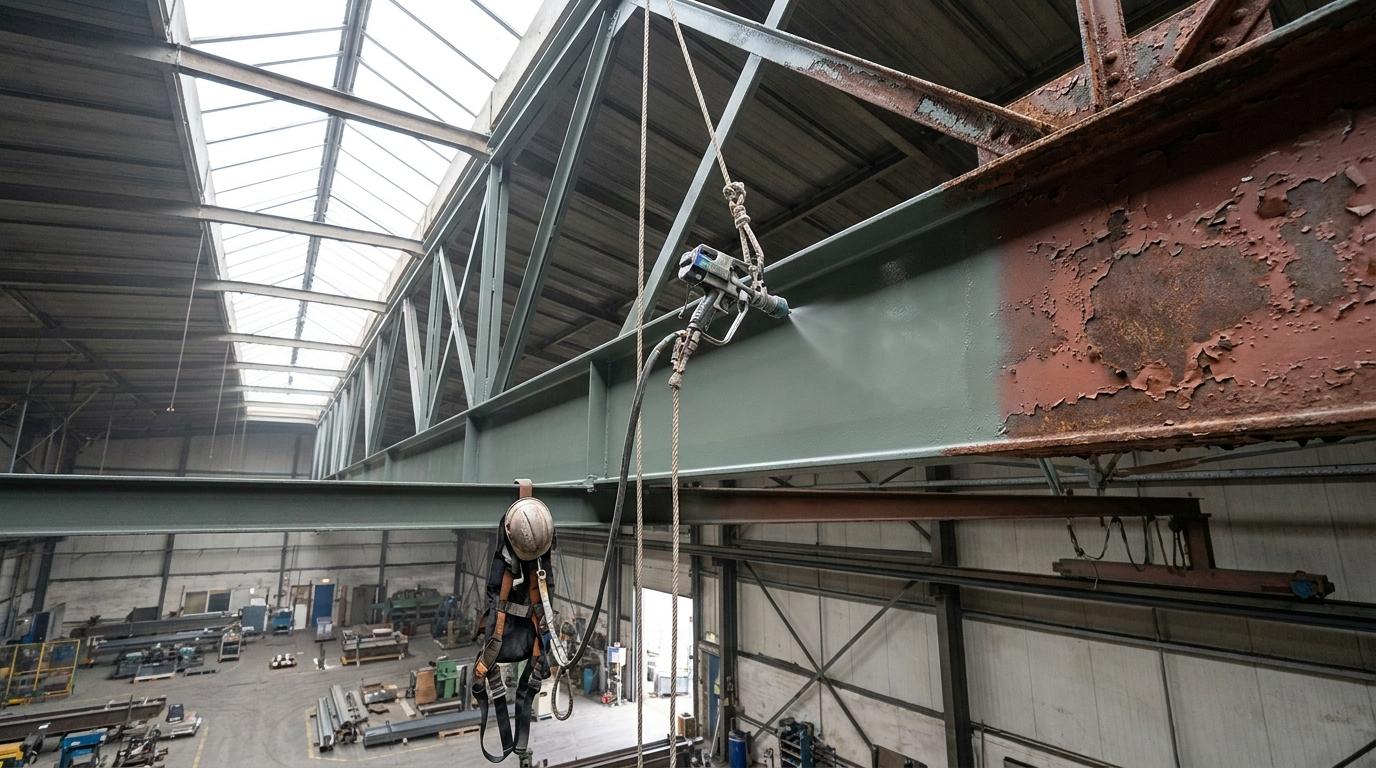
Effective anti-corrosion painting starts with surface preparation – removing old, flaking coating, surface corrosion, and contaminants that prevent the new layer from adhering properly. Skipping this stage, or carrying it out superficially, means the new coating will fail within months, not years – and the cost of the poorly executed work has to be paid a second time, this time together with the additional cost of removing the failed coating that was applied earlier.
Choosing the right coating system for the conditions of a given structure – exposure to moisture, temperature, an aggressive chemical environment in some industrial plants – is a decision that requires technical knowledge, not just access to height. We describe the full maintenance cycle and the real costs of this kind of work in the article on anti-corrosion painting of steel structures.
Quality control of surface preparation – the degree of steel cleaning, coating thickness measured with a thickness gauge, humidity and temperature conditions during application – is something a specialised subcontractor documents as a standard part of the job. A company without specialised anti-corrosion experience often skips this quality control stage, which only becomes apparent once the coating starts flaking well before its expected service life.
When it makes sense to combine anti-corrosion work with another structural inspection
Since the crew already needs access to a high-level steel structure to apply an anti-corrosion coating, it is worth considering using the same visit for a broader inspection of the structure’s technical condition – checking bolted and welded connections, the state of roof drainage near the structure, or other mechanical damage not visible from ground level. This combined approach reduces the number of separate ascents, and with it the total cost of mobilising a crew, while at the same time building a fuller picture of the structure’s technical condition at a single point in time.
For companies managing several industrial facilities at once, this approach also makes it easier to plan the maintenance budget for the coming years – instead of separate, unrelated orders for anti-corrosion work and structural inspection, a single, coherent inspection-and-maintenance schedule emerges.
Why rope access instead of scaffolding
Steel structures in production halls, industrial chimneys, and sheet-metal roofs often have a geometry where scaffolding takes a long time to erect and still fails to provide full access to every surface – corners, edges, elements under the roof. A crew working with rope access techniques reaches those places directly, without erecting a temporary structure, which genuinely shortens the time needed for the job and limits interference with the day-to-day operation of a production facility.
This has a particular, measurable impact on jobs that require temporarily stopping part of production – the shorter the work at height itself takes, the lower the cost of the production stoppage on the client’s side.
The weather window required by coating systems
The coating systems used in industrial anti-corrosion work have application parameters strictly defined by the manufacturer – air and substrate temperature, relative humidity, and the margin to the dew point, below which moisture condenses on the freshly applied coating and ruins its adhesion. Most epoxy and polyurethane paints used on steel structures require a substrate temperature above a few degrees Celsius and relative humidity below a defined threshold – in practice, this means that in Poland the season favourable for outdoor anti-corrosion work is concentrated in the spring and summer months, although work inside heated halls can be carried out year-round.
For the client, this translates into a concrete practical takeaway: plan anti-corrosion work well in advance so that it fits within the weather window, rather than trying to force it into a date that doesn’t meet the application parameters. A specialised subcontractor should openly refuse to apply a coating in conditions that don’t comply with the product’s technical data sheet – even under deadline pressure – because a coating applied in the wrong conditions will not hold its declared durability, regardless of the quality of the material itself.
Fire safety requirements and other technical constraints
Cleaning and painting steel structures under the roof of a hall often comes with additional fire safety requirements – proper protection of zones, control over the use of flammable materials, and coordination with the building’s smoke detection system. We cover these requirements in more detail in a separate article on cleaning steel structures under the roof.
With sheet-metal roofs, an additional challenge is surface preparation itself before painting – a different process than for a lattice structure, described in detail in the article on preparing a sheet-metal roof for painting at height.
With structures in production halls, it is also worth taking the facility’s work schedule into account – anti-corrosion painting comes with solvent odour and sometimes the need to restrict access to part of the hall, which is better planned in advance for a period of lower production intensity than fitted into whatever date happens to be available.
Wind farms – anti-corrosion work as part of the seasonal inspection
On wind farms, anti-corrosion protection of turbine towers is one of the key elements of the broader seasonal preparation of a farm, alongside inspection and washing – described in the article on preparing a wind farm for the season. This is a good example of why anti-corrosion work is rarely a one-off order – it works best as a recurring, repeatable part of a facility’s maintenance plan, rather than an emergency response taken only after the fact.
Why companies outsource this instead of doing it in-house
A few specific reasons come up repeatedly in conversations with clients, regardless of the industry the ordering company operates in:
- Equipment and certification for access at height – maintaining an in-house team with IRATA qualifications, up-to-date fall protection equipment, and regular inspections of that equipment rarely pays off for a company for which this is not the core business.
- Knowledge of coating systems – choosing the right paint, primer system, and surface preparation method requires experience that a one-off, incidental internal job simply won’t build.
- Accountability for the result – a subcontractor specialising in anti-corrosion work takes responsibility for the durability of the coating, which is far harder to enforce and quantify when the work is carried out by an internal team’s own resources.
- Scheduling flexibility – a specialised subcontractor responds to the weather window required by coating systems, instead of fitting the timing of the job around the tight schedule of an internal team occupied in parallel with other, ongoing duties.
The cost of neglect – what happens when anti-corrosion work is postponed
Corrosion progresses at a non-linear rate – the longer steel remains unprotected or with a damaged coating, the faster material loss accelerates, because a corroded surface retains moisture far more effectively than a clean, protected surface. A structure that a year ago required nothing more than a coating refresh may, after another year of neglect, already require full cleaning down to bare metal, and in extreme cases, a structural analysis of whether the loss of steel cross-section has affected the load-bearing capacity of the structure.
This mechanism means that postponing anti-corrosion work “for later” almost always raises the total cost of the intervention rather than lowering it – a delay of a year or two rarely simply shifts the same expense further into the future; more often it means a significantly higher repair cost by the time the work finally happens. For this reason, specialised subcontractors recommend treating anti-corrosion work as part of a recurring maintenance plan, rather than a one-off intervention taken only once the condition of the structure has become a visible problem.
What a typical anti-corrosion maintenance cycle looks like
How often an anti-corrosion coating needs refreshing depends on the type of coating system, the aggressiveness of the environment (a production hall with water vapour and chemicals ages a coating faster than a dry warehouse), and the quality of the original application. After every job, a good subcontractor leaves behind documentation – the system used, coating thickness, application conditions – which becomes a reference point when planning the next inspection and makes it possible to assess whether the coating is wearing in line with the manufacturer’s expectations or faster than it should.
A regular review of the coating’s condition – ideally combined with another job at height on the same facility, to limit the cost of mobilising a crew – makes it possible to catch localised damage (abrasion, mechanical impact, isolated flaking) and repair it locally, before it develops into extensive corrosion that requires a full coating renewal across the whole surface.
Frequently asked questions
How long does a typical anti-corrosion coating last before it needs refreshing?
It depends on the coating system and the aggressiveness of the environment – a well-applied coating in moderate conditions can last many years, but the exact timeframe is always worth confirming with the contractor based on the system used and the specifics of the facility, rather than assuming a universal deadline.
Can a new coating be applied directly over the old one, without full removal?
Sometimes yes, if the old coating is in good adhesive condition and chemically compatible with the new system – but that is a decision that requires an on-site assessment, not an assumption applied automatically to every job.
Can anti-corrosion work be carried out without stopping the production hall’s operation?
In many cases yes, especially with rope access, which limits interference with the hall’s space to a minimum – but it requires prior planning of work zones and, with strong-smelling coating systems, taking ventilation and the production schedule into account.
What if the inspection reveals a loss of steel thickness, not just a damaged coating?
That is a situation that goes beyond standard anti-corrosion work – it requires assessment by a structural engineer as to whether the loss affects the load-bearing capacity of the element, before any decision is made on how to proceed.
What to look for when choosing an anti-corrosion subcontractor
Beyond the standard verification of certificates and public liability insurance, for anti-corrosion work it is worth additionally asking about: the specific coating system the subcontractor proposes and why that particular one, a warranty on the durability of the coating, and full photographic documentation before and after surface preparation and after each coating layer is applied. A company that cannot justify its choice of coating system with the specific conditions of the facility is likely applying a single, universal solution to everything – regardless of the actual needs of a given structure.
It is also worth asking about the warranty terms in practice – whether it covers only material defects, or also the durability of the coating’s adhesion to the substrate, and exactly which operating conditions of the facility (e.g. humidity, chemical exposure, mechanical loads) could void that warranty.
You can find the scope of our offer in this area on the painting and anti-corrosion offer page. If you have a specific facility that needs an assessment of the structure’s condition and the selection of a coating system, get in touch with us – we always start with a site visit and an assessment of whether full cleaning down to bare metal is necessary, or whether refreshing the existing coating is enough.
For companies planning anti-corrosion work as part of recurring maintenance rather than a one-off intervention, we can also propose an inspection schedule linked to other work at height on the same facility – so that every ascent by the crew is used as efficiently as possible, both in cost and logistics.
Author
Piotr Lankiewicz
Specialist in height work and rope access techniques. Owner of a company providing services in the most inaccessible locations nationwide. He prioritizes punctuality, strict health and safety standards, and solutions that save time and costs where the use of heavy machinery is impractical or not cost-effective.