Cleaning Steel Structures Under the Roof and Fire Safety Requirements
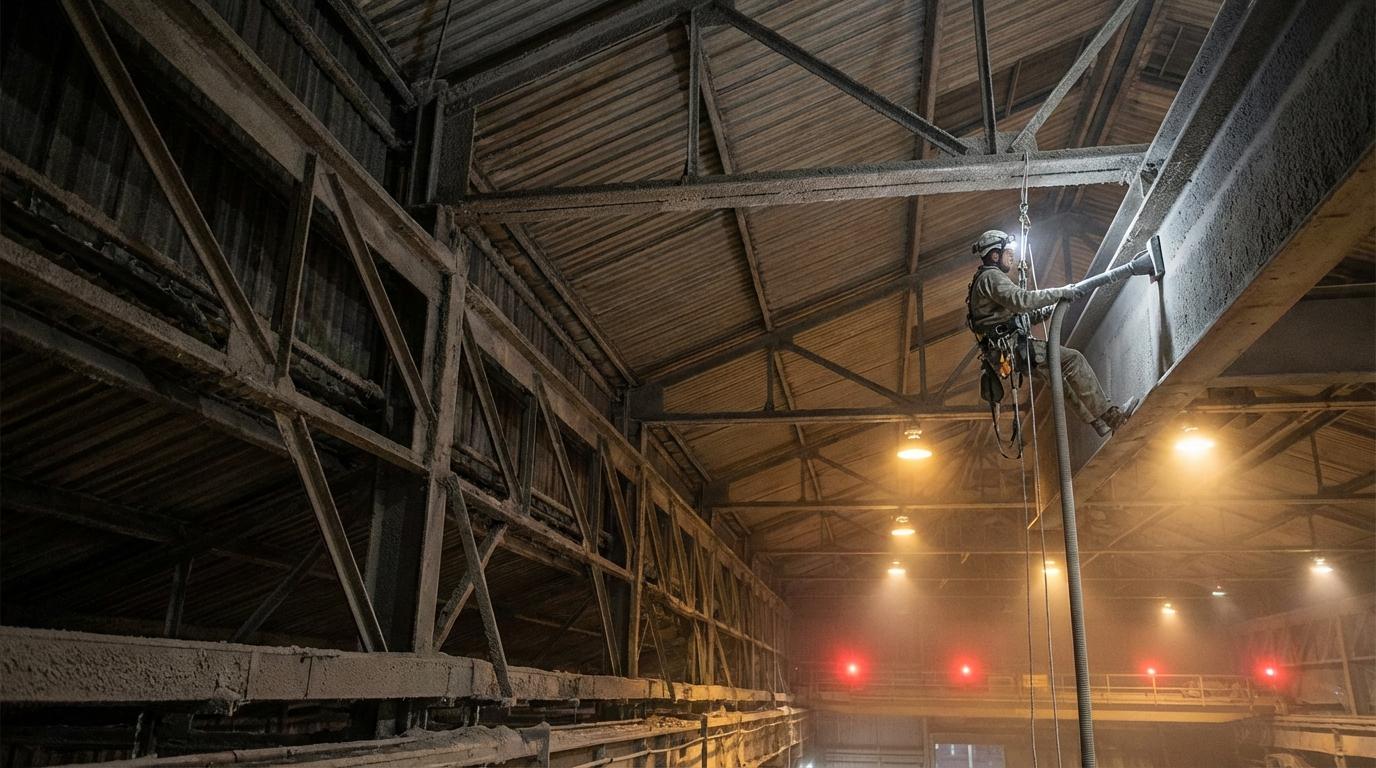
A State Fire Service inspector has scheduled an inspection of the hall in six weeks. The plant manager reviews the documentation, and when the point concerning the cleanliness of overhead structures appears, there is silence. The last entry in the work register is from more than three years ago. From the floor, a dusty layer of dark technical dust is visible on the steel beams. The question arises: is this already a problem, or not yet?
In the case of technical dust in industrial halls, this question has a specific regulatory answer, and it is worth knowing it before the firefighters arrive, not during their visit.
Fire Safety Regulations and Technical Dust in Halls: Where the Risk Begins
Fire safety regulations require owners and managers of buildings to maintain cleanliness in a way that prevents fire hazards. This obligation results from fire protection legislation and regulations concerning the fire protection of buildings.
In the context of technical dust, the key factors are flammability and particle size. Organic dusts, such as wood, grain, flour, sugar, and plastic powders, can form explosive mixtures with air even at low concentrations. Metallic dusts, including aluminium, magnesium, and iron, may also be potentially explosive. Coal and coke dusts are highly flammable. Even dusts that are not explosive on their own can settle on heated components of electrical installations and become a cause of fire.
The PN-EN 60079 standard and regulations concerning explosive atmospheres classify spaces in which dusts may create dangerous concentrations. In Ex zones, proper classification requires the regular removal of dust deposits. Lack of such documentation constitutes non-compliance.
Apart from the issue of explosiveness, overhead dirt has one more dimension: a thick layer of dust on beams and installations is combustible material that can significantly accelerate fire spread. This is something a State Fire Service inspector can assess without specialist instruments. A visual inspection while walking through the hall is often enough.
Who Is Legally Responsible for Cleanliness in the Hall?
Responsibility for cleanliness in terms of fire safety rests with the owner or manager of the facility, and also with the employer to the extent resulting from labour law and occupational health and safety regulations.
In practice, this means that:
•the building owner or manager is responsible for the building condition, including structures, installations, flashings, and the cleanliness of structural elements such as beams, bracing, and purlins;
•the employer, or hall tenant, is responsible for cleanliness resulting from the production process, including dust emitted by machines, production lines, and technological processes.
In many cases, these roles overlap or are combined, because the owner of the hall is also its user. In such a situation, full responsibility for fire-safety-related cleanliness lies on one side.
During a State Fire Service inspection, the inspector may request documentation confirming regular cleaning. The absence of this documentation is not only a non-compliance issue. It may also be grounds for initiating administrative proceedings or issuing an order to remove irregularities within a specified deadline.
Methods of Overhead Vacuum Cleaning Using Rope Access
Cleaning overhead steel structures is one of the typical scopes of industrial rope access work. The reason is simple: beams, trusses, and bracing are often located at heights of 8–15 meters. Standard cleaning equipment, such as mops or industrial vacuum cleaners with long handles, does not reach these areas effectively, while scaffolding occupies the hall for many days.
Rope access allows industrial rope-access technicians to work directly next to the structure, using ropes anchored to fixed points. The typical scope of work includes the following methods.
Industrial vacuuming uses high-capacity industrial vacuum cleaners with HEPA filters or filters dedicated to organic dusts. The technician works directly at the beam, collecting dust without spreading it throughout the entire hall.
Pressure washing or steam cleaning is used in halls where dust is mixed with oily contamination, such as grease, oils, or fat particles from production processes. Vacuuming alone is not enough in such cases. Steam cleaning breaks down dirt thermally, while pressure washing removes it mechanically. Steam has the advantage of not leaving large amounts of water behind.
Installation cleaning covers ventilation pipes, sprinkler systems, and cable routes on cable trays. These elements are often located next to beams and require separate attention.
The work is carried out in sections. The technician moves systematically from one end of the hall to the other, with photographic documentation prepared for each section.
Working in an Active Hall: How to Minimize Production Disruption
Overhead cleaning in an operating hall requires coordination with the production department. The key principles are as follows:
•machines and production lines directly under the work zone should be switched off or covered, because cleaning waste, such as dust or water from washing, must not contaminate the production line;
•the schedule should be arranged by sections, with one section of the hall cleaned first, then the next, gradually covering the entire facility;
•work should be carried out during a downtime window, such as technical breaks or weekends, in sections where stopping production is otherwise unacceptable;
•electrical equipment and switchgear must be protected, and before pressure washing or steam cleaning, power must be disconnected or electrical cabinets must be sealed.
Work Documentation for the State Fire Service and the Health and Safety Department
After overhead cleaning is completed, the plant should have documentation that will be useful during a State Fire Service inspection. This documentation should include:
•a protocol stating the date and scope of work, divided into hall sections;
•photographic documentation of the condition before and after cleaning for each section;
•a list of the agents and equipment used;
•certificates and qualifications of the working team, such as IRATA certificates or equivalent qualifications;
•information about the working method, including ropes, anchor points, and personal protective equipment.
Such documentation is concrete evidence for the State Fire Service inspector that the facility manager is undertaking systematic maintenance activities. It should be entered in the building maintenance work register or kept in a dedicated fire safety file for the facility.
If you are preparing for a State Fire Service inspection or want to bring the overhead cleanliness of your hall into compliance, order an inspection and work quotation. We will assess the condition of the structure, propose the scope, and suggest a completion date that can be implemented without interrupting production.
Author
Piotr Lankiewicz
Specialist in height work and rope access techniques. Owner of a company providing services in the most inaccessible locations nationwide. He prioritizes punctuality, strict health and safety standards, and solutions that save time and costs where the use of heavy machinery is impractical or not cost-effective.