Window cleaning at height – a guide for property managers
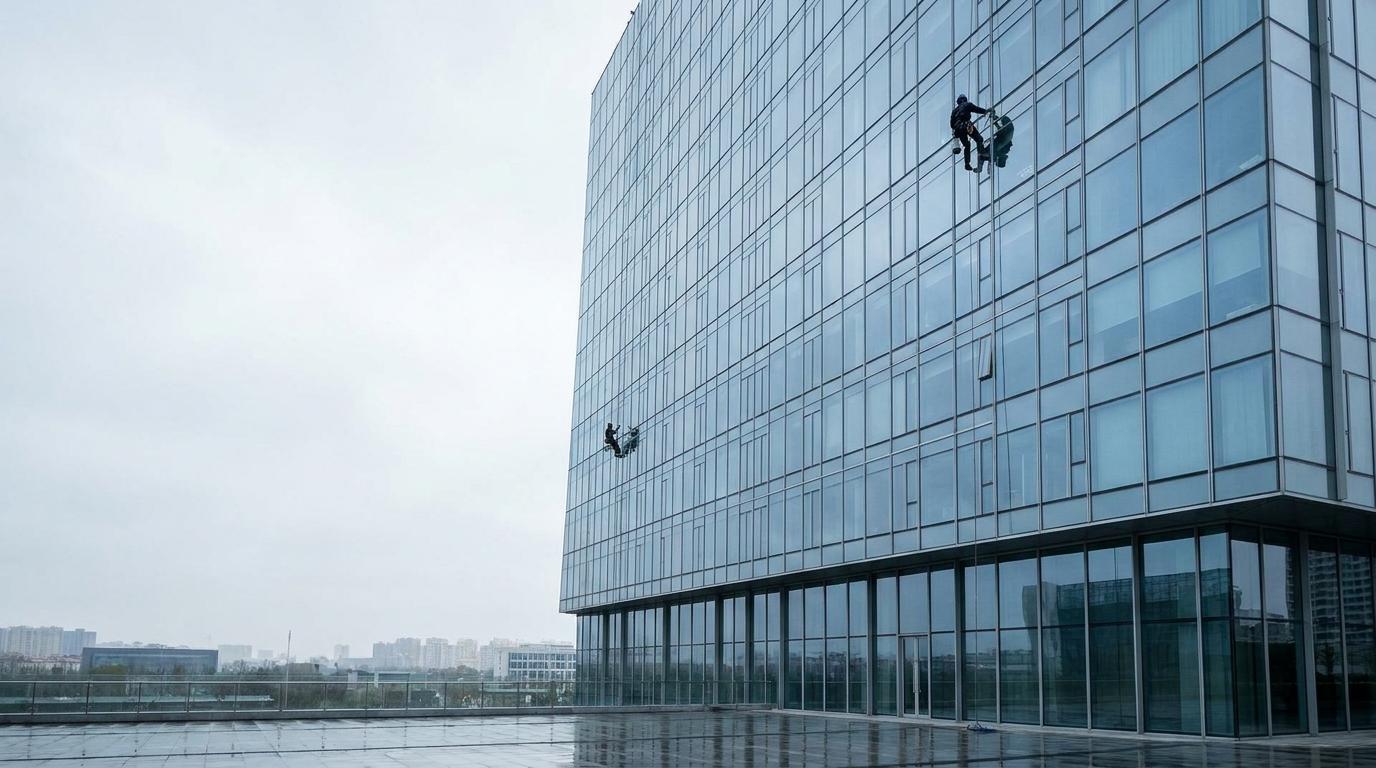
Window and facade cleaning at height is not just a matter of booking a service. It requires assessing the access method, selecting the right team, and preparing the building – with occupational health and safety regulations and responsibility for organizing the works always in the background on the property manager’s side. Before a rope access company even shows up at your building, you need to answer a few questions: how much it will cost, what you need to prepare, how often the service should be repeated, and what the whole process actually looks like from first contact to sign-off. Each of these questions carries different weight depending on the type of building, its location, and whether you’re ordering the cleaning for the first time or already managing an established service cycle.
This article works as a starting point – it brings together in one place all the texts that cover individual aspects of the topic in detail, from the perspective of the property manager rather than the contractor. Instead of hunting for answers scattered across different sources, you’ll find here a short summary of each topic and a link to the full article whenever that particular subject is relevant to your situation. Below, we’ve arranged the articles in an order that follows the property manager’s natural decision-making process – from the first quote, through preparing the building, to the actual execution and planning the schedule for the following years.
How much does rope access window cleaning cost?
This is the question that starts almost every conversation with a potential contractor. The article explains exactly what affects the price of a job – from the square footage and accessibility of the facade, through the degree of soiling, to the specifics of the building itself, including the type of facade material and the number of storeys. It also covers the difference between a flat-rate quote and billing by the working hour, and why two seemingly similar offers can differ in price by several dozen percent. If you want to know exactly how to read a contractor’s quote, which variables to look for, and how to spot an offer that quietly leaves out an important cost element – this article is a good starting point before your first contact with a rope access company.
Checklist for preparing a building for window cleaning
A rope access company won’t start work if the building isn’t properly prepared – and what specifically needs to be organized depends on the type of building and its accessibility. The article brings this together as a ready-made checklist: access to the roof and anchor points, tenants notified with sufficient advance notice, securing the zone below the facade before work begins, and establishing who on the property manager’s side will be the point of contact on the day of the job. For a property manager ordering window cleaning for the first time, this checklist helps avoid the most common, recurring delays that aren’t the contractor’s fault, but result from insufficient preparation on the client’s side.
Glass facade cleaning: technology, materials and rope access work
A glass facade requires a completely different approach than standard windows set into masonry – different chemicals, different application technique, different requirements for the final result, especially with anti-reflective or structural glass. The article covers the types of soiling typical for large glass surfaces, the selection of cleaning agents matched to the specific type of glass, and how to avoid streaks and micro-damage to the surface during cleaning. This is a particularly useful read for managers of office buildings and shopping centers, where large glazed surfaces are the building’s calling card, and visible streaks or stains directly and negatively affect how the building is perceived by customers, visitors, and tenants themselves.
Window cleaning in multi-storey buildings: challenges and rope access solutions
Above a few storeys, the logistics of window cleaning get more complicated on several levels at once – the impact of weather conditions grows, especially wind, which tends to be significantly stronger at height than at ground level, coordination with tenants becomes more demanding due to the number of units affected by the work, and the choice of access method has real consequences for cost and completion time. The article explains why rope access gains an advantage over scaffolding or a lift for tall buildings, and how to plan the job to minimize the number of days when work is completely impossible due to unfavorable weather conditions.
How rope access window cleaning is carried out – from order to sign-off
Step by step: what happens from the moment you send an inquiry to the sign-off of the work. The article describes the entire process – the site visit, the quote, preparing the building, execution, and post-completion documentation – from the perspective of a property manager ordering this type of service for the first time and unsure what to expect at each stage. You’ll also find information on the typical duration of the job depending on the size of the building, what the team’s work looks like on the day of service, and exactly what you should check at handover before signing the protocol confirming completion of the entire job.
How often to clean windows and glass facades – a seasonal schedule for commercial buildings
How to plan the cleaning cycle throughout the year – which dates are mandatory, which are optional, and when it’s worth scheduling an additional service outside the established schedule. The article factors in variables such as the building’s location, facade type, traffic intensity in the area, and tenant requirements, and also shows the differences in schedule between a city-center office building, a shopping center, and a residential building. This material is particularly useful when planning an annual budget, when you need to estimate in advance the number and timing of services for the entire season.
Why rope access instead of scaffolding or a lift
Before moving on to the detailed articles, it’s worth understanding why rope access is the standard method in this industry for commercial buildings, rather than just one of several equivalent options. A cherry picker requires firm, level ground and unobstructed access around the building – in dense urban development, on narrow streets, or with parking right up against the facade, it simply won’t fit or won’t reach the required height. Scaffolding means a multi-day assembly and disassembly, occupying space around the building for the entire duration, and a cost that rarely pays off for cyclical, recurring cleaning compared to the alternative.
Rope access doesn’t require occupying space around the building beyond a narrow safety zone directly below the working team, doesn’t block driveways or pavements for longer than it takes to clean a given section of the facade, and works regardless of whether the building has five or twenty-five storeys – as long as it has suitable anchor points, or they can be installed. This flexibility makes rope access the default choice, not just a cheaper alternative used out of necessity, for commercial and residential buildings in city centers.
Team certification as a guarantee of quality and safety
Regardless of which article on this list interests you at the moment, it’s worth remembering one common denominator across all the work described there – it’s carried out by technicians certified under the IRATA system (Industrial Rope Access Trade Association), the international standard for training and examination in rope access techniques. For a property manager, this means a concrete, verifiable guarantee that the team working at height on your building operates according to unified safety procedures, rather than improvising the working method on site depending on current circumstances.
When choosing a contractor, it’s always worth asking for the certificates of the specific people who will come to the building, not just a general claim of a “certified team” – this is one of the basic verification steps that should precede every job, whether it’s a one-off cleaning or a year-round service contract. A reliable company should have no problem providing these documents even before the contract is signed.
Where to start if you’re ordering window cleaning for the first time
If you’ve never ordered rope access window cleaning before, it’s best to start with the step-by-step article – it will give you a general picture of the whole process before you dive into details about price or building preparation. If, on the other hand, you already have experience with this type of job and are looking for specific information – for example, why an offer seems too low, or how to prepare the building before a specific date – you can go straight to the article that answers your question, without reading through everything else from the start.
Managers of a portfolio of several buildings who are planning a cleaning cycle for all buildings at once will benefit most from the seasonal schedule article – it lets you lay out an annual plan in advance and avoid a situation where individual buildings are serviced in a random order, unrelated to their actual degree of soiling or the time of year. Managers of tall, multi-storey buildings, on the other hand, should first turn to the article dedicated to that specific category of buildings, because it contains details about weather and logistical constraints that don’t apply to lower buildings.
Frequently asked questions
Do all these articles cover the same access method?
Yes, they all describe window and facade cleaning using rope access (industrial climbing), although some of them also compare it with scaffolding and a cherry picker in the context of specific building types.
Does this page apply only to commercial buildings, or also to residential ones?
Most of the articles focus primarily on commercial buildings – office buildings, shopping centers, warehouses – but the principles regarding building preparation and execution are largely universal and also apply to residential buildings managed by homeowners’ associations or housing cooperatives.
Do I need to read all the articles before ordering window cleaning?
No – this page is meant to help you find the specific information you need at the moment, not to serve as mandatory reading in full. You can also contact us directly, and we’ll work out the rest during a conversation and a site visit.
Is rope access safe for the facade itself, or does it risk damaging it?
When a certified team works with appropriate anchor points and techniques suited to the specific facade material, the risk of damage is minimal – this is one of the topics covered in detail in the article on glass facade cleaning, which describes exactly how non-invasive methods are selected for different types of facade surfaces.
What if my building doesn’t have anchor points installed on the roof yet?
That doesn’t rule out the job – a rope access company can assess the possibility of installing temporary or permanent anchor points during the site visit, which is one of the key elements checked at the preparation stage for a first order, described in detail in the step-by-step article on rope access window cleaning, from first contact through to sign-off.
You’ll find more about the service itself and the option to arrange a quote on our facade washing page. If you’d rather talk about your specific building right away, instead of browsing through all the articles one by one, get in touch with us – we’ll arrange a site visit and prepare a quote tailored to the specifics of your building, without you having to estimate the scope of work yourself based solely on these general articles.
Author
Piotr Lankiewicz
Specialist in height work and rope access techniques. Owner of a company providing services in the most inaccessible locations nationwide. He prioritizes punctuality, strict health and safety standards, and solutions that save time and costs where the use of heavy machinery is impractical or not cost-effective.