How to prepare a brief for banner or mesh installation – what a company needs to know before quoting
An email to a rope access company: “Please quote the installation of a banner on the building at XYZ Street, deadline end of month.” An advertising agency sends this kind of request and waits for a reply. The reply arrives a few hours later – asking about at least six missing pieces of information nobody thought to gather beforehand. Or – worse – the company quotes “by eye” and sends an offer that turns out to be inaccurate the moment the crew arrives on site.
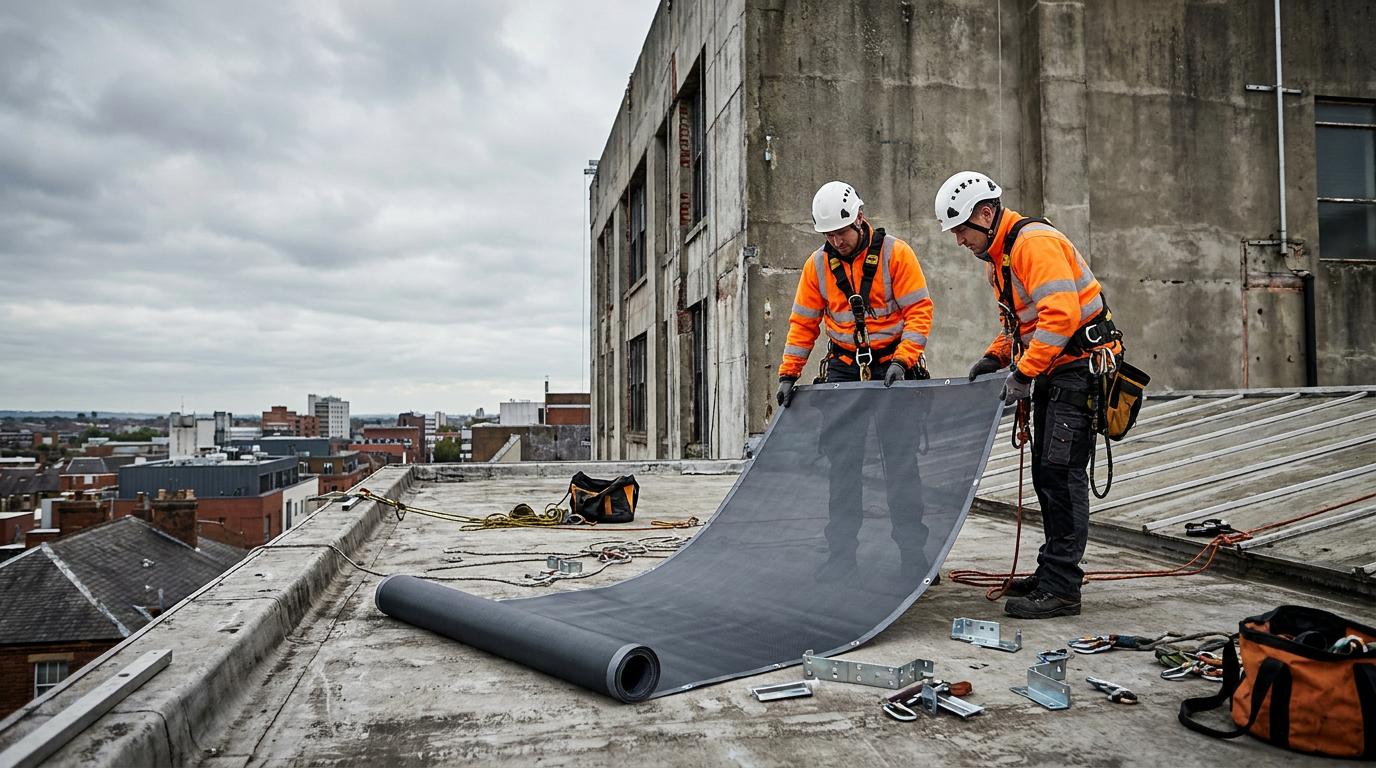
An incomplete brief is one of the most common – and at the same time easiest to eliminate – causes of problems in large-format advertising installations. Below you’ll find what good preliminary documentation must include – so the quote is reliable and the installation goes without surprises.
Why an incomplete brief leads to mistakes
A rope access company cannot reliably quote an installation without knowing the building and the advertisement format. Without this data, it can do one of two things: refuse to quote, or give a figure with a buffer for the unknown. Neither option serves the client – the first extends the process by another round of questions, the second shifts the risk of underestimation to the execution stage, where a price correction is far harder to accept than at the quoting stage.
The practical consequences of an incomplete brief:
- Inaccurate quote – the company assumes a standard scenario that may not match the specific building. A cost correction appears at the execution stage.
- Surprises on site – the crew arrives and it turns out the roof is locked, the facade is made of a material requiring special anchors, or the pavement under the wall is public and the zone needs to be marked off. Each of these situations means extra time and cost, and sometimes rescheduling to another day if the problem can’t be solved on the spot.
- Delays – if the company has to obtain missing information during the job, the deadline slips.
What the installation process itself looks like on the contractor’s side is described in the article Installation of large-format advertising on facades: process, requirements and rope access. Comparing that with the checklist below makes it easy to see why each piece of information is needed.
Section 1 – Building information
- Full address + identification of the specific wall – an address alone isn’t enough. Specify which wall is meant: a compass direction (east wall, the wall facing X Street) or a verbal description (front, gable wall, the facade facing the car park). On corner buildings or buildings with several wings, ambiguity leads to a quote for the wrong wall.
- Facade photos – a general shot showing the whole building and a close-up of the planned installation area. The clearer the documentation, the more accurate the assessment of the facade’s condition and the mounting options.
- Roof photos – a ground-level view showing the parapet, plus satellite images if available (e.g. from Google Maps). The roof is the point from which the crew secures itself during the work. The company needs to know what’s on the roof and what access looks like.
- Facade material, if known – mineral plaster, clinker, composite panels, glass, architectural concrete. Each material requires different tools and drilling technique, or a different mounting method. If you don’t know – say so, the company will assess it from the photos.
- Information about roof access – whether there is access to the roof, who holds the key (property manager, reception, building administration), whether access requires prior arrangement. A crew without roof access cannot start work.
Section 2 – Advertisement specification
- Dimensions – width x height in metres. Dimensions affect installation time, mounting requirements and whether the zone needs to be marked off.
- Advertisement format – PVC banner, mesh banner, illuminated or non-illuminated light box, 3D letters. These are four completely different technical operations – each format has different requirements for mounting points, the tensioning system and working time.
- Estimated weight – especially important for light boxes and 3D letters. If you don’t know the weight, give the dimensions and format – the company can estimate it.
- Mounting system, if known – the print shop or advertisement manufacturer sometimes specifies a particular hanging system (eyelets, aluminium profiles, lacing). If something like that has been specified, pass this information on to the contractor – it may change how the job is carried out or require consultation.
Section 3 – Execution conditions
- Execution deadline – a date or a time window. If the deadline is critical (a holiday campaign, a building opening), state this explicitly and give the final, non-negotiable date, not just an approximate month.
- Contact details for the building manager – who manages the building and how to reach them about access. The company may need to contact them directly before the installation.
- New advertisement or replacement of an existing one – a replacement may require prior removal, and the condition of the existing mounting points is unknown until the crew arrives on site.
- Pavement or road below the wall – whether the ground under the installation wall is publicly accessible (pavement, road, open car park). Work at height above publicly accessible ground requires marking off the zone, sometimes a temporary pedestrian diversion, and often affects the time and cost of the job.
Section 4 – Expectations after installation
- Post-installation documentation – whether you need photos of the completed work, an installation report, or other documents. Building managers often require a report as a condition of settlement. It’s better to agree on this before the installation than after.
- Installation warranty – ask what the warranty covers and for how long. The warranty usually covers the mounting work itself, not the advertising material, whose quality and durability are the print producer’s responsibility.
Example of a well-prepared brief
To show what this looks like in practice, below is an example of a complete request – in contrast to the one-sentence email from the start of this article: “Office building at ul. Piotrkowska 120 in Łódź, east wall facing the car park (3 photos attached: the whole building, a close-up of the wall, a view of the roof from street level). Facade – composite panels, graphite colour. Flat roof, access via the stairwell, key held by the administrator – contact details attached. Advertisement: PVC banner, 8m wide x 4m high, estimated weight around 25 kg, mounting on eyelets every 50 cm as recommended by the print shop. The pavement under the wall is publicly accessible and leads to the building’s side entrance. Deadline: second half of September, flexible within a two-week window. We need an installation report with a date and photos – required by the building manager.”
A brief like this lets the rope access company prepare a specific, not approximate, quote at the very first contact – without an extra round of questions and without the risk of underestimating the scope of work.
When the brief alone isn’t enough and a site visit is needed
Even the best-prepared written brief has its limits. On buildings with an unusual structure, facades in poor technical condition, limited roof access, or with very large advertisement formats, photos and a description may not capture every relevant detail – for example the condition of the specific points where mounting is planned, or the actual distance between the roof and the neighbouring plot boundary, which affects whether equipment can be set up.
In such cases, a reliable company, even with a complete brief in hand, will additionally propose a site visit before the final quote – not because the brief was incomplete, but because the scale or complexity of the job requires it. It’s worth treating such a proposal as a sign of the contractor’s diligence, not as an extra obstacle in the process.
Ready-made brief checklist – copy and fill in
- Building address and identification of the specific wall (compass direction or description)
- Facade photos: general shot + close-up of the installation area
- Roof photos: ground-level view + satellite images if available
- Facade material (if known)
- Roof access: who has the key, how to arrange entry
- Advertisement format: PVC banner / mesh banner / light box / 3D letters
- Advertisement dimensions: width x height
- Estimated weight (if known)
- Mounting system proposed by the print shop (if applicable)
- Planned execution deadline
- Contact details for the building manager
- New advertisement or replacement of an existing one
- Whether the pavement/road under the wall is public
- Expected post-installation documentation (photos, report)
Frequently asked questions
What if I don’t know the exact facade material?
That’s a normal situation, especially when the request is sent by an advertising agency rather than a building manager. Good close-up photos are usually enough for the rope access company to make an initial assessment of the material – final confirmation happens on site before work begins.
Does the brief have to be a formal document, or is a well-written email enough?
The format doesn’t matter – what counts is the completeness of the information. A well-structured email with attached photos does the job just as well as a formal document, as long as it contains all the elements from the checklist below.
Who should prepare the brief – the advertising agency or the building manager?
Usually it’s the advertising agency or the end client ordering the installation who gathers this information, but some of it – especially regarding roof access and facade material – often requires contact with the building manager. It’s worth involving both parties at an early stage to avoid delays.
Does a well-prepared brief guarantee a final, unchangeable price?
It increases the accuracy of the quote, but it doesn’t completely eliminate the risk of a correction if, on site, the building’s condition turns out to differ from what the photos showed. A complete brief reduces this risk to truly exceptional cases.
What a company cannot do without this data
Without information about the building and the advertisement format, the contractor cannot: reliably quote the time and cost of the work, plan fall protection and select the right equipment, assess whether the installation requires a site visit, or calculate how long the operation itself will take. The result: the quote is approximate or loaded with a buffer for the unknown.
A good brief is 15-20 minutes of work on the client’s side. In return – an accurate quote, a realistic deadline and no surprises on the day of installation. How to choose a reliable contractor after receiving offers is described in the article How to choose a company for large-format advertising installation – a checklist for investors.
It’s also worth remembering that a well-prepared brief speeds up not only the quote but the entire subsequent communication with the contractor. A company that sees complete data from the first contact can immediately plan logistics – select the right equipment, estimate the number of workers needed and book a realistic slot in the schedule, instead of provisionally blocking time “with a buffer” to clarify missing details. When requests for quotes are sent to several companies at once – a standard practice for larger advertising campaigns – an identical, complete brief sent to all contractors also makes it easier to compare offers fairly, since each company is responding to exactly the same input data.
Want to discuss the details of your job or have questions about the documentation you need? Get in touch with us – we’ll help you work out what’s needed before you send out a request for quotes, and if you prefer, we can arrange a site visit straight away instead of gathering data remotely. More about the service on the page advertisement installation and dismantling.
Author
Piotr Lankiewicz
Specialist in height work and rope access techniques. Owner of a company providing services in the most inaccessible locations nationwide. He prioritizes punctuality, strict health and safety standards, and solutions that save time and costs where the use of heavy machinery is impractical or not cost-effective.