

Window Cleaning in Multi-Storey Buildings: Challenges and Rope Access Solutions
The manager of an eighteen-storey building has two letters on the desk: one from the owners’ association, stating that the windows have not been cleaned for two years, and one from the main tenant, saying that the condition of the façade does not meet the standards of the premium office space they lease. On top of that, a building inspection is approaching. The window cleaning assignment may seem simple, but with a building of this height it involves a range of logistical and technical issues that do not occur in a typical three-storey property. This article explains what to pay attention to when planning window cleaning in high-rise buildings and why it is worth doing this before the assignment reaches the crew.
Why Do Tall Buildings Require Different Window Cleaning Planning?
For buildings of up to four storeys, window cleaning is a relatively simple logistical operation. Above a certain height, variables appear that require separate planning for each building.
Working time increases disproportionately. A rope access technician moving between sections on a tall building, installing ropes, and securing the work zone all take more time than on a low-rise property. The crew may clean fewer square metres per day not because they work more slowly, but because the logistics are more complex.
Weather conditions have a greater impact. At a height of 50 metres, wind may make work impossible even when conditions at street level seem calm. Scheduling the work must take into account a suitable weather window, not only at the moment of starting, but throughout the entire assignment.
Securing the area is more demanding. For tall buildings, the protection zone below the working crew must be marked out carefully. At greater heights, the potential fall range of an object increases. In a city centre, where there are pavements, pedestrian traffic, and car parks below the building, this requires more organization.
Coordination with building users is more complex. Eighteen storeys may mean a dozen or several dozen companies or residents. Each of them may have different requirements or restrictions concerning the presence of workers outside the windows.
Fixed Windows, Glass Façades, Loggias, and Difficult Access: Typical Problems
Tall buildings, especially those built within the last several years, combine different types of glazing, and each of them requires a different approach.
Fixed windows cannot be opened, so all cleaning is carried out from the outside. The rope access technician must have full rope access to every part of the window. In buildings where fixed windows dominate, working time is longer than with opening windows.
Structural glass façades consist of glass modules mounted on the supporting structure without visible frames. They are sensitive to mechanical damage and inappropriate chemicals. They require cleaning with demineralized water or precise manual cleaning, not pressure washing in a simple “top-to-bottom with a hose” approach.
Loggias and balconies are recessed into the building mass and often have limited rope access from the roof. They may require work from side ropes, additional safety anchor points, or an aerial lift. If loggias are occupied or used by tenants, coordination with them is required.
Windows in irregular façades, such as plinths, bay windows, recesses, and corners, each require a separate access solution. For the rope access crew, this is a matter of planning rope routes; for the property manager, it is a signal that working time will be longer than with a simple façade.
Sections inaccessible from the roof may occur in buildings with terraces, recessed sections, or technical installations blocking the roof edge. Parts of the façade may require access from another storey or the use of an aerial lift.
Weather Conditions and Planning the Work Window
Rope access window cleaning is outdoor work performed at significant height. Weather conditions directly affect whether the assignment can be carried out and the quality of the result.
Wind: rope work is possible only up to a certain wind speed, above which the technician cannot control their position on the façade or operate equipment safely. In tall buildings, this threshold may be reached under conditions that do not seem problematic at street level. Planning should take into account wind forecasts at the top of the building, not only at ground level.
Temperature: work at temperatures only a few degrees above zero requires additional precautions. Water freezing on the façade or on the rope is a hazard. At low temperatures, some chemical agents also lose effectiveness.
Rain and humidity: cleaning windows during rain or immediately after rainfall is ineffective, because rainwater contains contaminants that settle on freshly cleaned glass. Work should be planned for dry weather windows, with a margin for drying after cleaning.
Sun exposure: direct sunlight on the façade causes cleaning water to evaporate quickly before the rope access technician can remove it, which leads to streaks. Work on sun-exposed façades is planned for the morning or late afternoon, when the sun is at a different angle.
For assignments on tall buildings, it is worth agreeing a procedure with the contractor in case the weather changes during the work: when the work is suspended, how the crew returns, and whether this involves additional costs.
How to Reduce Inconvenience for Residents, Tenants, and Employees
The presence of rope access technicians outside windows is something most building users are not used to. Lack of information leads to complaints, interruptions, and organizational complications.
Advance communication: information should be sent to all tenants and residents at least three to five days before the work. The message should include the date, working hours, information that workers will appear outside the windows, and a request to move curtains and blinds away from the windows.
Section-by-section schedule: if the building has many storeys occupied by different tenants, it is worth agreeing a section-by-section schedule with the crew, indicating which level will be cleaned on each day. Companies dealing with sensitive data or specific security requirements may need advance notification of the exact date when their floor will be cleaned.
Contact availability: appoint a contact person who will be available throughout the working day. The crew coordinator must be able to resolve operational situations quickly, such as asking a resident to open a window or informing reception staff about a route change.
Securing the external area: barrier zones at entrances, pavements, and car parks require visible marking and user notification. In tall city-centre buildings, coordination with the road authority or municipal police may be required if the barrier zone occupies part of a public pavement.
A detailed description of building preparation procedures and tenant communication can be found in our article on how to prepare a building for window cleaning.
Rope Access vs. Aerial Lift for Tall Buildings
For multi-storey buildings, the choice of access method has a significant impact on cost and completion time.
Rope access is the method most commonly used for tall buildings with an accessible roof. The technician works from ropes anchored on the roof, moving vertically and horizontally across the façade. This method does not require equipment standing next to the building or a large operating area at ground level. Its limitations include the need for certified safety anchor points on the roof, sensitivity to wind, and reduced working speed on very complex façades.
A telescopic or boom lift is operationally fast for low and medium storeys, up to approximately 30–40 metres with typical machines. For buildings above this reach, specialist lifts are available, but their cost and logistics usually exceed what is justified for typical assignments. An aerial lift requires free space next to the building, hardened ground, and the possibility of deploying stabilizers. In city centres, dense development, or areas with hedges, it is often impossible to use.
A façade gondola, or BMU, is the natural access method for buildings with an installed gondola system. Operating a gondola requires operator qualifications and regular equipment inspections. If the building has a gondola, the contractor should be able to use it or coordinate work with the building’s technical services.
A detailed comparison of access methods, including the costs and limitations of each, is described in our article on what to choose: rope access, aerial lift, or scaffolding.
Work Safety and Securing the Area Below the Building
Safety during work at height is the contractor’s obligation, but the property manager also has their own area of responsibility.
On the contractor’s side:
•IRATA qualifications for every rope access technician working on ropes;
•certified equipment, including ropes, harnesses, descenders, and fall protection equipment;
•third-party liability insurance covering work at height;
•a work plan that includes hazard identification and protection of the work zone.
On the property manager’s side:
•ensuring access to the roof and certified safety anchor points;
•informing building users and security;
•enabling barriers to be set up around the building;
•coordinating with the road authority or other entities if the protection zone extends into public space.
Liability for an accident during work at height depends on the circumstances and on the scope of obligations of each party. With a well-prepared assignment and a verified contractor, the property manager’s risk is limited to their own omissions, not the crew’s negligence.
Documentation, Acceptance, and a Recurring Cleaning Schedule
After the assignment is completed, it is worth ensuring proper documentation, both for internal needs and in case of inspections or disputes with tenants.
Post-assignment documentation should include:
•a work completion protocol specifying the date, scope, crew, and method;
•contractor comments on the technical condition of the façade, such as cracked seals, loose panes, or corrosion marks on frames;
•before-and-after photographic documentation, especially for specialist or post-construction cleaning;
•an invoice with a description of the scope of work.
Quality acceptance: for large façades, acceptance should be carried out with a person appointed by the property manager, preferably under different lighting conditions, such as in the morning or evening, when angled sunlight reveals streaks. Any corrections should be agreed immediately, not several days later.
Recurring schedule: for tall commercial buildings, two to four services per year are standard. A schedule agreed in advance allows the property manager to plan tenant communication and budget costs. Under a service agreement, the contractor reserves dates and already knows the building’s specific characteristics, which reduces preparation time for each subsequent project.
When Is It Worth Ordering Permanent Building Service?
Window cleaning as a one-off assignment makes sense for new buildings or in connection with a specific event, such as building handover, an inspection, or a tenant change. For buildings in regular use, a permanent service arrangement is more efficient and often cheaper per service.
Permanent service provides:
•cost predictability, with an agreed price per cycle and no need to negotiate each assignment;
•crew availability on agreed dates, without the risk that no crews are available during the peak season;
•knowledge of the building, as the crew knows where keys are kept, how access is configured, and what specific difficulties exist;
•continuity of technical monitoring, as the contractor reports changes in the façade condition noticed during each service.
This is justified in particular for:
•buildings above six to eight storeys with a large glazed area;
•facilities with aesthetically demanding tenants, such as law firms, financial companies, or hotels;
•buildings located by busy streets or near construction sites, where dirt accumulates quickly;
•properties where the manager does not want to allocate internal resources to coordinating every assignment separately.
If you manage a multi-storey building and would like to discuss a service schedule or a one-off assignment, request a consultation for your property. Send photographs of the façade and information about the number of storeys, and we will return with an initial assessment and proposal.
You can find more information about rope access window cleaning in multi-storey buildings on the service page. We describe indicative pricing and the variables affecting quotations in our article on the cost of rope access window cleaning.
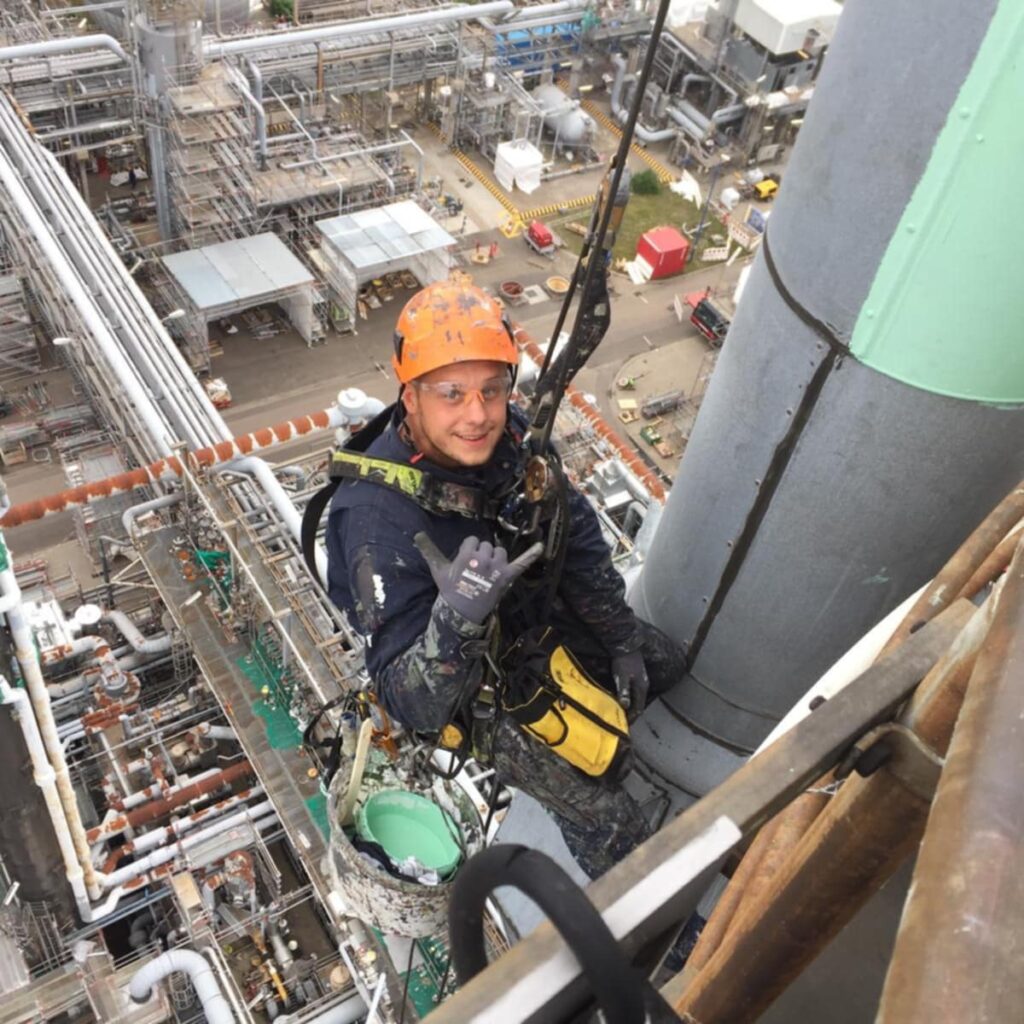
Author
Piotr Lankiewicz
Specialist in height work and rope access techniques. Owner of a company providing services in the most inaccessible locations nationwide. He prioritizes punctuality, strict health and safety standards, and solutions that save time and costs where the use of heavy machinery is impractical or not cost-effective.