Safety of Roof-Level Work at Height – Standards and Procedures Every Property Manager Should Know
A company servicing a lightning protection system is about to send a crew onto the roof of a 12-storey office building. The property manager gives approval, hands over the key to the technical stairwell, and goes back to other matters. Is that enough? And if a worker loses their fall protection during the job and an accident happens – what should the property manager have done, and what did they fail to do? Questions about the property manager’s role in organising roof work don’t have one simple answer. But there are a few things worth knowing before the next company drives onto the site.
Legal Basics: When Fall Protection Is Required
The Regulation of the Minister of Labour and Social Policy of 26 September 1997 on General Occupational Health and Safety Requirements sets out the obligations for work at height. Work at height is defined as work performed more than 1 metre above ground or floor level – and this kind of work requires fall protection to be provided.
This is an important distinction for a property manager: the regulations don’t apply only to rope access technicians or roofers working at the edge of the roof. They apply to every worker performing tasks above 1 metre. If a service company sends a technician onto a roof without protection, it is breaching regulations that are not a matter of goodwill but a legal obligation.
The property manager is not the employer of external companies, but is the owner or administrator of the site where the work is carried out. That creates specific obligations – described further below.
Standards for Anchor Points and Fall Arrest Systems
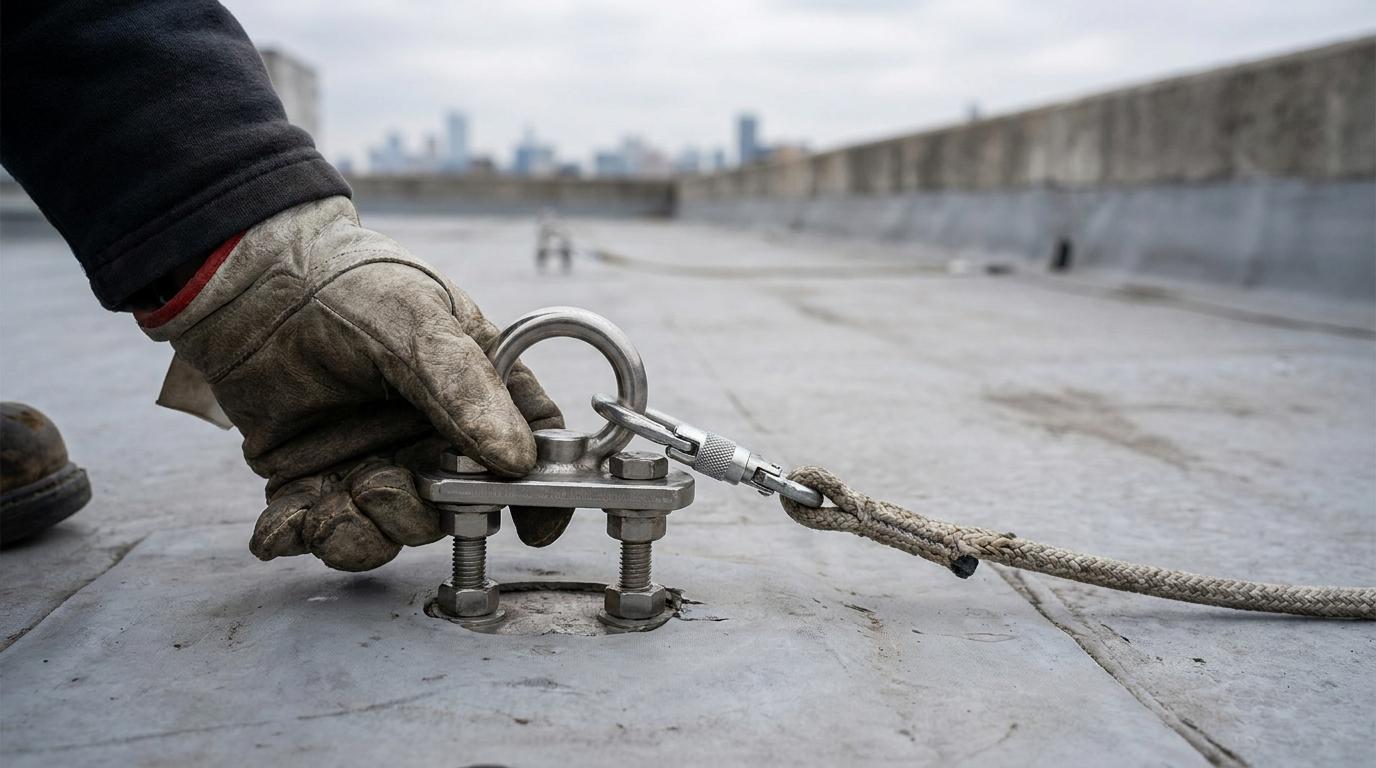
A technician working on a roof needs a point to attach their safety line to. That point – the anchor – cannot be just anything. Standards define the requirements that anchor devices must meet:
- PN-EN 795 – anchor devices: Defines classes of anchor devices – from single anchor hooks (Class A), through horizontal rails (Class C), to horizontal rope-type systems (Classes D and E). The standard specifies the required strength and rules of use for each class. A device certified to this standard must withstand the dynamic loads generated when arresting a fall.
- PN-EN 363 – fall arrest systems: This standard describes how the individual components of a fall protection system – ropes, connectors, harnesses, energy absorbers – are meant to work together. It is a standard for the whole system, not just its individual parts.
For a property manager, these standards have practical implications: what matters most is whether the roof of their building has permanent anchor points installed that meet these requirements. If it does, the rope access company can use them. If not, the company has to install temporary anchors. That affects how long the job takes to prepare and how it is organised.
Collective vs. Individual Protection – What’s the Difference
OHS regulations provide for two basic approaches to fall protection, and the hierarchy between them has practical significance for a property manager planning roof work. Collective protection – permanent railings, balustrades, safety nets – protects every person present in a given zone, regardless of whether they remember to clip in their harness. Individual protection – ropes, harnesses, anchor points – requires every worker to use the equipment correctly, and is always a secondary solution, applied where collective protection cannot be used.
For a property manager, this offers a concrete pointer when planning roof investments: if the building has zones regularly visited by different service crews (air conditioning, ventilation, lightning protection, antennas), it’s worth considering installing permanent railings or balustrades along frequently used access routes, instead of relying solely on individual protection arranged by every company that comes along. It’s an investment that pays off through lower risk and shorter preparation time for every subsequent service visit to the roof.
Certification and Inspections of Fall Arrest Systems
Permanent anchor points and safety lines on a roof are not a “once and done” installation – the manufacturer specifies a schedule of periodic inspections, and the inspection should be carried out by a person qualified to do so, not by whichever service company happens to use the system while carrying out other work. In practice, no current inspection means the property manager has no certainty that the system will hold under load in the event of a real fall – which defeats the purpose of having it.
Good practice is to keep a separate record card for the roof’s fall protection system in the building’s technical documentation – with the installation date, the type of anchor devices used, the inspection history, and the details of the company that carried them out. Such a card also makes it easier for every subsequent company working on the roof to quickly assess what they can use, without having to rebuild that knowledge from scratch each time.
What a Property Manager Should Know About Their Building’s Roof
A property manager who allows external companies to work on the roof should have answers to several questions:
- Are there permanent fall protection systems on the roof? A horizontal safety line along the roof edge, point anchors, rail systems – if they exist, where are they located and how many people can they protect at the same time.
- When was the system last certified? Permanent fall protection systems require regular inspections and certification by a qualified person. The inspection should be documented – an inspection report is a document the property manager should have in the building’s technical documentation.
- Who keeps the documentation for the fall protection systems? In management offices and ownership companies, knowledge about existing installations is sometimes incomplete – particularly for older buildings or after a change of property manager. If this documentation doesn’t exist, it’s worth reconstructing it at the next opportunity for roof servicing.
- What known hazards exist on the roof? Edges without railings, unstable sections of the roof covering, live installations, skylights – anything that could pose a risk to a worker should be known to the property manager and communicated to the company before they access the roof.
A Property Manager’s Obligations When Organising Roof Work
As the owner or administrator of the site, the property manager has the role under OHS regulations of the party responsible for coordinating work at their property. In practice, this means several specific things:
- Informing about hazards: Before the company accesses the roof, the property manager should provide information about known hazards – arising both from the structure and installations, and from the current technical condition of the site. If part of the roof is unstable, if there’s a live electrical installation near the work zone – the company needs to know.
- Providing access and control: The property manager provides access to the roof while also ensuring that unauthorised persons do not enter it while work is underway. Blocking access for other building users while the job is being carried out is an organisational obligation that rests with the property manager.
- Coordinating with other contractors: If several companies are working on the roof or facade at the same time, the property manager is responsible for ensuring their activities don’t conflict with each other in a way that creates a hazard. Two crews working on the same roof without knowing where the other is positioned is a scenario that simple organisation can avoid.
- Verifying the contractor’s qualifications and insurance: The property manager has the right – and it’s worth exercising it – to ask for documents confirming the crew’s qualifications and a public liability policy covering work at height. This isn’t excessive caution, it’s basic protection of your own interests.
The Health and Safety Plan (Plan BIOZ) – When It’s Required and When It’s Worth Having
A Health and Safety Plan (Plan BIOZ) is required for construction works that meet certain conditions – among others, work at height above 5 metres, work lasting longer than 30 working days, or exceeding 500 person-days. This is governed by the Polish Construction Law (Prawo budowlane) and the 2003 Regulation of the Minister of Infrastructure.
For standard service work on a roof – cleaning, inspection, minor installation repairs – a Plan BIOZ is not formally required. It’s worth knowing, however, that a well-prepared company draws up its own risk assessment documentation before every job on a roof. This is a work plan that covers hazard identification, division of tasks, and emergency procedures. It’s not a Plan BIOZ in the legal sense, but it serves a similar function.
If the company you’re inviting onto the roof has no work planning documentation at all, it’s worth asking how they organise safety on site. The answer will tell you a lot about who you’re dealing with.
Liability in the Event of an Accident on the Roof
If an accident occurs during work on a roof, the post-accident investigation examines not only the actions of the worker and their employer, but also whether the property manager fulfilled the information and organisational obligations described above. If the property manager knew about an unstable section of the roof covering and did not pass that information to the company before work began, this can be considered a contributing factor to the incident, regardless of whether the company itself also made a mistake in securing the worker.
That’s why the documentation discussed later in this article – reports, fall protection system record cards, confirmations that hazard information was communicated – matters far beyond simply organising the work. It’s evidence that, in the event of proceedings, can determine whether liability is limited to the contractor or also extends to the party managing the property.
Documentation After Roof Work
After work on the roof is completed, the property manager should have several things in the site’s documentation:
- Work completion report: Date, scope, company, the people who worked. A document confirming that the commissioned work was carried out and accepted, also useful as a basis for settling common-area service costs with tenants.
- Photos from the job: Especially important for work that affects elements of the roof structure, covering, or installations. Before-and-after photos are evidence of a condition that’s difficult to dispute later.
- Notes on the roof’s condition: A good service company reports what it noticed while carrying out the job – damaged sections of the covering, corrosion risk at installation penetrations, loosened elements. Such information, passed on in writing or by email, should go into the building’s documentation.
- Confirmation of the fall protection systems’ condition: If the crew used permanent anchors or lines on the roof, it’s worth confirming their condition after the work. Any damage during the job should be reported by the contractor and repaired before the next use, not discovered only at the next job by a completely different company.
Documentation of roof work is not a bureaucratic obligation – it’s evidence of the property manager’s diligence, built up systematically after every subsequent job. In the event of a dispute with a tenant, a building inspection, or an insurance incident, these are documents that carry real weight, and their absence is hard to make up for after the fact, once an inspector or insurer is already asking the questions.
You can read more about OHS issues when commissioning work at height, and what to require from an industrial climbing company, in the article What an Industrial Climbing Company Must Meet Under Polish OHS Regulations – A Guide for Property Managers.
If you have questions about organising work on your building’s roof, want to check the condition and certification of anchor points before commissioning a job, or are considering installing a permanent anchor system for future servicing – get in touch with us. Call or write, we’re happy to discuss the specifics of your site before quoting. You can find out more about work at height on buildings on the page about our quotation process and site visits.
Author
Piotr Lankiewicz
Specialist in height work and rope access techniques. Owner of a company providing services in the most inaccessible locations nationwide. He prioritizes punctuality, strict health and safety standards, and solutions that save time and costs where the use of heavy machinery is impractical or not cost-effective.