How to Choose a Roof Snow Removal Company – Criteria and Questions Before the Season
October. There’s no snow yet, but the technical manager of a homeowners’ association on Robotnicza Street knows that by December the phone will be ringing off the hook. Last year he tried to find a company during heavy snowfall – everything reliable was already booked. He ended up with a company “recommended by a friend,” with no contract and no report. The roof got cleared, but there was zero documentation. Now he’s looking early – and that’s exactly the right approach.
Choosing a roof snow removal company is a decision worth making before the season, not during it. Below you’ll find specific criteria and questions that will let you evaluate a contractor before the first snow falls.
Why choosing before the season is critical
During a snowstorm there’s no time for verification. Experienced companies with their paperwork in order have full schedules from November onward. What’s left are random operators – companies set up for a single season, crews without qualifications, uninsured contractors. Under time pressure, managers skip verification and hire these contractors anyway. The result: the work gets done, but without a report, without a policy, without any documentation that would protect the manager in the event of a claim.
Verification takes time. Checking the liability policy, discussing experience, negotiating the contract – this requires at least a few days. In October you have that time. By mid-January – you no longer do.
There’s another argument for choosing early that’s easy to overlook: reliable companies, like any work-at-height contractor, have a limited number of trained and experienced staff. Signing a seasonal contract early means your building gets entered into the priority schedule before competitors chasing the same pool of workers do. Managers who wait for the first snowfall are competing not just on price, but directly on availability – and at the peak of the season, the advantage goes to those who acted early.
Six criteria for choosing a company
- Qualifications for working at height: Roof snow removal is work at height. Company staff should hold occupational health and safety training for work at height, qualifications to operate fall-protection equipment, and current medical clearance. Ask about the certificates of specific employees, not just general assurances from the company.
- Liability insurance: The contractor’s liability policy should cover work at height with a coverage amount appropriate to the value of the building. A building with a glass facade and a roof full of installations requires a higher coverage amount than a simple flat roof. Check that the policy is current – a photo from last season isn’t enough. For more on what questions to ask about liability insurance during verification, see the article Liability insurance for a work-at-height company – what should you ask the contractor.
- Experience with your type of roof: A flat roof, a pitched roof, and a roof with a parapet, skylights, or installations are entirely different challenges. A company that has only ever cleared simple flat roofs may not have a proven, well-established procedure for a more complex pitched roof with chimneys and other obstacles. Ask directly: have they worked on a similar building before? Can they provide a reference project?
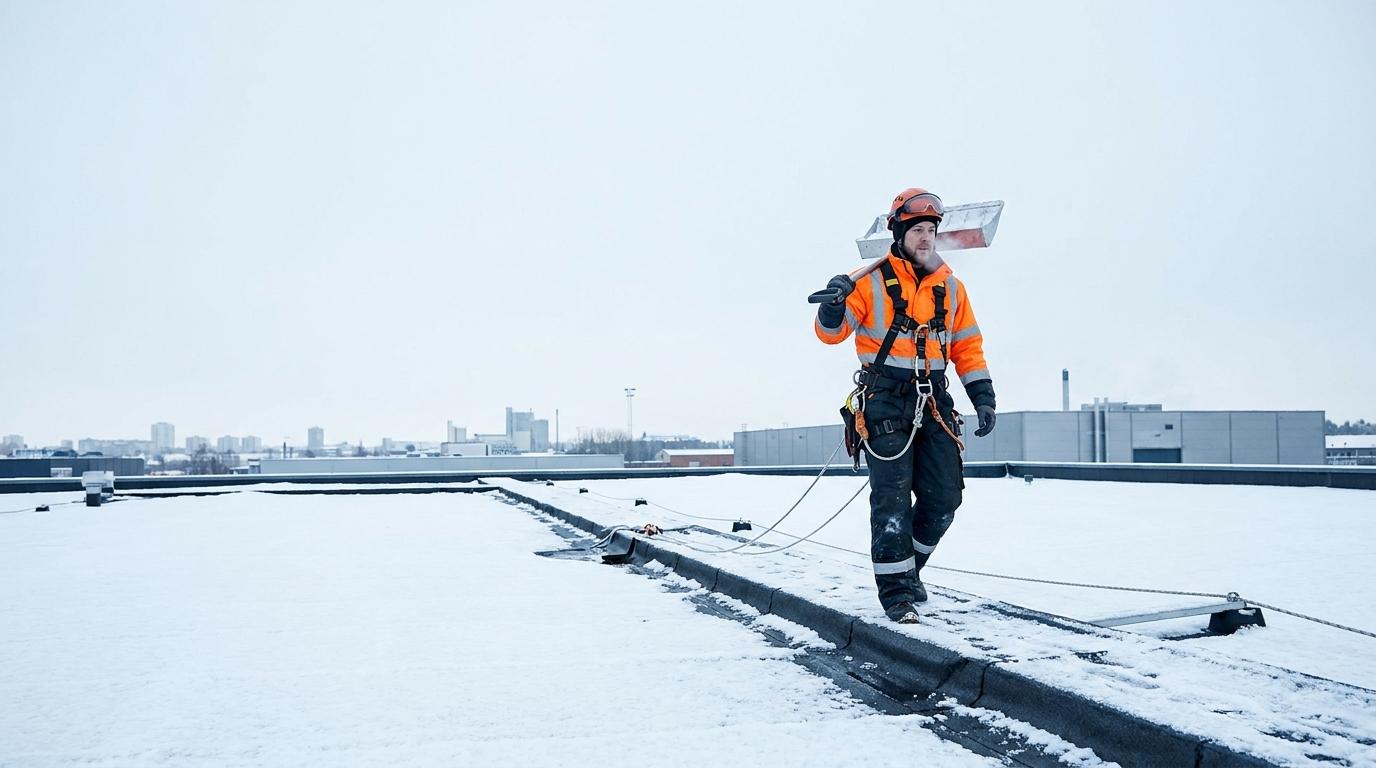
- Equipment and fall-protection methods: Their own ropes, harnesses, anchor points – that’s the minimum. Red flag: a company that promises “fast snow removal without unnecessary formalities.” In practice this often means working without fall protection. Damage caused by an unsecured worker falls legally on the property manager.
- Response time: Can the company arrive within 24 hours after heavy snowfall? What’s the maximum waiting time during peak season? For buildings with glazed roofs or structures sensitive to snow load, response time is critical.
- Documentation after the work: Does the company issue a report after every snow-removal job, with a date, scope of work, and the worker’s signature? This report is your evidence of due diligence. Without it, in the event of a claim, you can’t prove you took action. For more on the property manager’s legal liability, see the article Roof snow removal – when is the manager legally liable.
How to prepare the building before the season, even before you choose a company
Before you start comparing offers, it’s worth preparing some information about the building itself – this shortens the verification process and lets the company put together a realistic quote right away, instead of having to ask about the basics at a stage when time matters. A useful outline of the roof structure helps: whether it’s flat or pitched, what its surface area is, whether it has skylights, chimneys, photovoltaic installations, or other elements that need to be carefully avoided. It’s also worth establishing the roof’s permissible snow-load capacity – this information should be in the building’s technical documentation, and if it’s missing, that’s a signal to have it reconstructed before the season, ideally with the help of a structural designer or a company that will carry out an inspection.
It’s also good to establish in advance who in the building has access to the roof and keys to the hatches, so that on the day of the intervention no time is lost looking for someone authorized to open access. In many buildings – especially older ones – it’s precisely the access logistics, not the lack of a company, that ends up being the biggest delay in an urgent snow-removal situation.
How to evaluate several offers – what to look at besides price
With snow removal, as with other work-at-height services, the price per square meter alone says little without context on the scope of the service. It’s worth comparing offers based on exactly what they include: whether the price covers only snow removal, or also removing ice buildup from gutters and eaves, whether it includes urgent interventions without an extra surcharge, and finally whether it includes a photo report from each job.
It’s also worth asking how many crews and workers the company can deploy when there are simultaneous requests from different clients at the peak of the season – this question reveals whether a seasonal contract actually guarantees you priority, or is just a formality with no real backing in the company’s resources. A reliable contractor should be able to answer this question specifically, not with a vague assurance of “we’ll manage.”
Common mistakes when choosing a snow removal company
- Choosing at the last minute, under pressure from the first snowfall – results in limited choice and accepting a contractor without full verification, as in the example at the start of this article.
- Relying solely on the lowest price – with snow removal, as with other work-at-height services, a drastically lower price usually means skipped insurance costs or hiring people without proper qualifications.
- No written contract specifying response time – a verbal assurance of “we’ll come quickly” means nothing if the contract contains no specific time commitment.
- Poorly planned order of interventions across several buildings – if you manage several buildings, it’s worth agreeing with the company in advance on the order in which they’ll be handled in case of simultaneous demand, instead of figuring it out on the fly during a snowstorm.
Questions to ask a company before signing a contract
Specific questions worth asking every candidate:
- “What qualifications do your employees hold for working at height?” – Not “do you have qualifications,” but “specifically which ones.” Ask for the names of certificates or training courses.
- “Can I get a copy of your current liability policy before signing the contract?” – A reliable company will send the policy without hesitation.
- “Have you worked before on a roof with a structure similar to ours? Can you provide references?” – A roof with a parapet and skylights is a different category of difficulty than a simple flat roof.
- “What response time can you guarantee after overnight snowfall?” – Check whether the answer is specific (hours), not general (“quickly”).
- “Do you issue a report after every snow-removal job?” – A company that doesn’t do this doesn’t understand what you need as a manager responsible for the building’s safety.
- “How do you ensure the safety of pedestrians while working on the roof?” – Securing the zone below the roof is standard. An answer like “we tape off the entrance” is acceptable as part of the procedure, not as the only procedure.
Seasonal contract or per-intervention contract – which to choose?
A seasonal contract assumes ongoing cooperation throughout the entire winter season. The company has your building in its schedule, knows the roof, has established procedures. You pay a flat fee or a rate for each intervention under the contract. This solution works well for buildings with roofs sensitive to snow load, or for managers who don’t want to handle organizing things every single time.
A per-intervention contract means you call when there’s a need and agree on terms as you go. Flexibility is greater, but you have lower priority in the company’s schedule and every job requires a new order. This solution works if you have a list of verified companies and confidence that in an urgent situation you’ll find someone reliable. You can read about how to verify a company once winter has already started in the article How to verify a snow removal company on an urgent basis.
For most managers responsible for several buildings, or buildings with structurally sensitive roofs – a seasonal contract is the safer choice.
It’s also worth remembering that the decision doesn’t have to be binary. Some managers combine both approaches – a seasonal contract for priority buildings, where the risk of structural overload is real, and a list of verified intervention contacts for the remaining, lower-risk buildings. This model requires a bit more organization at the start of the season, but it provides budget flexibility without sacrificing safety where it’s needed most.
Frequently asked questions
Does a seasonal contract guarantee snow removal within a specific time?
It should – if the contract doesn’t include a specific commitment on response time, the name “seasonal” alone doesn’t mean much. Always specify the maximum response time in writing, ideally with a distinction between standard and urgent situations.
Can one company handle several of my buildings at the same time during heavy snowfall?
It depends on the company’s resources – this is one of the questions worth asking directly at the contractor-selection stage, to avoid a situation where all your buildings are waiting in line at the same time.
Is it worth signing a contract with more than one company?
For a large number of buildings, or buildings especially sensitive to snow load, this is a reasonable safeguard – provided both companies know about this arrangement and don’t treat you as lower priority because of it.
What if the company I have a seasonal contract with doesn’t answer the phone during heavy snowfall?
This is the most serious red flag, one that can only be detected in practice – which is why it’s worth checking references at the selection stage from other managers who worked with the company throughout an entire season, not just for a one-off job.
Snow removal costs – how much does it cost?
If you’re interested in indicative market rates and what affects the price of the service, you’ll find the details in the article How much does roof snow removal cost.
Next step
If you’re looking for a company to remove snow from a roof in Łódź and the surrounding area, we can arrange an on-site visit, assess the condition and accessibility of anchor points on the roof, and prepare a quote before the season. The earlier before the season you get in touch, the easier it will be for us to set a priority slot for your building. Call or write – you’ll find more information about the service on the page Rope Tech roof snow removal.
Author
Piotr Lankiewicz
Specialist in height work and rope access techniques. Owner of a company providing services in the most inaccessible locations nationwide. He prioritizes punctuality, strict health and safety standards, and solutions that save time and costs where the use of heavy machinery is impractical or not cost-effective.