Roof Snow Removal – When Is a Property Manager Legally Liable for Snow and Icicles?
February. An icicle falls from the roof of an apartment building managed by a homeowners’ association on Piotrkowska Street and hits a parked car. The car’s owner photographs the damage, notes the building’s address, and a few days later the property manager receives a demand for compensation. The manager’s question: “Am I even liable for this?” The answer: it depends on the specific circumstances of the case and what the manager did beforehand – but in most cases described in this article, yes.
A property manager’s legal liability for the condition of a roof during the winter season stems from several legal acts and is not a matter of interpretation, but of obligation. Below we explain when this liability arises, what limits it, and how documentation protects the manager better than any standalone insurance policy taken in isolation from the actual actions taken before the incident.
Legal Basis for the Manager’s Liability
Liability for the consequences of an uncleared roof or icicles left in place stems from several regulations that operate together:
- The Act on Ownership of Premises: The management board of a homeowners’ association is obligated to maintain common property in a condition that ensures the safety of users and third parties. The roof is part of the common property – its condition in winter falls under this obligation.
- Civil Code, Article 415: Anyone who, through their own fault, causes damage to another is obliged to repair it. In the context of property management: if the manager knew or should have known about a hazard (e.g., an icicle above an entrance visible from the street) and failed to take action – they are acting at fault. The key standard here is “due diligence.”
- Building Law Act, Article 61: The owner or manager of a building structure is obliged to maintain and use it in a manner consistent with its intended purpose and environmental protection requirements, and to keep it in proper technical and aesthetic condition, preventing excessive deterioration of its functional properties and technical-operational efficiency. A hazard from snow or icicles constitutes a breach of this safety condition.
When the Manager Is Liable
Liability is not automatic – it depends on whether the manager “knew or should have known” about the hazard and whether they took action appropriate to that hazard.
Practical cases where the manager’s liability is clear:
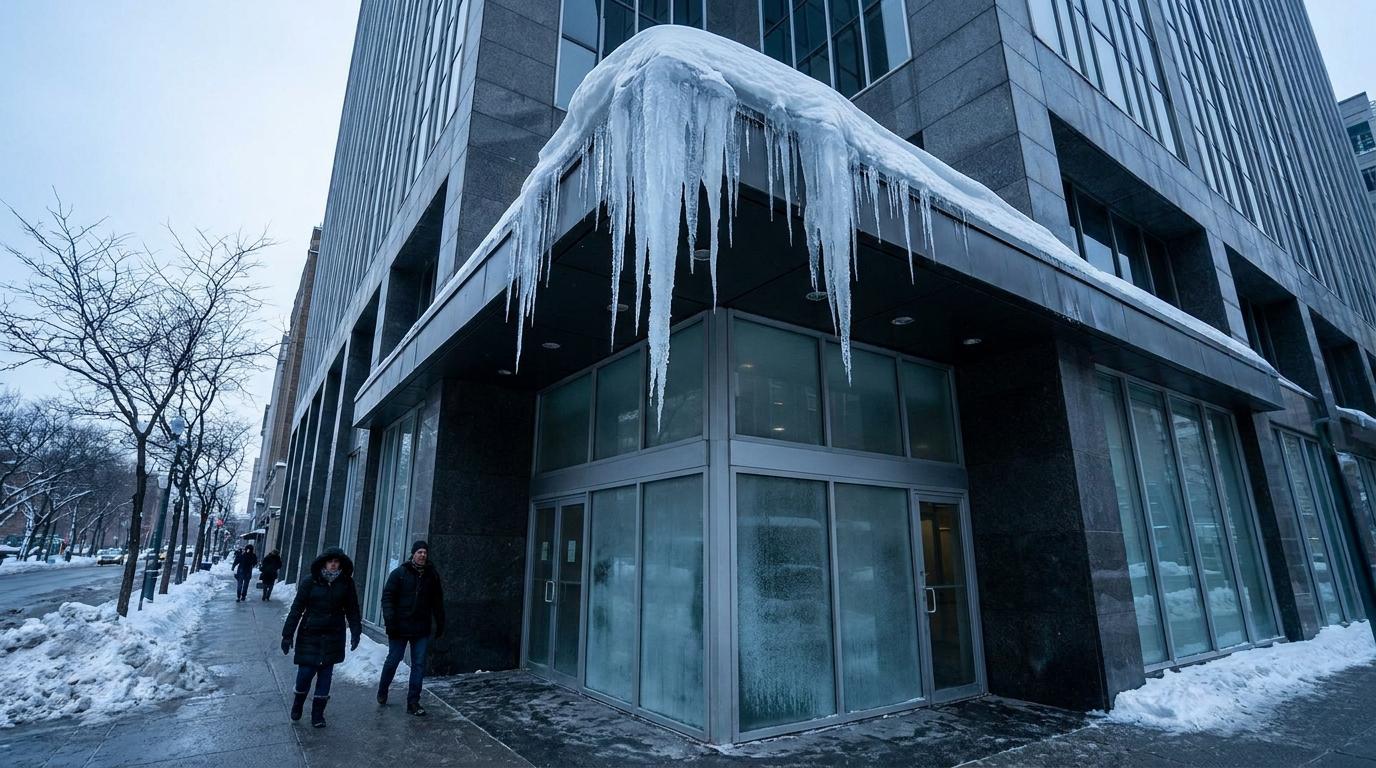
- An icicle above the building’s main entrance, visible from the street – the manager should have known, even if they were not on site.
- A roof left untouched after several days of snowfall, with no action from the manager – a failure to respond to an objective hazard.
- A prior report of the problem from a resident or another manager – documentation of the report creates evidence that the manager knew about the hazard.
Liability is less clear-cut or excluded when the manager took action promptly after the hazard arose and has this documented.
It’s worth emphasizing that “promptly” does not mean “immediately” in practice – a court or insurer assessing the case takes into account the manager’s real organizational capabilities, including the availability of contractors at that point in the season. A manager who requested snow removal within a reasonable time of the hazard appearing and had difficulty finding an available company – and can document this, for example with a record of attempts to contact several contractors – is in a completely different position than one who took no action for a week despite contractors being available on the market.
Building Insurance and the Manager’s Liability
The property’s liability insurance policy, which most associations and managers hold, does not automatically release them from liability or replace due diligence in managing the building. The building’s insurer covers damages arising from events covered by the policy, but if gross negligence on the manager’s part is demonstrated – for example, weeks of failing to respond to a reported hazard – the insurer may refuse to pay out or pursue a recourse claim against the manager who allowed the damage to occur through inaction.
For this reason, the property’s liability insurance and the manager’s documentation of their actions are two complementary safeguards, not substitutes for one another. The first covers the financial consequences of an incident; the second protects the manager themselves against an accusation of negligence that could void the insurance coverage or direct the claim straight at them as the person responsible for overseeing the building.
How Contracting a Certified Company Limits Legal Risk
Commissioning roof snow removal or icicle removal from a company with proper qualifications, liability insurance, and a completion report builds the manager’s “documentation shield.” Working through this scheme:
- The manager identifies the hazard.
- The manager commissions a qualified company to remove the hazard.
- The company performs the work and issues a completion report.
- The manager archives the report and the order.
…shows that the manager exercised due diligence. In the event of a claim, they have evidence of action taken – and liability for the performance of the work itself, including any damage occurring directly during the execution of the order, passes to the contractor and its liability insurer.
If, on the other hand, the company had no insurance or its staff worked without proper qualifications, and damage occurred during their work, the manager may be held jointly liable for choosing an unsuitable contractor. This is another argument for verifying a company before commissioning it, described in detail in the article How to Choose a Roof Snow Removal Company – Criteria Before the Season.
What Protects the Manager – Documentation Step by Step
- A contract or written order: Proof that the manager made the decision to commission the work and passed it to the contractor. A seasonal contract or a one-off order by email – both are sufficient, as long as they include the scope of work and the building’s address.
- A completion report after every snow removal: Date, scope of work, employee name, or company stamp. Without a report, the manager cannot prove that the work was performed on a specific date.
- A copy of the contractor’s current liability insurance policy: If the company causes damage while working on your building, its liability insurance covers the claim – but only if the manager can prove the company was insured. Request a copy of the policy before every season.
- Photographic documentation of the roof’s condition: Photos before and after snow removal or icicle removal. Optional, but helpful in disputes over the scope of work or the property’s condition.
What the Process Looks Like After a Damage Claim Is Filed
When the injured party files a claim – as in the example of the damaged car at the beginning of this article – the process usually unfolds in several stages. First, the injured party gathers evidence: photos of the damage, witnesses, sometimes an appraiser’s opinion estimating the cost of repair. They then direct the claim to the manager or directly to the manager’s liability insurer. In response, the manager should present their own documentation – evidence that they took action appropriate to the hazard, including the contract with the contractor, reports from recent interventions, and the history of reports concerning the building in question.
It is precisely at this stage that the real value of documentation gathered systematically throughout the season becomes apparent. A manager who has a complete set of reports and can demonstrate a regular service cycle is in a completely different position than one who relies solely on memory or the contractor’s verbal assurances. In practice, disputes of this kind rarely go straight to court – most are resolved during negotiations between the two parties’ insurers, where documentation determines who actually bears the cost of the damage.
The Most Common Mistakes Managers Make
- No written contract: A verbal order is difficult to prove. An email, text message, or form is enough – as long as a documentary trace exists.
- No reports after every snow removal: Managers often have a report from the company’s first visit but then stop requiring one. In reality, every intervention should be documented separately.
- No verification of the company’s liability insurance: Managers assume the company “surely has insurance.” That assumption – not a document – is useless in the event of a claim.
- Commissioning an unknown company without any verification: Particularly risky in urgent situations – we cover how to verify a company even under time pressure in the article How to Verify a Snow Removal Company on an Urgent Basis.
The Role of Reports from Tenants and Residents
A hazard report from a tenant, resident, or passerby carries significant legal weight, because once it has been received, it becomes difficult to claim that the manager “didn’t know” about the problem. It is therefore worth having a clearly established, simple channel for reporting such situations – a phone number, email address, or a form on the building’s website – and consistently documenting every report with a date and description of the situation, regardless of whether it seems urgent at the time.
It happens that managers treat such reports informally – a verbal conversation in the elevator, a message in a residents’ group chat that no one archives. Yet it is precisely the timing and manner of the hazard report that can prove decisive in proceedings following damage: if the manager received a report three days before the incident and did nothing about it, it is difficult for them to claim they had no knowledge of the hazard. A simple log of reports – even in the form of a spreadsheet with date, description, and response status – costs little time and significantly strengthens the manager’s position in the event of a dispute.
Icicles – a Separate Category of Hazard
Icicles require a faster response than snow, because they form dynamically during a thaw and can fall without warning. A manager who sees an icicle above a building entrance and takes no action cannot later claim they “didn’t know about the hazard.” We cover when icicles become a legal hazard and how to respond correctly in the article Icicles on a Building – Legal Hazard and Response Procedure.
Frequently Asked Questions
Is the manager liable if the damage was caused by snow blown off by wind without human intervention?
Liability depends on whether such a risk could have been foreseen and whether the manager took reasonable preventive measures – for example, cordoning off the hazardous area beneath the roof during periods of heavy snowfall. A complete lack of response to a known risk is harder to defend than a documented attempt to secure the area.
Do the homeowners’ association and an external manager share liability, or are they liable separately?
Usually it is the manager, as the entity actually handling the property’s day-to-day affairs, who is the first recipient of a claim, but the final distribution of liability depends on the content of the management agreement and the scope of duties delegated. It’s worth ensuring that this agreement clearly specifies who is responsible for organizing snow removal.
Is a one-off order by email sufficient as evidence, or is a formal contract needed?
A one-off order in written form, even by email, is sufficient evidence that action was taken. A formal seasonal contract additionally provides certainty about the terms of cooperation and response times, but it is not the only acceptable form of evidence.
How long should snow removal reports and documentation be kept?
Given the statute of limitations for civil claims, it’s worth keeping such documentation for at least several years back, not just until the end of the current season – a claim can arise long after the incident, especially in cases involving personal injury.
Next Step
If you’re looking for a snow removal company with documentation and current liability insurance for a building in Łódź and the surrounding area, get in touch with us. We issue a report after every job and can provide a copy of our current liability insurance policy even before the contract is signed, so your documentation is complete from day one of the partnership. More information: roof snow removal by Rope Tech.

Author
Piotr Lankiewicz
Specialist in height work and rope access techniques. Owner of a company providing services in the most inaccessible locations nationwide. He prioritizes punctuality, strict health and safety standards, and solutions that save time and costs where the use of heavy machinery is impractical or not cost-effective.