
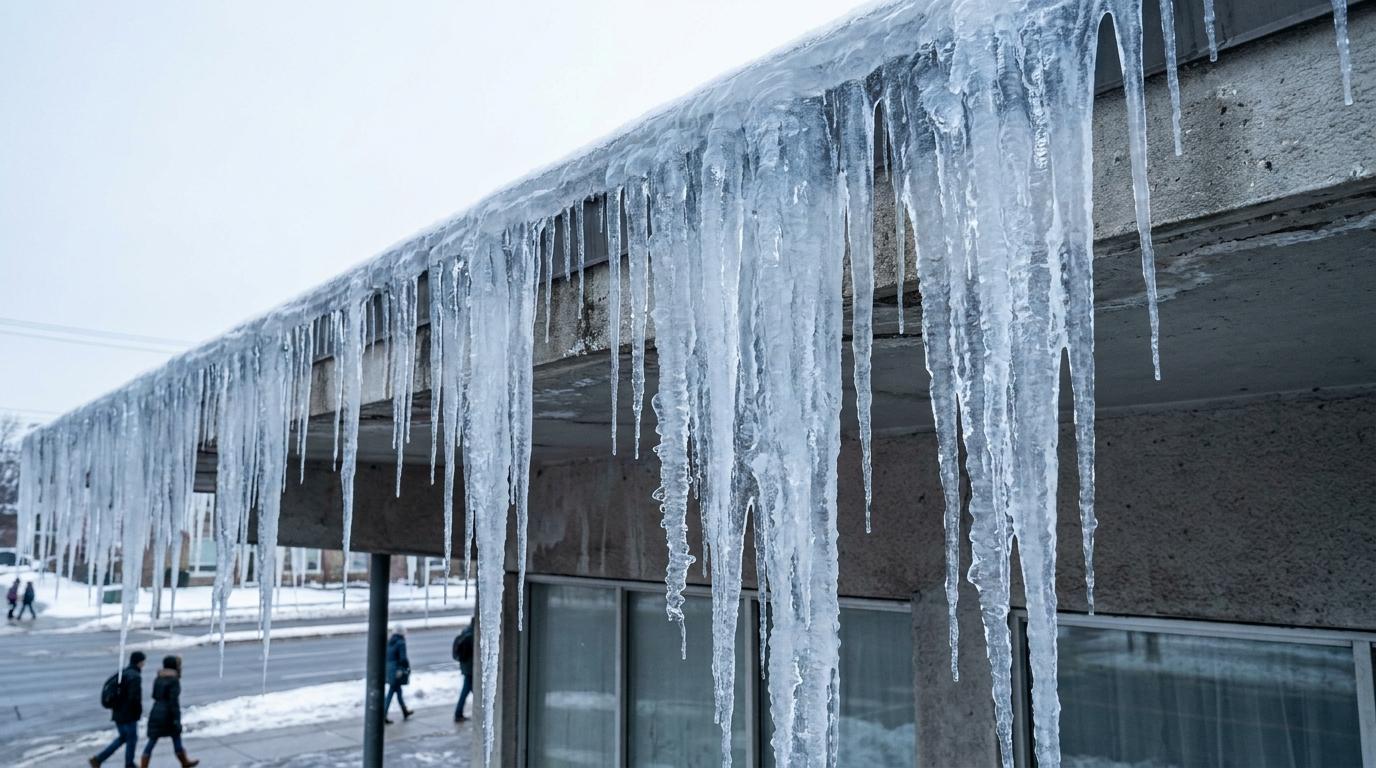
Icicles on a Building – When They Become a Legal Liability and What to Do Before an Accident Happens
February, a mid-week thaw. The manager of an office building on Narutowicza Street looks out the window in the morning and sees three icicles hanging above the main entrance, right over the retractable canopy. Two smaller ones and one thick, almost a metre long. Employees and clients pass through that entrance all day. What should the manager do in this situation, how should they assess the real urgency of the problem, and how quickly should they respond to avoid being exposed to a claim of negligence?
An icicle is not just an aesthetic problem, nor merely a matter of winter maintenance. The moment a manager sees one and fails to act, legal liability arises. Below we explain when and why icicles form, where they pose the greatest danger, how to prevent them from forming, and what the correct response procedure is once they appear.
When and Why Icicles Form
Icicles form under specific conditions, and their formation is not random. There are three main causes:
- Daily temperature swings: Above freezing during the day – snow on the roof melts from the top, water flows into the gutter or eaves. Below freezing at night – the water freezes before it can drain away. The cycle repeats, and the icicle grows day by day.
- Roof leaks and thermal bridges: Heat from inside the building escapes through a poorly insulated roof or thermal bridges and melts the snow from underneath. Water flows beneath the snow layer and freezes at the eaves, where the temperature is lower. This is why icicles often form even when outdoor temperatures stay below zero.
- Blocked gutters and drains: A clogged gutter holds water in place, which then freezes instead of draining away. Ice in the gutter is both a direct hazard (the weight on the gutter) and a cause of icicles forming along its edge.
Where Icicles Are Most Dangerous
Not every icicle poses an equal threat. Location determines whether the problem requires immediate action or can wait for a planned intervention:
- Above building entrances: The main entrance, the emergency exit, the entrance to the underground garage. High foot traffic plus large icicles equals the highest accident risk.
- Above pavements and car parks: Areas where third parties – passers-by, clients, delivery drivers – are regularly present. A manager’s responsibility for the pavement adjoining the building extends to hazards coming from the roof.
- Near window panes and glass facades: An icicle falling near a glass facade can shatter a pane or damage the cladding. Damage of this kind is costly and easy for the injured party to document.
- Near parapets and fire walls: Icicles forming on the edge of a parapet are often invisible from street level, but they reach down into the pedestrian zone.
How to Tell an Icicle That Requires an Immediate Response from One You Can Monitor
Not every icicle demands the same urgency, and it is a mistake both to dismiss the risk and to panic at every ice formation you spot. Several factors determine the real urgency: the length and thickness of the icicle, the angle of the facade at that particular point, the intensity of foot traffic directly underneath it, and the weather forecast for the coming hours – continued thaw means the icicle will keep growing and eventually fall, while a drop in temperature can temporarily stabilise it.
An icicle that is thick at the base, longer than half a metre, and hanging directly above a pedestrian route during an active thaw is a situation that requires a response the same day, ideally within a few hours. Smaller icicles in areas with limited foot traffic, under stable or falling temperatures, can be monitored and scheduled for removal at the nearest reasonable date, provided they stay under active observation rather than simply being forgotten until the next thaw.
How to Prevent Icicle Formation in the Long Run
Reacting to icicles that have already formed is a stopgap measure – equally important, and often cheaper in the long run, is limiting the conditions that let icicles form in the first place. Regularly clearing gutters of leaves, branches and other debris before the winter season reduces the risk of blockages, which are one of the main causes of icicles forming along roof edges. It is also worth checking the state of roof thermal insulation in spots where icicles form year after year – that is a sign that heat from inside the building is escaping through the roof faster than it should, melting the snow from underneath regardless of the outdoor temperature.
Anti-icing systems are also available on the market – heating cables installed in gutters and along roof edges that prevent water from freezing at critical points. This is a capital investment that makes sense primarily for buildings where icicles keep appearing despite proper roof and gutter maintenance – worth considering as a supplement, not a replacement, for regular inspections and snow removal.
The Threshold for a Manager’s Legal Liability
A manager’s liability for the consequences of a falling icicle arises when they “knew or should have known” about the hazard and failed to act. An icicle visible from the street, from the manager’s office window, or reported by a tenant or resident meets that condition beyond doubt – the manager should have known, because all it took was a glance or answering a report.
It makes no difference whether the icicle fell because of the manager’s fault or because of weather conditions. What matters is whether the manager knew about the hazard and whether they took adequate action. Failing to act on a visible icicle above an entrance is, under Article 415 of the Polish Civil Code, a failure to exercise due diligence. We discuss the legal basis for a manager’s liability in detail in the article Roof Snow Removal – When Is the Manager Legally Liable.
Response Procedure – Step by Step
A proper response to icicles is not a single action, but a sequence:
- Temporary securing of the zone: Warning tape, bollards, signs reading “caution – icicles”. This is the action you take immediately, before you even call a contractor. Taping off the zone beneath the icicle reduces the accident risk while you wait for professional removal. Important: this is a temporary measure, not a solution to the problem. The icicle is still hanging – the manager’s liability still stands.
- Assessing the scale of the hazard: How many icicles, how large, and where they hang. An icicle longer than 50 cm above an entrance is a situation that requires an immediate order. Small icicles on a side wall with no foot traffic can have their removal scheduled within 24-48 hours.
- Deciding on the type of response: Is taping temporarily enough (small icicle, no direct traffic)? Do you need to act the same day (large icicle, main entrance, thaw ongoing)? The rule: if you have doubts, you act.
- Ordering the work from a professional contractor: A written order with the address, scope, and deadline. Once the work is done, a report with a date and signature. This is your documentation of due diligence – useful not only in the event of a dispute, but also for assessing whether a given spot needs a more permanent solution.
Why Taping Off the Zone Alone Is Not Enough
This is a common misunderstanding: a manager tapes off the entrance and assumes the problem is solved. It is not solved – it is only temporarily contained. The icicle is still hanging. The thaw continues. People can still step past the tape. And the manager’s liability continues until the icicle is physically removed.
There is an additional risk: taping off the main entrance of an office or residential building makes people look for alternative ways in – through a side entrance or the garage. Check whether those spots have icicles too – and whether the alternative route is even safe – before you redirect foot traffic there from a closed main entrance.
We write about why knocking down icicles yourself is both physically dangerous and legally risky in the article Removing Icicles – Why Doing It Yourself Is Dangerous.
How to Budget for Icicle-Related Interventions
Urgent icicle removal is usually more expensive than roof snow removal planned in advance, because it requires quickly mobilising a crew outside the standard schedule. That is why managers of buildings where icicles appear regularly do well to set aside a separate pool in the winter budget for emergency interventions, independent of the cost of planned roof snow removal. Treating both categories as a single budget line often leads to a situation where funds for regular maintenance run out halfway through the season, and every further intervention requires justifying an additional expense on the spot to the community board or the property owner.
It is also worth agreeing urgent-intervention rates with the contractor in advance, as part of a seasonal contract, rather than negotiating the price on the spot when an icicle requiring immediate removal is already hanging over the entrance. Knowing the rates ahead of time also makes it easier to decide quickly, without the delay caused by having to approve a previously unknown cost.
When Icicles Are a Symptom of a Deeper Problem
If icicles appear every year in the same spots, that is a sign of a problem with the roof insulation, the gutter, or the flashing. An icicle is the visible result of a problem whose cause usually lies deeper – in the roof structure, its insulation, or the condition of the drainage system. Regular roof snow removal before the melting phase reduces the risk of icicles forming, because it removes the material they form from before the melt-freeze cycle described earlier can take place. For more on snow removal as a preventive measure: How Much Does Roof Snow Removal Cost and Roof Snow Removal in Difficult Conditions.
Frequently Asked Questions
Can I decide myself that an icicle is “safe” and wait before intervening?
You can make that decision, but it is worth documenting it – a note with the date, a description of the icicle, and the reasoning for treating it as less urgent is better than having no record at all of a risk assessment having been made. When in doubt, though, it is safer to treat the icicle as a hazard that requires action.
Is warning tape enough as the only safeguard for longer than one day?
No – tape is a temporary solution for the time it takes to arrange professional icicle removal, not a substitute for the removal itself. Relying on tape alone for an extended period, especially during an active thaw, weakens the manager’s due-diligence argument.
If icicles from a neighbouring building fall onto my property, is that my liability or the neighbour’s?
It depends on whose roof the icicle actually fell from and who owns or manages that building – liability generally follows the source of the hazard, not the location where the damage occurred. In practice such cases can be disputed, and it is worth documenting them with photographs immediately after the event.
How often is it worth checking a building for icicles during the winter season?
During periods of active temperature swings – that is, frequent thaws – it is worth doing a short daily visual round of the building, especially the entrance zones and pedestrian routes. During stable frost with no thaw the risk is lower, but a round every few days still makes sense.
Next Step
If you have icicles on a building in Łódź or the surrounding area and need an urgent intervention, call us. We work on ropes, secure the zone beneath the building before starting work, and issue a report for every job so your due-diligence documentation is complete. Service details: Roof Snow Removal and Icicle Removal by Rope Tech.

Author
Piotr Lankiewicz
Specialist in height work and rope access techniques. Owner of a company providing services in the most inaccessible locations nationwide. He prioritizes punctuality, strict health and safety standards, and solutions that save time and costs where the use of heavy machinery is impractical or not cost-effective.