
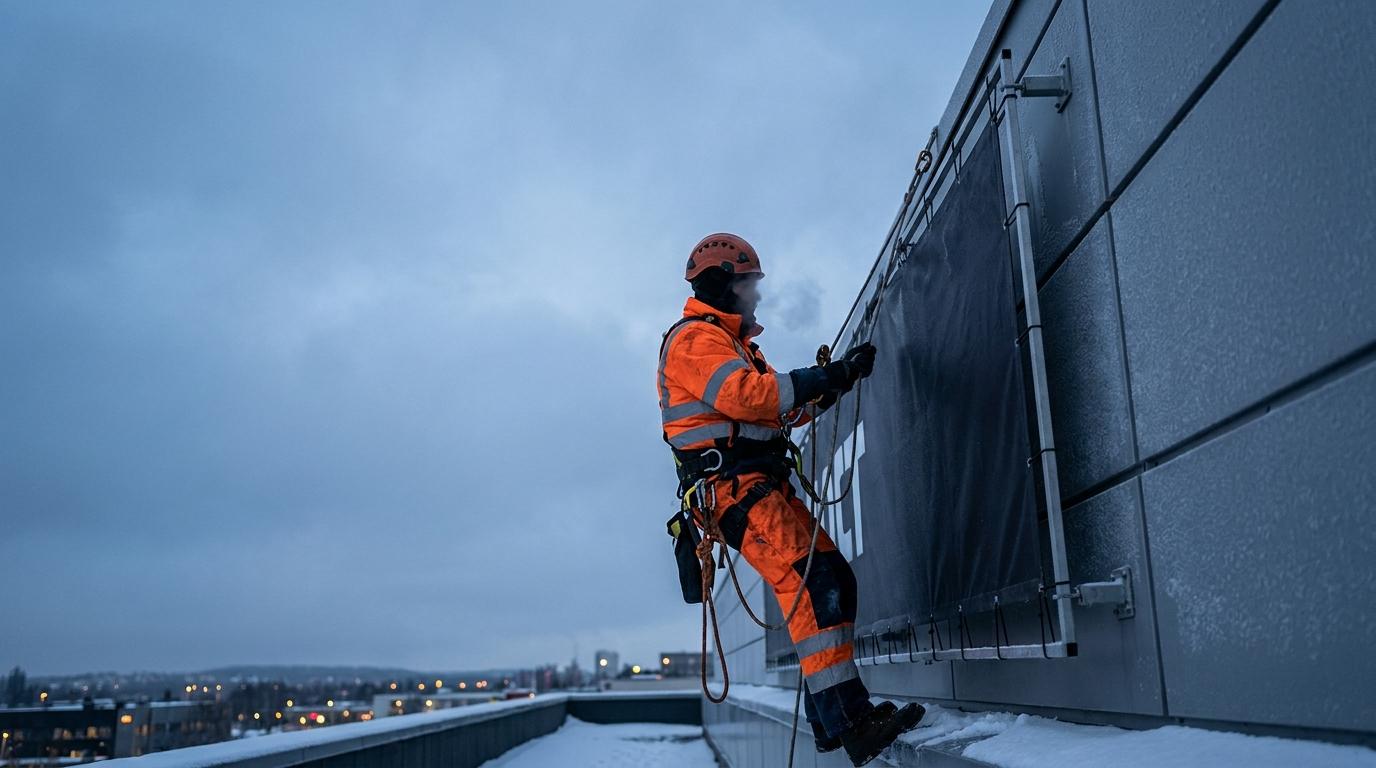
Advertising Installation on Buildings in Winter – Technical Challenges and Safety Requirements
A Christmas campaign, the banner needs to hang until December 15. It’s early November. The client asks: can this be done in winter? The answer is simple – yes, it can, provided the preparation is right, but “winter” isn’t a single uniform weather and technical scenario. November with temperatures around zero creates different challenges than January with frost and ice on the parapet. Planning a winter campaign requires a realistic risk assessment and a suitably early start.
Why Clients Order Advertising Installation in Winter
Christmas campaigns, New Year openings, seasonal promotions – the deadline pressure is real and business-justified. The advertisement needs to hang when it’s needed for business, not when it’s most convenient from a technical conditions standpoint. Most winter installations are feasible – provided the contractor is brought into the planning early enough and has the chance to choose the right weather window.
The problem isn’t that a client orders an installation in winter – it’s when they assume winter changes nothing about the schedule or the technique, and plan the completion date exactly as they would if placing the order in June.
It’s worth setting the right expectations right at the start of the conversation with the contractor: a winter installation is fully feasible, but it requires more flexibility in the schedule, more preparation time, and acceptance that the final decision on whether to proceed on a given day belongs to the crew assessing conditions on site – not to a fixed date in the marketing campaign calendar.
Technical Limitations at Low Temperatures
Not every element of the installation reacts to frost the same way. Key differences:
- Mounting adhesives and sealants – most industrial adhesives used for mounting light boxes and 3D letters have a minimum application temperature, typically between +5°C and +10°C. Using adhesive below that temperature results in incomplete curing – a bond that looks solid may not have the required load capacity. On installations where bonding is a critical element, low temperature can rule out this method entirely or require temporary heating of the surface.
- Mechanical fasteners (anchors, screws, dowels) – mechanical anchors are essentially frost-resistant. Drilling into a frozen facade, however, is harder and slower – materials become more brittle, and with some types of render the risk of chipping increases. This isn’t a disqualifying factor, but it does extend working time.
- Advertising materials – PVC loses flexibility at low temperatures. A banner or mesh sheet cooled to a few degrees below zero becomes stiffer and more prone to cracking when tensioned. Unrolling and tensioning large formats in hard frost is particularly risky. Workaround: transport the material in a heated vehicle until the moment of unrolling, then install it as quickly as possible.
The Impact of Winter Conditions on Fall Protection Safety
Roof and facade conditions in winter create hazards that don’t exist in other seasons:
- Ice on the roof and parapet – the anchor point must be stable. An icy parapet or roof makes setting up the anchoring system harder and creates a slipping risk when moving around the roof. Before installation, the crew assesses the state of the ice and decides whether the work area needs clearing or whether temporary anti-slip mats are needed.
- Accumulated snow on the roof – snow hides anchor points, roof structure elements and installations. The added weight of snow changes how the crew can move around. With a thicker layer, clearing the anchor point area beforehand becomes necessary.
- Icy facades – ice on the facade affects how the ropes behave during work. A rope resting against an icy edge can slip or accumulate ice around its protective sleeve. This calls for using rope protectors and taking extra care with positioning.
Wind Limits for Work at Height
Wind is an independent variable with no room for compromise. Work at height using rope access techniques has limits set by safety standards – above a certain wind speed, work cannot proceed. In practice: at wind speeds above 8-10 m/s, working on ropes becomes dangerous and imprecise; at stronger gusts, it’s simply not permitted.
Winter in Poland is a season of elevated wind risk – especially from November to February, in open areas and around taller buildings. Planning a winter campaign has to include a backup installation date in case conditions on the originally agreed day turn out to be unfavorable.
Requirements for Crews Working in Low Temperatures
A rope access technician working at height in winter is exposed to conditions that seem abstract from behind a desk. At 20 meters, wind chill and perceived temperature can be significantly lower than at ground level. Standards for crews working in low temperatures include:
- Multi-layer thermal clothing that doesn’t restrict the movements needed for technical work and doesn’t trap moisture during physical exertion at height.
- Limited exposure time in extreme temperatures – with breaks to warm up.
- Monitoring how crew members are doing during work – the first signs of hypothermia can affect judgment, concentration and manual dexterity, which are exactly the factors that determine safety when working on ropes.
A good work-at-height company has established winter working procedures – that’s a part of safety management, not a matter of preference. A company without established winter procedures risks improvising on site, which translates directly into worker safety. For more on which signals indicate a properly prepared crew, see the article on fall protection issues in advertising installation: Large-Format Advertising Installation – Fall Protection Issues.
When to Postpone the Installation
Some conditions rule out installation regardless of deadline pressure:
- Bonding below the adhesive manufacturer’s minimum temperature – technically possible, but the outcome is unpredictable. For load-bearing elements (light boxes, 3D letters) this is an unacceptable risk.
- Active snowfall or freezing rain during work – these reduce visibility and quickly create a layer of ice on working surfaces and ropes.
- Wind above permitted limits – no exceptions.
- Air temperature well below zero during prolonged outdoor work – the specific threshold depends on the scope of work, the building’s exposure and working conditions, but the decision must belong to the crew assessing conditions on site.
Shorter Working Days and Their Impact on the Schedule
In winter, beyond the temperature and wind constraints, there’s one more factor that’s easy to forget when planning an installation from behind a desk: the number of daylight hours. In December and January, effective working time at height – while maintaining safe visibility – is significantly shorter than in summer, which for large or complex installations (illuminated light boxes with electrical connections, 3D letters requiring precise positioning) can mean the work needs to be spread over two days instead of one.
A good contractor factors this in at the quotation and scheduling stage, instead of assuming the pace of work will be identical to summer. For the client, that’s a practical takeaway: for winter orders, it’s worth asking directly about the estimated number of days needed for completion, not just the start date.
Removing a Winter Advertisement After the Campaign Ends
Seasonal campaigns – Christmas, New Year – have a limited display period by definition, which means the company doing the installation is often also responsible for removal shortly after New Year, a period when winter conditions are usually at their toughest all season. It’s worth planning this right when signing the installation contract, setting an approximate removal date and the same rules regarding weather window and schedule flexibility that applied to the installation.
It happens that the client focuses solely on the installation date, since that’s tied to the campaign launch, and treats removal as a formality to be settled later. In practice, removal in the middle of hard winter can be just as technically demanding as the installation itself – the advertising material is often stiff and brittle after weeks of exposure to frost, which requires care when detaching it so as not to damage the facade or the banner itself, if it’s meant to be reused.
How to Plan a Winter Campaign
A few rules that make it possible to run a winter installation without unnecessary stress:
- Minimum lead time: 3-4 weeks – the contractor needs time to assess the building, plan logistics and choose the right weather window. Ordering with a week’s notice in December drastically limits room for maneuver, especially when the forecast for that week looks unfavorable.
- A plan B for bad weather – agree with the contractor on an alternative completion date in case conditions on the original date turn out unpredictable. A campaign planned without an alternative is a campaign that may not happen at all, or – worse – get carried out in unsuitable conditions at the expense of crew safety.
- Building manager’s consent and roof access – especially important in winter, when roof access can be difficult. Arranging access in advance eliminates one of the most common causes of delay in a winter schedule.
- Consulting the print shop about the material – if the advertisement is going to be installed in winter, it’s worth agreeing the format and material with the print shop with the installation conditions in mind, rather than finding out after the fact that the material is too stiff to tension safely in frost. Some films and PVC materials tolerate low temperatures better and retain flexibility under tension even on freezing days.
The general principle of the installation process – regardless of season – is described in the article Large-Format Advertising Installation on Facades: Process, Requirements and Rope Access.
Frequently Asked Questions
Is a winter installation surcharge standard in the industry?
An additional cost can be justified by longer completion time and a greater number of variables to manage, but it shouldn’t be hidden – it’s worth having the contractor explain plainly what accounts for the difference from a summer quote, if there is one.
Can an advertisement be installed the same day the request is made, in the middle of winter?
Theoretically yes, if weather conditions happen to allow it, but that’s a high-risk approach – without time to assess the building and plan a weather window, it’s hard to guarantee quality and safety. The recommended minimum is the several weeks of lead time described above.
What happens if the weather doesn’t allow installation on the planned date after all?
A reliable contractor should have a contingency plan set up in advance – a next available date within a short interval, not a full renegotiation of the whole order from scratch. This is one of the things worth asking about before signing the contract.
Do winter-adapted advertising materials cost more?
Sometimes yes, if they require a different film specification or PVC that tolerates low temperatures better – but that cost is worth weighing against the risk of the material cracking or being damaged during installation in frost, which would be more expensive than the small difference in material price.
Planning an installation in the autumn-winter season and want to assess whether conditions at a specific building are workable? Call for a quote – we’ll discuss the date, scope, the advertising material required, and what could affect completion during that particular winter period. Service details on the installation and dismantling page.
Author
Piotr Lankiewicz
Specialist in height work and rope access techniques. Owner of a company providing services in the most inaccessible locations nationwide. He prioritizes punctuality, strict health and safety standards, and solutions that save time and costs where the use of heavy machinery is impractical or not cost-effective.