
Liability Insurance for a Work-at-Height Company: What Should You Ask the Contractor?
A work-at-height company arrives at your facility to carry out work at height, for example a roof repair, when suddenly one of the technicians slips and damages a skylight and part of the ventilation system. Total damage: several dozen thousand zlotys. The contractor says they “have liability insurance.” But does that policy actually cover this type of damage, and is the coverage limit sufficient to cover the costs?
Liability insurance for a contracting company is not a formality added to the contract for the sake of order. It is a real mechanism for protecting your property, your employees, and your liability towards the building owner or landlord. It is worth knowing what to check before you decide on a specific contractor.
Minimum Coverage Limits in the Work-at-Height Industry
Polish law does not define a minimum third-party liability coverage limit for companies carrying out work at height, unlike, for example, carriers or travel agencies. This means that each company may have a policy with a different coverage limit and scope of protection. As the client, you must determine what is sufficient for you.
In industry practice, several approximate ranges are used:
Up to PLN 500,000: a level typical for small companies performing simple work on low structures. For industrial plants, halls, and buildings with high-value property, this is usually an insufficient level of protection.
PLN 500,000–1,000,000: the market standard for companies working on commercial buildings, tenement houses, and medium-scale industrial facilities.
Above PLN 1,000,000: the level required by large institutional clients, corporate clients, and facilities with high-value infrastructure. For framework agreements with production plants or special economic zones, coverage limits of PLN 2–5 million are not uncommon.
The coverage limit is the maximum amount the insurer will pay for all claims during the insurance period. Importantly, if several claims occur during the year, the amounts paid are added together and the coverage limit may be exhausted. This is why companies servicing many facilities or carrying out high-value assignments should have appropriately high limits.
Scope of Insurance: What Should Be Covered?
The coverage limit itself is not everything. The scope of a third-party liability policy may be very narrow or very broad, depending on the wording and extensions. For work at height, the following elements are important.
Property damage: damage to property at your facility, such as windows, façades, roofs, external installations, or the area in front of the building. This is a basic element of every liability policy, but it is worth checking whether there are exclusions relating to specific materials or zones.
Personal injury: bodily injury to third parties caused by the crew’s actions or by falling objects. This is one of the more serious risk categories in work at height. Accidentally dropping a tool or cleaning agent may result in serious injury to a person passing below the work zone.
Liability for subcontractors: if the company with which you sign the contract uses subcontractors, which is common in the industry, the policy should cover their actions. Without this extension, you may have difficulty obtaining compensation for damage caused by a worker who is not formally employed by your main contractor.
Employer’s liability clause: this covers liability for accidents involving the contractor’s employees at your facility. Without this clause, if a technician is injured on your premises, you may become involved in disputes over shared responsibility.
Damage to entrusted property and property in custody: if the crew takes over any equipment or elements of your property for storage or handling, it is worth checking whether the policy covers such damage. Standard liability insurance often does not cover this.
Five Questions You Must Ask the Company Before Signing the Contract
Instead of asking generally for “confirmation of insurance,” ask specific questions that will allow you to assess the real level of protection.
1. What is the current liability coverage limit, and does the policy apply per occurrence or per insurance year? The difference between a per-claim limit and an annual aggregate limit matters for long-term or multi-stage assignments.
2. Does the policy include liability for subcontractors? If the company uses subcontractors and this extension is missing, there is a gap in protection.
3. Does the insurance cover work at height above a specific height threshold? Some policies exclude work above a certain height as standard or treat it as a special risk requiring a separate clause.
4. When does the policy expire, and can you receive a copy for review before signing the contract? A policy valid only until the end of the current month for a project lasting three months is a problem worth identifying before the work starts, not during it.
5. Will the insurer confirm coverage for your specific facility? For large assignments or high-value facilities, you can request an endorsement, meaning confirmation from the insurer that the policy covers the specific project.
How to Verify a Liability Insurance Policy: What to Look For in the Document
You have a copy of the policy in front of you. What should you check before filing the document away?
Policyholder and insured party: the company name on the policy must match the company name in the contract you are signing. If the company operates under a different trading name or is part of a group, make sure that the correct legal entity is covered.
Validity period: the policy must be valid for the entire duration of your assignment. Check whether it expires during the work and ask the contractor to commit to informing you immediately about any change in the scope of insurance.
Territorial scope: most business liability policies cover the territory of Poland, but it is worth confirming this, especially if the facility is close to a border or the company also performs work abroad and it is not clear which policy covers the given project.
Exclusions of liability: this is the most important section and usually the one read last. Look for exclusions relating to work at height, damage during construction and renovation work, damage caused intentionally or through gross negligence, and environmental damage. Any of these exclusions may mean that a specific loss at your facility will not be covered.
Deductible: this is the amount the insurer deducts from each compensation payment. A deductible of PLN 5,000 for a claim of PLN 8,000 means you will receive only PLN 3,000. For small claims, this may be the decisive difference.
Additional clauses: look for extensions that may be crucial for your assignment, such as liability for subcontractors, an employer’s liability clause, and an extension for work at height. Their absence is a red flag, not necessarily a reason to reject the offer, but it is an argument for renegotiating the scope of the policy or the price.
Do You Want to Check Our Insurance Documents Before Making a Decision?
We provide a copy of our liability insurance policy on request and are ready to discuss the scope of coverage in the context of your facility and the planned work.
Author
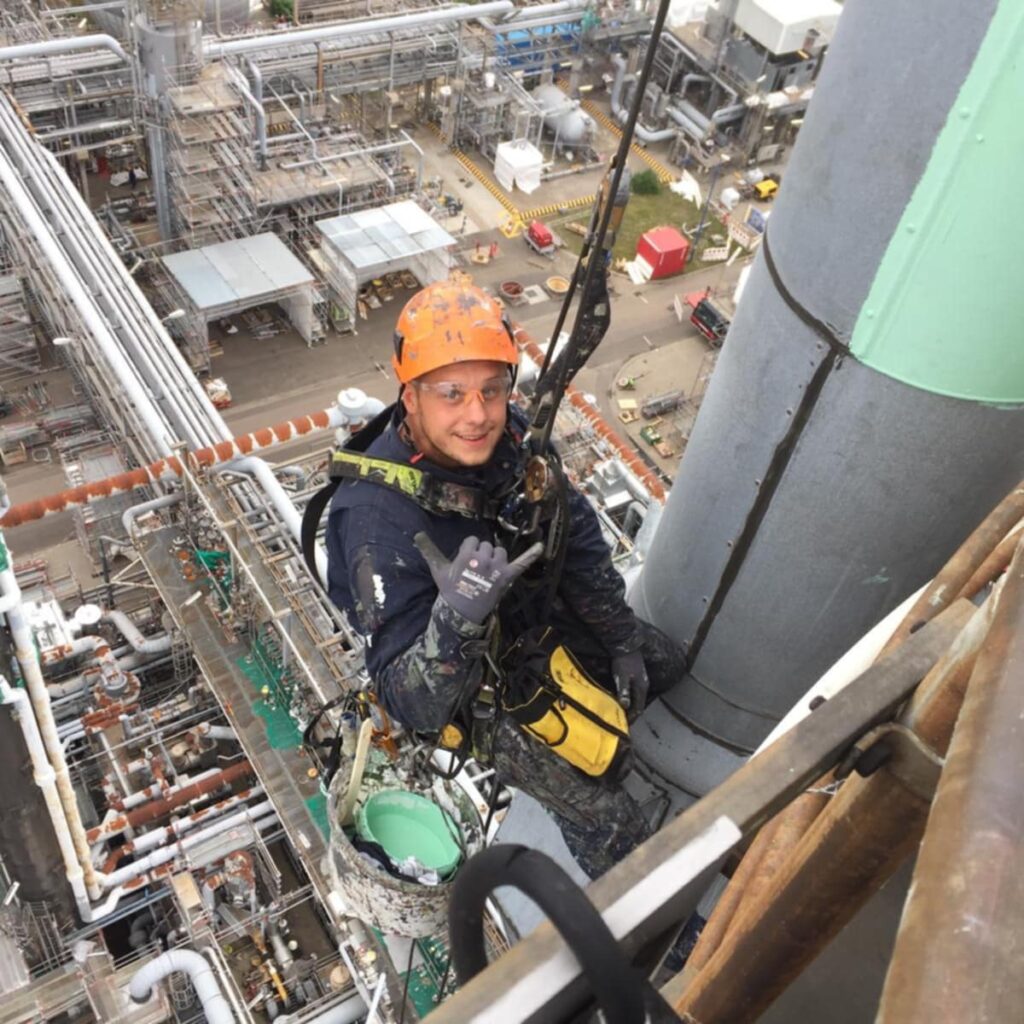
Piotr Lankiewicz
Specialist in height work and rope access techniques. Owner of a company providing services in the most inaccessible locations nationwide. He prioritizes punctuality, strict health and safety standards, and solutions that save time and costs where the use of heavy machinery is impractical or not cost-effective.