Paint coatings on chimneys – how many years they last and what determines the service life of the system
The board asks about the time horizon for the next investment in chimney renovation, and the answer “it depends” does not sound very convincing at a budget meeting. At the same time, every paint supplier or contractor you talk to about the work gives a slightly different number of years, often without explaining under what conditions that number was estimated. To plan the budget for the coming years responsibly, it is worth understanding what actually determines how long a paint coating on a concrete chimney retains its protective properties, instead of relying on a single averaged number taken from the product’s technical data sheet.
Why there is no single universal answer
The service life of a coating system declared by the manufacturer is a point of reference, not a guarantee. The same paint, applied to two different chimneys, can remain fully functional for very different periods, depending on the environment in which the structure operates, how thoroughly the substrate was prepared and how the application itself went. Paint sellers and some contractors are happy to give one specific number of years, because it sounds convincing in a sales conversation, but a reliable answer to the question of service life always has to take into account the specific conditions in which a given chimney operates, not just the laboratory parameters of the product.
Climatic factors affecting the service life of a coating
Sunlight and UV radiation
UV radiation causes gradual chalking and loss of gloss of the coating and, in the longer term, weakens its structure. Chimneys, unlike many other structures, are usually exposed to the sun all day, without shade cast by neighbouring buildings, which accelerates this process compared with partly shaded elements. The south and west sides of a chimney usually degrade faster than the north side, which can sometimes be seen with the naked eye as a difference in colour intensity between the sides of the structure.
Freeze-thaw cycles
In colder seasons, water that has penetrated the micropores of the coating or places with small defects increases in volume as it freezes and mechanically breaks up the structure of the material. The more such cycles there are in a year, the faster degradation progresses, especially where the coating already has micro-damage that serves as an entry point for moisture.
Air humidity and rainfall
High air humidity persisting for longer periods promotes the growth of algae and fungi on the surface of the coating, which not only affects appearance but in the longer term can weaken the paint layer itself. Structures located in regions with higher average annual humidity, close to bodies of water or in river valleys, statistically require more frequent inspections of the coating’s condition than those in a drier climate.
Chemical exposure – how the process affects durability
The composition of the flue gases emitted by the installation connected to the chimney has a direct impact on the rate of coating degradation, especially in its lower parts, where condensation occurs. Installations burning fuels containing sulphur compounds create a more aggressive chemical environment than gas-fired installations, which translates into a shorter real service life of the coating in this zone, even when the same paint system is used. An additional factor can be the proximity of other industrial facilities emitting pollutants, which settle on the surface of the chimney regardless of the process taking place in the installation to which the chimney belongs. That is why, when planning a renovation, it is worth considering not only your own process but also the wider context of the structure’s location in an industrial environment.
Quality of workmanship – why two identical paints give different results
The same paint product, applied by two different crews, can produce completely different results in terms of durability. The quality of substrate preparation – thoroughness of cleaning, correct assessment of concrete moisture before painting, proper repair of defects and reinforcement corrosion – has a greater impact on the service life of the coating than the choice of a specific product. The application technique is just as important: maintaining an appropriate, uniform coat thickness over the entire surface, observing the right technological breaks between successive coats and working in weather conditions that comply with the manufacturer’s recommendations. A crew working under time pressure, shortening drying times or applying paint in unfavourable weather, can reduce the real service life of the system by several years compared with what the product’s technical data sheet declares.
Maintenance and inspections – does the coating work on its own for its entire service life
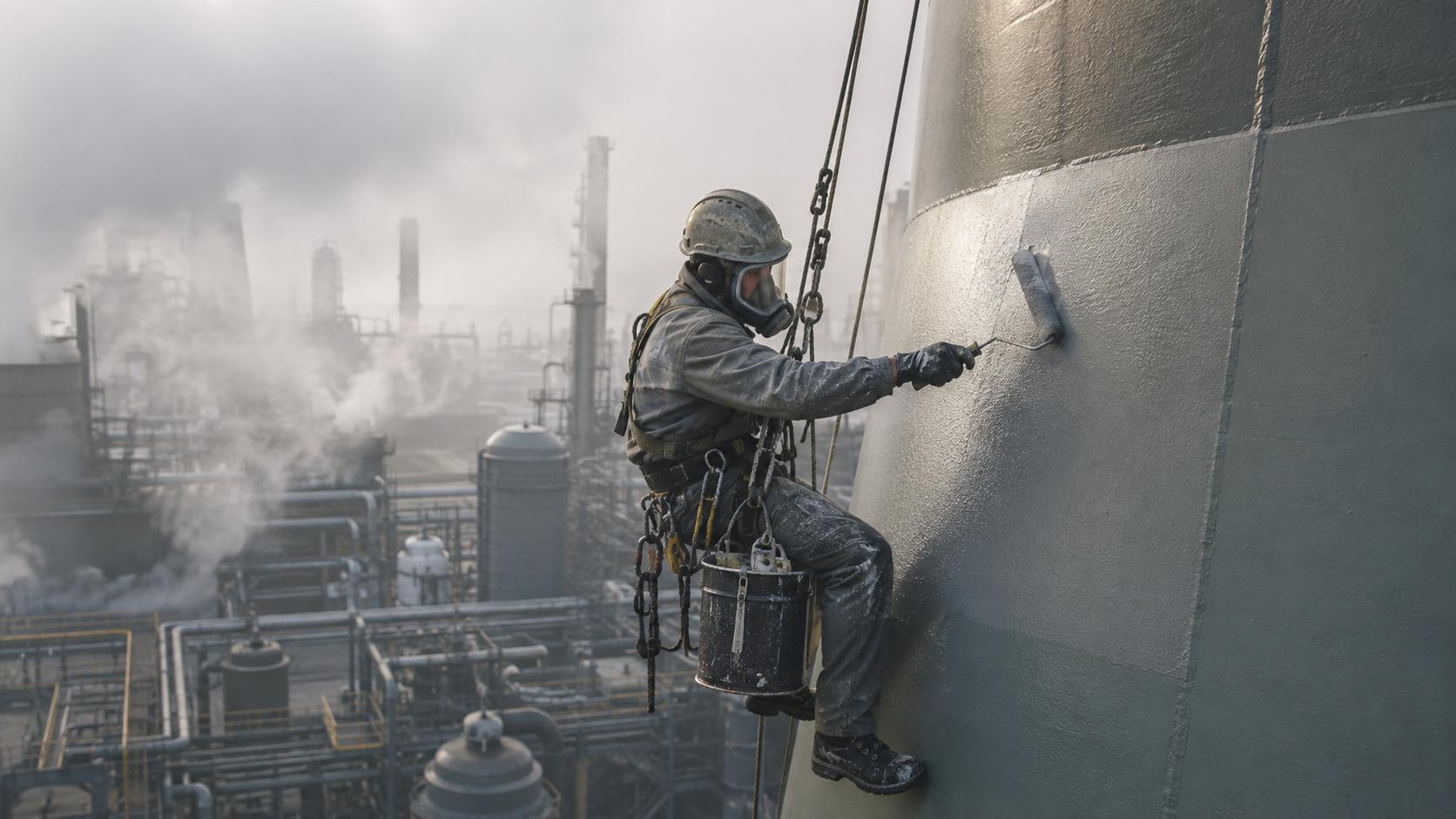
A paint coating is not an “apply and forget” solution. Regular, even basic, visual checks of the condition of the surface make it possible to catch the first signs of degradation before they turn into a more serious problem requiring full renovation. Minor mechanical damage to the coating, if noticed and repaired locally fairly quickly, does not lead to the concrete being exposed and corrosion processes starting at that spot. The same damage, left without a response for a longer time, becomes an entry point for moisture and consequently accelerates the degradation of the entire surrounding surface. Rope access is well suited to precisely such periodic inspections – it makes it possible to produce close-up photographic documentation, assess the condition of the coating over the entire height of the structure and point to specific places requiring intervention before the problem grows to a scale requiring full renovation. It is worth bearing in mind that this type of inspection is a visual assessment and photographic documentation of the condition of the coating and visible concrete damage, not certified non-destructive testing of the structure of the material – these are two different types of service with different purposes.
How to read the service life declared by the manufacturer
The values given in the technical data sheets of paint products usually come from tests carried out under controlled conditions or in accelerated ageing simulations, which do not always fully reflect the real exposure of an industrial structure. This does not mean that these data are useless – they are a good point of reference for comparing different systems with each other, but they should not be treated as an exact forecast for a specific chimney in a specific location. A reliable supplier or contractor can explain under what conditions a given value was estimated and how it translates into the real exposure of the structure, taking into account the climate, chemical exposure and the planned intensity of maintenance.
Signs that a coating is approaching the end of its service life
- A clear loss of gloss and colour uniformity over a large area, not just in isolated places.
- Chalking of the surface, that is a dust-like deposit visible after wiping the coating with a hand or cloth.
- Fine mud cracking on the surface of the coating, preceding its delamination.
- Local blisters or delamination, especially in the lower parts of the chimney and in zones exposed to condensate.
- Visible rust streaks indicating reinforcement corrosion progressing under the coating.
- Increased growth of algae or fungi on the surface, suggesting a disturbed moisture balance of the coating.
The appearance of one of these signs does not always mean that an immediate full renovation is necessary, but each of them is worth treating as a starting point for a more detailed assessment of the condition of the structure, ideally carried out up close rather than from ground level.
How to extend the real service life of a coating system
Regular visual inspections, ideally carried out at fixed intervals rather than only during mandatory audits, make it possible to catch a problem at a stage when a spot repair is still possible and relatively cheap compared with a full renovation. A quick response to minor mechanical damage to the coating, instead of postponing the repair until the next major inspection, limits the risk of local damage turning into an extensive structural problem. Choosing a coating system matched to the real exposure conditions of the structure, rather than the cheapest available solution, also has a direct impact on the real service life, as does the quality of the application itself, which is worth keeping in mind already when choosing a contractor to carry out anti-corrosion protection of chimneys. Finally, it is worth keeping a simple record of the structure’s history – dates of previous renovations, systems used, inspection results – so that the next decision on the scope of work is based on facts rather than on the approximate memory of the people responsible for the structure at the time.
Why it is worth planning the budget on a real rather than a declared time horizon
Planning the budget for the coming years solely on the basis of the service life declared by the manufacturer, without taking into account local climatic conditions, chemical exposure and the quality of the previous renovation, often leads to unpleasant surprises – either the investment appears in the budget earlier than assumed or, less often, funds are reserved unnecessarily early. A more sensible approach is to base the forecast on a combination of the system’s declared service life, the rate of degradation observed in regular inspections and knowledge of the specifics of the particular structure. Such a forecast, although harder to present as one simple number, is much closer to reality and helps avoid both costly emergency repairs and reserving funds unnecessarily early.
Is it worth commissioning periodic coating inspections from an external company
In many plants, assessment of the coating condition on a chimney is limited to what can be seen from the ground during a site walk, or to photos taken by drone during the annual audit. This is enough to notice serious, extensive problems, but not to catch early signs of degradation – fine mud cracking, local chalking or the first signs of delamination in hard-to-reach places near the chimney head. Commissioning a periodic inspection from a company with rope access capability makes it possible to assess the condition of the coating up close over the entire height of the structure and to obtain photographic documentation that becomes a point of reference when planning further work. Such an inspection fits into the wider range of Rope Tech rope access services, covering not only painting but also other work requiring access to hard-to-reach parts of industrial structures, which makes it easier to entrust several related tasks to one proven team instead of coordinating several different contractors.
How often to plan inspections depending on the age of the coating
In the first years after a renovation, the risk of more serious problems is usually lowest, so a basic visual check once a year, combined with the mandatory technical inspections of the structure, is usually sufficient. As the end of the service life declared by the manufacturer approaches, it is worth increasing the frequency of observation, because it is in this period that the first, still small signs of degradation most often appear, which are easier and cheaper to repair locally before they turn into the need for a full renovation. Structures operating in a more aggressive chemical or climatic environment, as described in earlier parts of this article, deserve more frequent inspections regardless of the age of the coating, because the rate of degradation in their case is often harder to predict from the manufacturer’s declaration alone.
Conclusions
The service life of a paint coating on a concrete chimney is not a fixed value written in the product’s technical data sheet, but the result of climate, chemical exposure, quality of workmanship and regularity of maintenance. Understanding which of these factors matter most for a particular structure makes it possible to plan the budget and inspection schedule realistically, rather than relying on one averaged number of years given by the paint supplier. Regular observation of the coating’s condition and a quick response to the first signs of degradation are the simplest way to bring the real service life of the system closer to the upper rather than the lower limit of what the coating system can offer. It is also worth remembering that the question of a coating’s service life is best asked not once, in a single sales conversation, but revisited periodically as real observations from the particular structure accumulate – only such knowledge, built up over time, makes it possible to plan further renovations well in advance instead of reacting only when the problem becomes visible to the naked eye from ground level.
Author
Piotr Lankiewicz
Specialist in height work and rope access techniques. Owner of a company providing services in the most inaccessible locations nationwide. He prioritizes punctuality, strict health and safety standards, and solutions that save time and costs where the use of heavy machinery is impractical or not cost-effective.