Red Flags When Choosing an Industrial Climbing Company – What to Watch For in the Quote and the Contract
You’ve received three quotes for cleaning an office building’s facade. Two are close in price. The third is 40% cheaper. Now what? The cheapest offer isn’t necessarily a trap – but a gap of that size needs an explanation. Either the company uses faster equipment and methods, happens to have a gap in its schedule, and the savings are real – or it has cut corners somewhere. The only question is where.
The problem is that as a property manager, you don’t always have the time or the technical knowledge to evaluate an offer in detail. Below is a list of signals that should put you on alert – they don’t automatically disqualify a company, but they do call for extra questions before you sign a contract.
Red Flags in the Quote
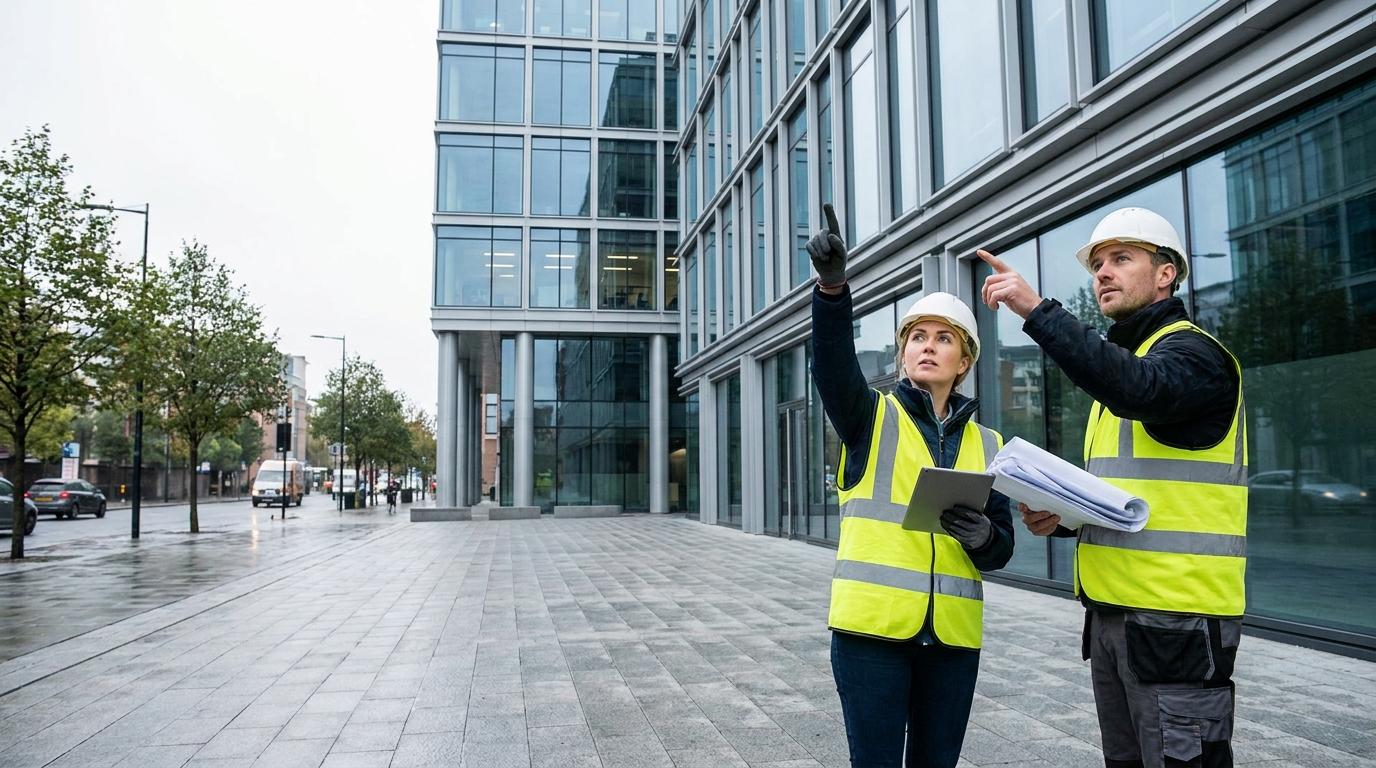
- A quote given without seeing the building: Rope access companies that work reliably will almost always want to see the site before quoting a price. The type and condition of the facade, roof access, the layout of anchor points, obstacles near the building – all of this affects the price and how the work is organised. A quote given over the phone after just an address and a floor area is a signal that the company either doesn’t understand the specifics of this kind of work, or is deliberately quoting a low starting price.
- A price without a defined scope: A quote should specify exactly what’s included in the price: which surfaces, what method, how many people, how much time. If you’re given a single figure with no description of scope, you don’t really know what you’re paying for. At handover, it can turn out that “facade cleaning” meant one thing to you and something else to the company.
- No questions about the specifics of the building: A good company will ask about roof access, the type of facade (ceramic tile, glass, render), whether there are elements to work around, and whether the building has residents or tenants who need to be informed. The absence of such questions can mean the company is estimating the job “by eye” – without a real plan.
- An unrealistically short completion time: Cleaning a building of a dozen or so storeys takes several days of work in favourable weather. If a company promises to do it “over the weekend” with no explanation of how – ask about the method and the number of workers. Unrealistically fast timelines with no justification can mean the company will promise anything to win the job.
Red Flags in the Documents
- Unable to show a current liability insurance policy: The policy should be available on the spot. A company that “needs to check with the insurer” or keeps putting off sending it may simply not have one, or may have a policy that doesn’t cover rope access work. Find out what to ask about a rope access company’s liability insurance.
- A “general” health and safety certificate: Workstation health and safety training is a baseline for every employee – but it’s not proof of qualification for rope work. Ask about IRATA certificates or documents confirming training in rope access techniques. If a company can only produce general health and safety certificates with no industry-specific certification, that’s not enough for work at height using rope access methods.
- No IRATA documentation or equivalent: IRATA certification is the industry standard in industrial rope access – a three-level system for training and examining rope technicians. Companies go without it for various reasons – not always bad ones – but having no document at all confirming workers’ qualifications is a serious warning sign.
Red Flags Concerning Equipment
- No knowledge of periodic equipment inspections: Ropes, harnesses, descenders and fall-arrest devices have manufacturer-defined inspection and replacement schedules. A company that can’t say when the equipment was last inspected, or uses “we’ve used it for years without a problem” as an argument, isn’t keeping the records that responsible use of height-safety equipment requires.
- Visibly worn or incomplete equipment at the site visit: If you get the chance to see the equipment before work starts – frayed ropes, harnesses with no manufacturer tags, improvised attachments – that’s one of the most direct signals that a company is cutting costs where it shouldn’t.
- Improvised anchor points: Anchoring to elements that weren’t designed for it – antennas, railings, ventilation ducting – instead of to certified anchor points or the building’s load-bearing structure, is a serious risk to both the workers and the building itself.
How to Vet a Company Before You Ask for a Quote
Before you even get to the price conversation, part of the vetting can be done on your own, without involving the company. Checking the basic business registry data (the Polish CEIDG or KRS register, depending on the legal form) shows how long the company has been operating and whether its registered scope of activity actually includes work at height, and not just general construction or cleaning services. It’s also worth reviewing photo portfolios of completed projects – ideally ones of a similar scale and type to your building – and feedback from other property managers or homeowners’ associations, if the company has already worked in your area.
It’s also a good sign if the company shows up in recognised industry sources – a website describing its working methods, with references and a clearly presented scope of services. A company with no way to verify it beyond a phone number in a listing calls for extra caution – that doesn’t necessarily mean it’s unreliable, but it does mean you’ll have to verify more on your own before making a decision.
Red Flags in Behaviour
- Agreeing to everything without questions: If a company agrees to every one of your conditions without objection, that can be a good sign – but it can also mean it doesn’t understand the scope, or that it plans to hand the work off to a subcontractor you know nothing about.
- No information about who will actually be working: You’re entitled to ask who will actually be on your site. A company that can’t say whether it’s their own crew or a subcontractor may struggle to control the actual execution of the work and the qualifications of the people doing it.
- Avoiding the question of anchor points: Every rope job requires anchoring to the roof or the building’s structure. A company that doesn’t ask about the available anchor points, or says it will “figure it out on site,” is signalling that it’s not planning the work, just improvising. That’s a safety risk, but also a risk of damage to the building.
Red Flags in the Contract
- No defined liability for damage: The contract should clearly state who’s liable for any damage to the facade, window and door frames, or cars parked in the work zone. A general statement that “the company is liable for its actions” isn’t enough – a detailed clause protects both sides.
- No clause on post-job documentation: A reliable company leaves behind a handover report and photo documentation of the facade’s condition once the work is done. If the contract doesn’t provide for this, you may have trouble filing a complaint or proving the scope of work actually carried out.
- Unclear terms for termination and scope changes: What happens if weather makes it impossible to finish on time? Who decides on a change of scope, and how does it affect the price? A contract without these clauses leaves too much room for misunderstandings.
What a Good Contract With a Rope Access Company Should Include
- Exact scope of work – which surfaces, what method, what’s included in the price and what isn’t
- Completion deadline and conditions for changing it – what happens in bad weather, when there’s no access
- Scope of liability for damage – including for safety zones and site access
- Documentation after the work is completed – handover report, photos, confirmation of scope
- Liability insurance details – policy number, coverage, expiry date, attached to the contract
- Information on who will carry out the work – whether the company uses its own employees or subcontractors
What to Do if Doubts Arise After the Contract Is Already Signed
Sometimes a red flag only shows up once the job is underway – for example, a crew you knew nothing about turns up on site, or workers can’t produce basic documents despite earlier assurances. In that situation you have the right to halt the work until your doubts are resolved – that’s not overstepping your authority, it’s carrying out the coordination duty that rests with the property manager. It’s worth doing this in writing, or at least with photo documentation of the situation that raised concerns – that protects you if a dispute with the contractor later ends up in a formal complaints procedure.
If the contract didn’t explicitly require documents to be shown before every site entry, it will be harder to enforce during the job – another reason for these clauses to be in the contract from the start, rather than treated as something obvious that “everyone understands the same way.”
Questions Worth Asking a Company Before You Sign the Contract
- Who exactly will carry out the work – your own crew or a subcontractor? What are their qualifications?
- Can you show a current liability insurance policy that covers rope access work?
- What’s your procedure in the event of an accident or property damage?
- What documentation do you leave behind once the work is finished?
- When can you come for a site visit before giving a final quote?
Why the Cheapest Offer Can Turn Out to Be the Most Expensive in the Long Run
A significant price drop rarely comes from work efficiency alone – in rope access work, the margin available from “speed” is limited, because time is largely set by site access, the number of anchor points and weather conditions. A low price more often points to one of a few scenarios: skipping the cost of insurance that covers rope work, using uncertified people instead of trained technicians, cutting the crew below the safe minimum for the scope, or skipping the site preparation and securing stage.
The consequences of these savings usually don’t show up right away – only at the first unusual event: equipment failure, a sudden change in weather, an accident. That’s when the difference between a company with a current policy and a trained team, and one that skipped those costs, stops being theoretical. So with a large price gap, it’s less about rejecting the offer automatically and more about asking directly what allows the company to offer that price – and weighing the answer against the red flags described above.
Frequently Asked Questions
Does a low price always mean a problem?
Not always – sometimes it comes down to a gap in the company’s schedule, proximity to the site, or a simpler scope of work than in competing offers. What matters is whether the company can explain the difference specifically, rather than in vague terms.
Can I ask for references from recent projects?
Yes, and it’s worth doing. A reliable company will have no trouble giving examples of completed projects of a similar type, and ideally contact details for a property manager who can confirm how the work went.
How many quotes is it worth collecting before deciding?
Three quotes is a reasonable minimum that lets you see where the real market price level sits for a given scope of work, and catch extreme outliers in either direction.
Before you evaluate an offer, it’s also worth knowing what documents and qualifications an industrial climbing company is required to have under Polish health and safety regulations – it gives you a concrete basis for verification. You’ll find the details in the article What an Industrial Climbing Company Must Meet Under Polish OHS Regulations.
If you’d like to compare offers for a specific building and have questions about the scope of work – get in touch with us. We’ll come out for a site visit and prepare a quote with the full scope of work.
Author
Piotr Lankiewicz
Specialist in height work and rope access techniques. Owner of a company providing services in the most inaccessible locations nationwide. He prioritizes punctuality, strict health and safety standards, and solutions that save time and costs where the use of heavy machinery is impractical or not cost-effective.