
How Rope Access Window Cleaning Works From Order to Handover – A Client’s Guide
You manage an office building and you’re commissioning rope access facade cleaning for the first time. You have a few questions and no one obvious to ask: when will the crew arrive, do you need to call anyone in advance, how long will it take, and what should you actually check at handover. This article answers those questions step by step – from the first contact with the company to signing the handover protocol.
Stage 1 – Inquiry and Site Visit
The first step is contacting the company and scheduling a site visit. This isn’t a formality – it’s the basis for an accurate quote and proper work planning.
During the visit, the company assesses several things at once. The condition and type of the facade – ceramic, glass, render, composite – because each material needs a different method and cleaning agents. Roof access– where the rope access technicians will enter, whether the roof is flat or pitched, where the hatches and keys are. Anchor points – fixed anchoring points on the roof or facade to which the ropes will be attached. If the building doesn’t have them, or they’re outdated, the company has to plan their installation or an alternative form of fall protection. Finally, the surroundings of the building: pedestrian and vehicle traffic below the facade, building entrances, air conditioning units, and other elements that will need to be worked around.
If a company offers a quote without a site visit, that’s a warning sign. Cleaning a facade without knowing the building means working blind, which leads either to an underestimated price (and problems during the job later) or to skipped difficult sections.
Why Rope Access Rather Than a Cherry Picker or Scaffolding
During the site visit, the company also assesses which access method actually makes sense for the building – and it’s worth understanding why rope access wins out in most cases for office buildings and multi-storey structures. A cherry picker needs firm, level ground around the building and unobstructed access – in dense urban development, on narrow streets, or with parking right up against the facade, it simply won’t fit or won’t reach the required height. Scaffolding means multiple days of assembly and disassembly, occupying the space around the building for that entire period, and a cost that rarely pays off for a one-off cleaning job.
Rope access doesn’t require occupying space around the building beyond a narrow safety zone directly below the working crew, doesn’t block driveways or pavements for longer than it takes to clean a given section, and works regardless of whether the facade has 5 or 25 storeys – as long as the building has suitable anchor points, or they can be installed. This flexibility is exactly why, in commercial and residential buildings in city centres, rope access is the default choice, not just the cheaper alternative.
Stage 2 – Quote and Scope of Work
After the site visit, the company prepares a quote. A good quote includes: the exact scope of surface area (which walls, which windows, whether cleaning also covers frames and sills), the working method (rope access, platform, or a combination), the cleaning agents used (especially important for ceramic or anti-reflective glass), and a work schedule with the number of working days.
When comparing quotes, look not only at the price but at whether the scopes are actually comparable. A company quoting for cleaning four walls isn’t more expensive than one quoting for two – even if the figure is higher. Clarify the scope before you compare the numbers.
Stage 3 – Preparation on Your Side
A rope access company can’t start work without preparation on your side of the building. This is one of the most common causes of delays – not a lack of goodwill, simply that no one established in advance who organises what.
Your checklist before the work starts:
- Roof access: Keys, codes, contact details for the person who will open the hatch – the company needs this arranged in advance, not on the day of the work.
- Notice to tenants and building users: Employees will see rope access technicians outside their windows – it’s worth warning them in advance so there’s no surprise. In office buildings especially, it’s good practice to send the notice a few days before the work.
- Safety zone below the facade: The company will provide barriers and tape, but you need to make it possible to cordon off the area – particularly parking spaces, entrances, or pavements. If technicians will also be working above the building entrance, you may need to close it temporarily or designate an alternative one.
- Switching off air conditioning and ventilation during cleaning: Cleaning agents shouldn’t get into the intakes. Agree with the company which ventilation grilles are in the work zone and when they need to be switched off.
A typical notification schedule looks like this: 5-7 days before the work – notice to tenants, 2-3 days before – confirmation of roof access, the day before or on the morning of the work – confirmation that the zone is ready and installations are switched off.
Stage 4 – Carrying Out the Work
On the day of the work, the crew arrives in the morning, unpacks the equipment, and heads up to the roof. The first hour is usually preparation: installing or checking the anchor points, running out the ropes, securing the zone below the facade.
The time required depends on the size of the building and the number of technicians. Cleaning a typical office building with a facade area of 1,000-2,000 m2 takes 2 to 5 working days with a two-person crew. Larger buildings take proportionally longer or require a bigger crew.
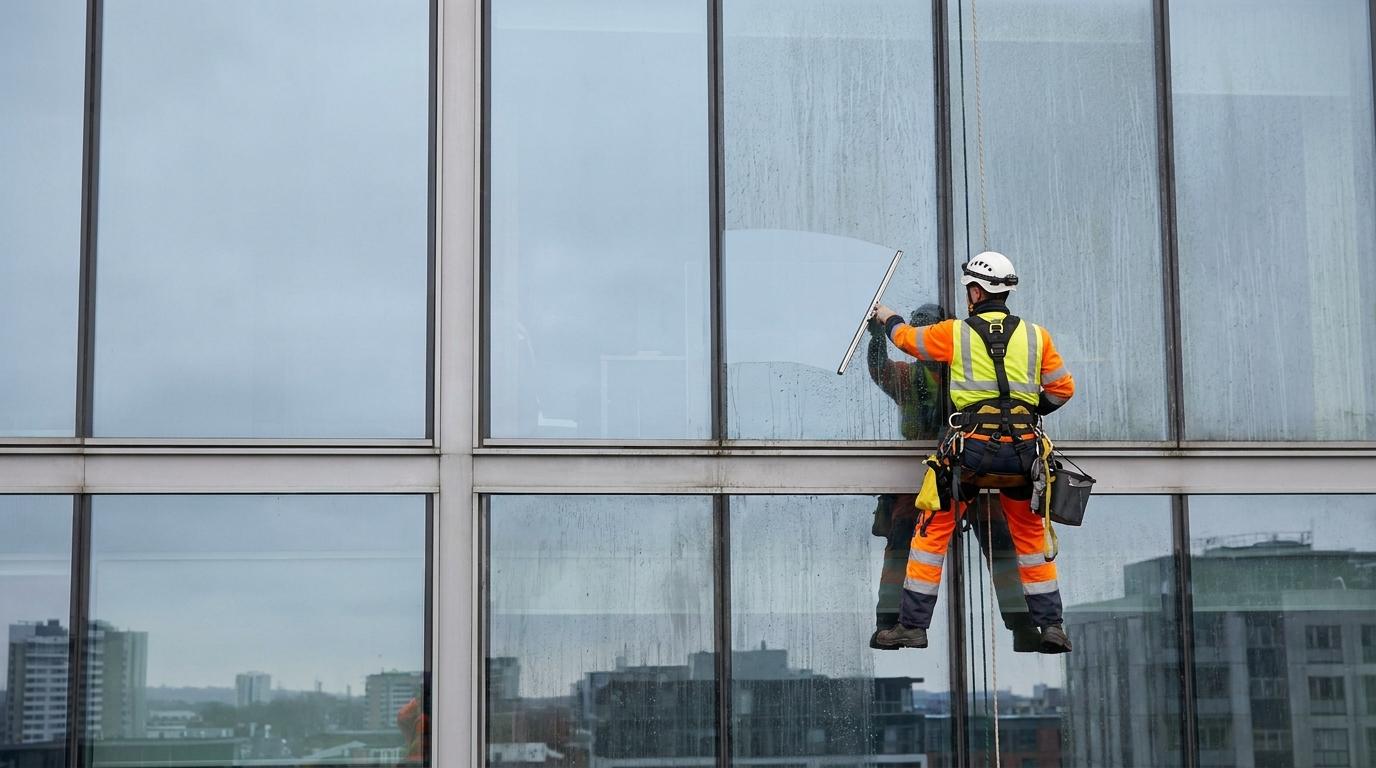
Technicians move section by section – usually wall by wall, from top to bottom. You’ll see them outside your window, ropes anchored on the roof, water and cleaning agents running down the facade. On a well-run job, the safety zone beneath them stays cordoned off the whole time.
If the weather changes during the work – strong wind, rain, or a storm – a reliable company stops working. That’s a safety standard, not a whim. A clause covering this should be in the contract.
How Weather and the Season Affect the Schedule
Rope access work is heavily dependent on weather conditions, which is why a reliable company won’t give you a “fixed” completion date, but rather a window of a few days within which the weather will allow safe working. Strong wind – typically from around a few dozen km/h upward, depending on the building’s height and how sheltered the site is – makes it unsafe to move across the facade, because the rope starts to sway and the technician loses control of their position. Rain and storms rule out work not only because of slippery surfaces, but also because of the risk posed by metal equipment components during lightning.
Seasonally, the best conditions for facade cleaning are usually spring, early summer, and early autumn – fewer heavy downpours, moderate temperatures, longer working days. Winter work isn’t ruled out, but it requires extra attention to ice on the facade and roof, and to lower temperatures, at which some cleaning agents lose effectiveness. If you need a specific date tied to, say, an event at the building, it’s worth booking well in advance and asking the company about backup days in case of bad weather.
Stage 5 – Handover and Documentation
Once the work is finished, handover takes place. This is a moment where it’s worth being present in person, or delegating someone who knows the building.
What to check at handover:
- Even results: Walk around the building and check whether all the walls look the same. Localised differences in cleanliness can indicate skipped sections.
- No streaks: Especially visible on glass and smooth facades. Streaks can indicate cleaning done too quickly or the wrong agents used.
- Condition of facade elements: Before handover, the company should tell you about any damage it noticed during the work – cracks, chips, loose elements. This is important information for you as the manager, regardless of who caused the damage.
Documents you should receive after the work:
- Handover protocol – signed by both parties, confirming the scope of work completed
- Photo documentation – photos of the facade’s condition after cleaning; a good company also takes photos during the work as proof it was carried out
- Recommendations for the next date – if the company noticed elements needing extra attention during the work (for example, a specific facade zone getting dirty faster because of nearby trees or a busy street), it’s worth having this recorded as a recommendation for the future
- Information about any damage noticed – if the technicians found anything concerning (cracks, detachment, corrosion around fittings), it should be documented
The Most Common Problems and How to Avoid Them
- No roof access on the day of the work: The crew arrives in the morning, there’s no key, the responsible person is unreachable. Sort this out in advance – establish exactly who hands over access, and how.
- No way to switch off the air conditioning: If you manage a multi-tenant building, controlling the air conditioning may need agreement from several parties. Sort this out a week before the work, not the day before.
- Notifying occupants too late: The most common problem in office buildings. Employees who weren’t informed react with concern or lean out of windows – which can be a hazard. A few days’ notice is enough to avoid these situations. A good practice is to put the notice both in an email to tenants and on the noticeboard at the entrance, so it also reaches visitors to companies in the building.
- Cars in the work zone: If tenants’ or visitors’ cars park below the facade, you need to arrange for them to be moved in advance. The company will cordon off the area, but it won’t move someone else’s vehicle.
Frequently Asked Questions
Do I need to be present in person for the whole job?
Not the whole time, but it’s worth being reachable by phone and showing up at least at the start and at handover. The company may need a quick decision – for example about damage noticed on the facade, or a change in access to a particular area.
What happens if the work is interrupted by weather halfway through?
A reliable company comes back and finishes the scope once conditions allow, with no extra charge just for resuming – this should follow from the contract. It’s worth agreeing this explicitly before signing, to avoid a dispute over whether the downtime is charged to the client or the contractor.
Do tenants need to keep their windows closed during cleaning?
Yes, that’s the standard recommendation – both for safety reasons and to avoid cleaning agent streaking into the interior. This should be included in the notice sent to tenants before the work.
Is photo documentation an extra cost?
With reliable contractors, it’s a standard part of the service, not a premium add-on – though it’s worth confirming this at the quote stage to avoid misunderstandings at handover.
Planning rope access work requires good coordination on both sides. Companies that do this well will guide you through every stage – from the site visit to handover – without surprises.
If you want to commission window or facade cleaning and you’re looking for a company that will guide you through the whole process – visit Rope Tech’s facade cleaning services or call for a quote. We start with a site visit.
Author
Piotr Lankiewicz
Specialist in height work and rope access techniques. Owner of a company providing services in the most inaccessible locations nationwide. He prioritizes punctuality, strict health and safety standards, and solutions that save time and costs where the use of heavy machinery is impractical or not cost-effective.