
Preparing a Building for Winter – A Practical Schedule for Housing Communities and Cooperatives
December, the first serious snowstorm. A building manager gets a phone call – the roof is leaking through the parapet wall, because the flashing hasn’t been checked in three years. The gutters have been clogged with leaves since mid-October and haven’t been draining water properly for weeks. There’s no contract with a roof snow removal company – because no one thought early enough to look for a contractor, and now, in the middle of the season, every reliable company already has a full booking calendar. Scenarios like this happen every winter, in almost identical form – and every winter they are entirely avoidable, if preparations start early enough.
Below is a schedule that lets you enter the winter season fully prepared – without firefighting in the middle of the season and without making decisions under the pressure of the first snowfall.
Why It Pays to Start Planning for Winter in September
Three reasons why September is the right moment to start:
- Queues at service companies: Gutter cleaning, roof inspections, snow removal contracts – companies specializing in these services have full calendars by October and November. Anyone who reaches out in December either waits in line or pays a higher rate for urgent-mode service, described in more detail in the article on verifying a snow removal company on an urgent basis.
- The window for facade washing: Below-freezing temperatures make washing impossible for several months. October is the last window to wash the facade before winter – it can be repeated in spring, but the dirt accumulated over winter will be heavier.
- Time for board decisions: If the order requires a resolution or budget approval, September provides enough margin for the formalities.
What Happens When Preparations Are Skipped
The scenario from the beginning of this article – a leaking parapet wall, clogged gutters, no snow removal contract – is not the exception. It is the most common pattern that managers and communities fall into when they treat the winter season as something that will “somehow work itself out,” instead of planning ahead. The consequences of skipped preparations compound over time: a clogged gutter that isn’t cleaned in October freezes in winter and cracks under the weight of the ice, meaning a replacement instead of a simple cleaning. Leaky flashing, unnoticed in September, becomes – after a series of freeze-thaw cycles – a source of leaking that damages the interior of the top floor, generating a cost disproportionately higher than the earlier repair would have been.
The snow removal contract works the same way – a manager who hasn’t secured a contractor by November has, in December, a choice between paying more for a contractor available on short notice or accepting a company without full verification, which carries the risk described in detail in the article on verifying a snow removal company on an urgent basis. The common denominator in all these scenarios is simple: the cost of reacting to a problem always exceeds the cost of preventing it, and the difference is often a multiple, not just a percentage.
Monthly Schedule
September
- Roof inspection: A review of the condition of the roof membrane, parapet wall seals, and flashing after the summer season. Summer brings intense sun exposure and temperature swings that can cause cracks and detached seals. September is the right moment for this assessment, before autumn rainfall starts putting the roof under full load.
- Cleaning roof drains: On flat roofs, drains and drainage grates collect debris throughout summer. September – before the autumn leaf fall – is the optimal time to clean them.
October
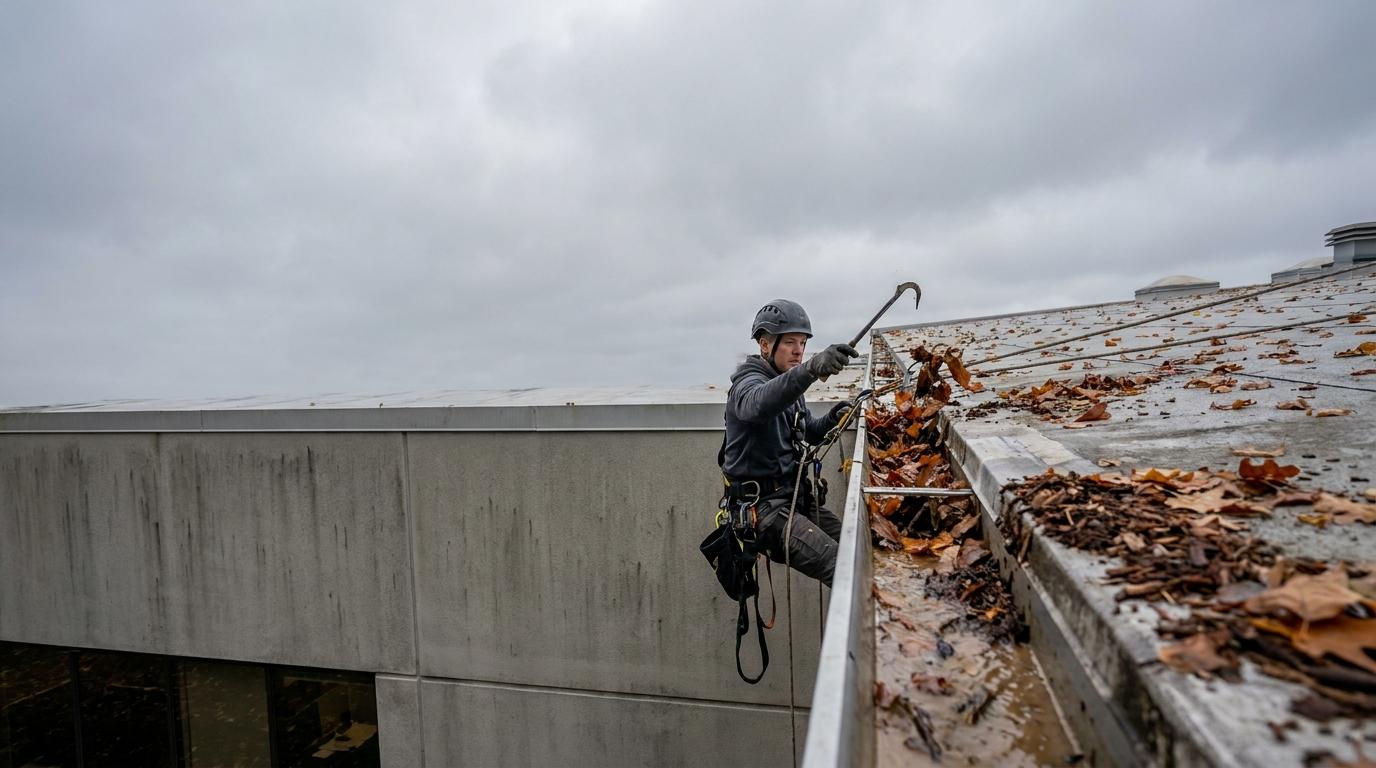
- Gutter cleaning: The main gutter cleaning season falls in October – after most leaves have fallen from the trees. Clogged gutters don’t drain water, which backs up under the roof covering or freezes inside the gutter and destroys it from within, forcing a costly replacement instead of a simple cleaning.
- Checking the seal on flashing and chimneys: Leaky flashing is one of the most common causes of leaks. October, before the season of heavy rain, is a good time for inspection and any necessary resealing.
- Facade washing: The last window before winter. Work can be carried out down to a few degrees Celsius above freezing – below that, cleaning agents don’t work properly and water freezes on the surface. A board that doesn’t manage to order washing in October has to wait until spring, and the facade collects additional dirt throughout the winter.
October – November (before the first frosts)
- Signing a contract with a roof snow removal company: This is the most important deadline in the entire schedule. Snow removal contracts signed in the middle of the season are more expensive, and at peak load companies simply don’t have crews available. Verifying a contractor – liability insurance, experience, scope of responsibility, staff qualifications – takes real time, which simply isn’t available in the middle of the season. Don’t leave this until December, when the availability of verified contractors drops sharply. We cover more on the criteria for choosing a company in the article How to Choose a Roof Snow Removal Company.
- Checking the flat roof drainage system: Drains, downpipes, grates – all of it should be fully functional before the first significant snowfall. A clogged drain on a flat roof during a thaw is a serious risk of leaking into the building’s interior.
December – March
- Emergency snow removal: If the contract was signed on time, this stage is predictable – a crew responds to a call-out according to the agreed terms. Problems arise when there’s no signed contract, or when the contractor has no availability during the peak of the season.
- Removing icicles near insulated walls: Icicles forming at roof edges and eaves pose a hazard to passers-by. On buildings with system insulation (EPS/polystyrene), removing icicles requires particular care so as not to damage the finishing layer – more on this in the article on the dangers of removing icicles yourself.
March – April
- Post-winter roof inspection: Once the snow has cleared, it’s worth commissioning a roof review for any damage from snow load, ice, and freeze-thaw cycles. Damaged membranes, detached flashing, or damaged gutters are better discovered in spring and repaired with adequate lead time than found only once the next autumn’s rain reveals the consequences.
- Planning post-winter repairs: Based on the inspection results, the board can schedule renovation work for spring and summer – with adequate lead time, at a calm pace, and without the time pressure that accompanies repairs undertaken in the middle of the winter season.
How to Plan a Budget for Winter Preparations
The preparatory work described in this schedule varies in cost, so it’s worth including it in the annual budget as a separate line item, rather than as an ad hoc expense that appears out of nowhere in the autumn budget. Roof inspection and drain cleaning are usually the least expensive elements of the whole cycle, but they carry key preventive value – they catch problems before they become costly failures. Gutter cleaning and checking the flashing are a mid-range expense, and it’s worth adjusting their frequency to the building’s surroundings – more deciduous trees nearby means gutters need cleaning more often than for a building in an open area.
The largest and most variable line item tends to be the snow removal contract, especially if the building has a flat roof or elements requiring particular attention – skylights, installations, parapet walls that hinder the free flow of snow. It’s worth reserving in the budget not only the cost of the seasonal contract itself, but also a pool for above-standard call-outs if the season turns out to be exceptionally snowy – similarly to budgeting for icicle-related call-outs, which we cover in the article on the legal risk associated with icicles.
Why the Order of Tasks in the Schedule Matters
The sequence of months in this schedule isn’t arbitrary – each task has been placed at the point where carrying it out makes technical and logistical sense. Roof inspection comes before gutter cleaning, because during the review it’s easier to spot which parts of the drainage system need particular attention. Gutter cleaning comes before signing the snow removal contract, because a functioning drainage system reduces the risk of problems related to standing water and ice, which later complicate the snow removal itself.
Managers who try to compress all these tasks into a single month – most often November, under the pressure of the approaching winter – regularly run into the same difficulties: a lack of available contractors, whose schedules are most heavily booked during that period, and no time for a calm response if the inspection reveals a problem that needs repairing before the first snow. Spreading the tasks over four months, starting in September, gives enough margin for each task to be carried out at the right time, rather than in a rush.
Frequently Asked Questions
What if the community starts preparations later than September?
It’s better to start in October than not at all – the schedule is best treated as a reference point, not a rigid straitjacket. In that situation, the priority should be having a signed snow removal contract in place before the first frosts, even at the cost of skipping less urgent tasks.
Do all these tasks require a company with work-at-height qualifications?
Most tasks related to the roof, gutters, and facade – yes, because they require access above 1 meter in height. It’s worth assigning them to a single, verified company that knows the specifics of the building from previous work, rather than looking for a separate contractor for each individual task.
Does the schedule differ for a building with a pitched roof versus a flat roof?
The basic structure of the schedule stays similar, but a flat roof requires additional attention to the drainage system – drains and grates, which usually don’t occur in that form on a pitched roof, and where clogging carries a more serious risk of leaking.
How long does it take to carry out the entire schedule?
Spread over four months, individual tasks usually take anywhere from a few hours to a maximum of two days each – the key isn’t the length of any single task, but scheduling them properly over time so they don’t pile up into one overloaded deadline.
Summary – Priority Table
| Month | Task | Priority |
|---|---|---|
| September | Post-summer roof inspection | High |
| September | Cleaning roof drains | High |
| October | Gutter cleaning | High |
| October | Checking flashing and chimneys | High |
| October | Facade washing (last window before winter) | Medium |
| October – November | Signing the snow removal contract | High |
| October – November | Checking flat roof drainage | High |
| December – March | Emergency snow removal, icicle removal | High |
| March – April | Post-winter roof inspection | Medium |
| March – April | Planning post-winter repairs | Medium |
For more on gutter cleaning and bird protection systems, see our article Gutter Cleaning and Bird Protection Installation. We cover the criteria for choosing a snow removal company in the article How to Choose a Roof Snow Removal Company, and the rules for safely removing icicles in the article on the legal risk associated with icicles.
If you’d like to discuss which tasks are worth planning for your building for the coming season, assess the condition of the roof and facade before winter, or secure a snow removal contract date right away – get in touch with us. Call or write to us through the Rope Tech website for a free quote.

Author
Piotr Lankiewicz
Specialist in height work and rope access techniques. Owner of a company providing services in the most inaccessible locations nationwide. He prioritizes punctuality, strict health and safety standards, and solutions that save time and costs where the use of heavy machinery is impractical or not cost-effective.