
How Often to Clean Windows and Glass Facades – A Seasonal Schedule for Commercial Buildings
A message lands on the office manager’s desk from a key tenant – fifth floor, two companies, the same complaint: dirty windows, the view over the city blocked by a layer of grey film. The windows were washed once a year, in spring. It’s October. The manager has no good answer, because there’s no set frequency – only habit. The question of how often to wash windows usually comes up once the problem already exists. It’s better to set a schedule before the tenant calls.
Why window cleaning frequency matters
Dirty windows are an aesthetic issue, but not only that. For office tenants, working comfort and the image of the office space are things they pay for in rent. For the owner of a shop or shopping centre, glazing is part of the display. The condition of the facade shapes the first impression for visitors.
Beyond aesthetics, there are technical arguments:
- Mineral deposits from hard water: Rainwater contains minerals that leave a white residue on glass once they evaporate. The longer the residue stays on the surface, the harder it is to remove. With a gap of several months between washes, the deposit can permanently dull the glass – removing it then requires specialist chemistry, which raises the cost of the service.
- Biological corrosion: Algae, moss and fungi settle on shaded, damp sections of glass facades. Left untreated, they work their way into seals and frame structures, degrading the materials. Regular cleaning removes these deposits before they take hold.
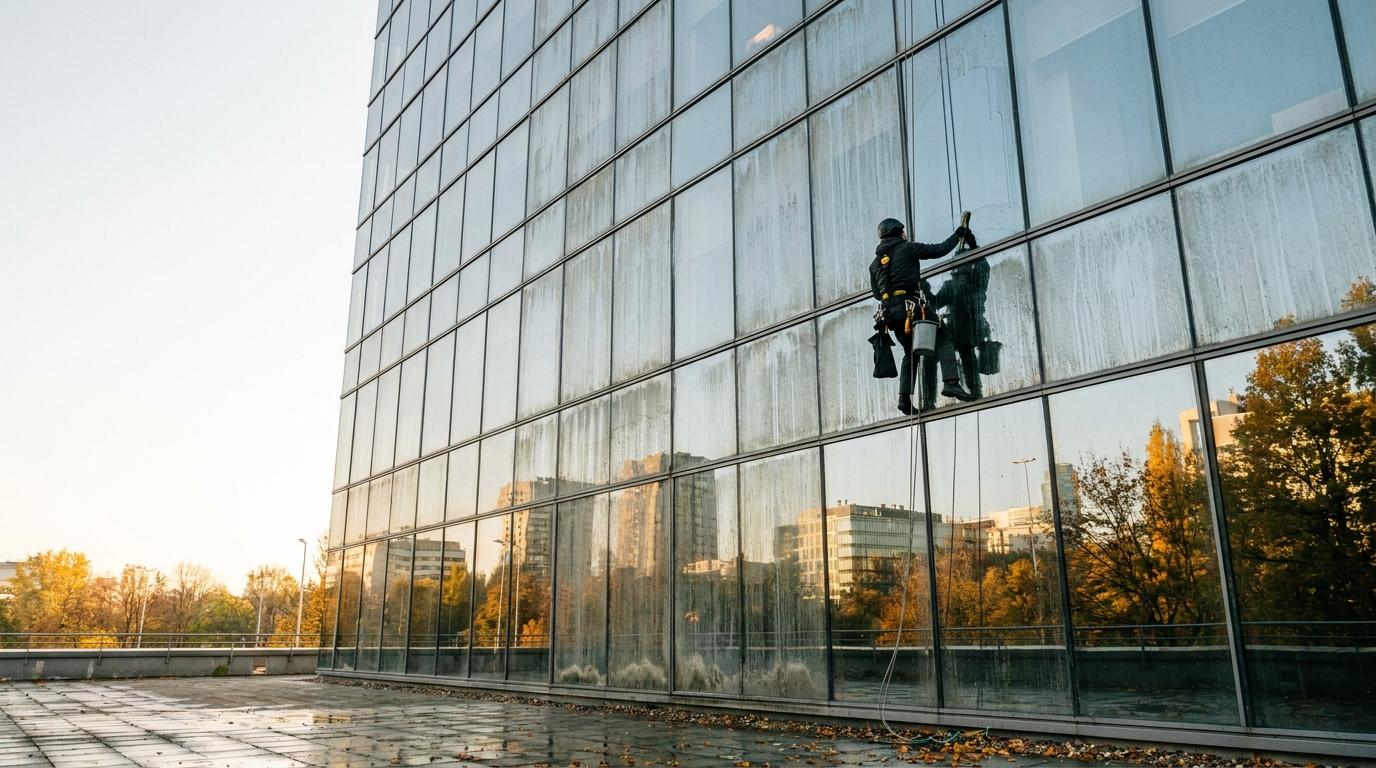
- Technical condition inspection: A rope access technician working at the window notices things a manager can’t see from street level – cracked seals, loose panes, corrosion marks on frames. Every cleaning service doubles as a free facade inspection. Problems caught early are cheaper to fix.
What affects how often you need to clean
There’s no single answer for every building. Several variables determine how fast a facade gets dirty and how often intervention is needed.
Building location. A big-city centre with heavy road traffic is a constant source of dust, exhaust fumes and particles from tyre and brake wear. An office building on a busy arterial road gets dirty faster than the same building in a business park on the outskirts. The difference between these locations can mean twice as many services a year.
Traffic intensity and air pollution levels. In cities with a smog problem – and many Polish cities have one – the heating season brings an extra layer of pollution settling on glass. Buildings near industrial plants or expressways face this problem all year round.
Nearby construction sites and trees. Active construction next door means cement dust, plaster and concrete particles settling on the facade – regardless of season. Deciduous trees near windows, in turn, bring pollen in spring and organic dust in summer. Both factors shorten the cleaning cycle.
Facade type. A structural glass facade gets dirty differently and needs a different cleaning technique than standard windows set into masonry. With a large glass surface area, dirt is also more visible – which raises the expectations of the building’s tenants and visitors.
Recommended schedule for an office building in a major city centre
For a typical office building with a large glazed area in the centre of Warsaw, Wrocław, Kraków or another major city, the recommended cycle is three services a year: spring, optionally summer, and autumn. Winter is usually skipped.
Spring – March or April: The first and most important wash of the year. Winter builds up grime – road salt used to de-ice pavements and streets rises into the air and settles on the facade. Add to that dust from grit, exhaust fumes from heavier traffic, and streaks left by meltwater running down the facade. Spring cleaning removes this build-up and restores the facade’s appearance for the whole spring-summer season.
Summer – June or July: An optional service, depending on the degree of soiling and the building’s requirements. For premium office buildings or retail properties with heavy customer traffic, it’s worth scheduling. For buildings in quieter locations, it can be skipped. The decision should be based on an inspection of the glass, not a fixed calendar.
Autumn – September or October: The second mandatory wash. Summer brings organic dust, rain marks and accumulated atmospheric pollution. Autumn cleaning prepares the facade for winter, when servicing is harder or impossible. A facade that goes into winter clean accumulates dirt more slowly and withstands biological corrosion better.
Winter – December to February: Usually skipped. Temperatures of a few degrees or below make it harder to work with cleaning chemistry, and short days shrink the available weather windows. The exception: the special circumstances described below, where the decision to intervene is made regardless of the season.
Schedules for other types of buildings
The three-service cycle above works well for a class A office building in a major city centre, but other types of buildings have different soiling patterns and different priorities worth factoring into planning.
Shopping centres and malls. Large entrance glazing and shopfronts are a customer’s first contact with the building, so aesthetics translate directly into visitor impressions here. Retail properties benefit from a more frequent cycle than office buildings – four services a year, with an additional wash before seasonal sales peaks such as the pre-holiday period, when customer traffic and expectations about the building’s appearance are at their highest.
Residential buildings and housing communities. Here the schedule tends to be less frequent – usually two services a year, spring and autumn – and the decision on frequency is more often made by the community board as part of the annual budget resolution. It’s worth including in the calculation not just the flat windows, but also common areas – stairwells with skylights, glazed entrances, glass balcony railings.
Industrial and warehouse halls. In production facilities, the priority is often not aesthetics but daylighting – dirty roof skylights and industrial windows reduce the amount of natural light, which translates into higher electricity consumption for lighting. Here it’s worth linking cleaning frequency to the building’s energy audit, not just to appearance.
How to monitor facade condition between services
A seasonal schedule is a starting point, not a fixed rule that can’t be adjusted. It’s worth developing a simple way to monitor facade condition between scheduled dates, to catch situations that need earlier intervention. The simplest solution is a monthly visual walkaround of the building – from street level or from the upper floors of neighbouring buildings, if accessible – with a short note on the condition of each facade.
It’s also worth collecting signals from tenants and building users in one place, instead of reacting to individual ad hoc reports. If several independent comments about the same zone of the building come in within a short time, that’s a signal that local soiling has sped up faster than the schedule assumed – for example because of a nearby construction site that wasn’t there when the year’s cycle was planned.
When intervention outside the schedule is needed
An established schedule covers standard soiling cycles. There are, however, situations that call for extra cleaning regardless of the calendar plan:
- After an incident at the building: A fire, a flood, a system failure – each can leave marks on the facade that ordinary rain won’t remove. Smoke staining, soot, traces of fire extinguishing agents – these should be removed at the first opportunity.
- After renovation work is completed: Construction work on the building or in its immediate vicinity leaves cement dust, adhesives, binders and paint on the glass. Post-construction cleaning is a separate scope of work – it’s worth commissioning it right after the works are accepted, rather than waiting for the next service cycle.
- Before an important event: An opening for a new tenant, a visit from a key client, a technical inspection, photographing the building for marketing materials. On such occasions, the condition of the glass carries symbolic weight – it’s worth taking care of it in advance, not at the last minute.
Frequently asked questions
Can a schedule be set several years in advance?
Yes, and this works well for buildings with stable soiling patterns – a calendar of services can be set for the whole budget year or even longer, with flexibility reserved for unplanned interventions. It’s worth checking every year, though, whether the building’s surroundings have changed – for example whether new construction has started nearby.
Does more frequent window cleaning extend the life of the frames and glass themselves?
Indirectly, yes – regularly removing mineral deposits and biological growth prevents them from working into seals and micro-damage on the glass surface, which becomes harder to remove over time without risking scratches. Neglected, years-old grime often requires more aggressive chemistry, which itself carries a greater risk to the surface than regular, gentler cleaning.
What if a building has both offices and retail units on the ground floor?
In such cases, a mixed schedule works well – the standard cycle for the upper office floors and more frequent cleaning of the ground-floor shopfronts, where aesthetics have a direct commercial impact. This can be planned as two separate, overlapping cycles within a single service contract.
Is it worth adjusting the schedule after an unusual winter or an exceptionally dry summer?
Yes – a seasonal schedule is a starting point based on typical conditions, not a fixed rule independent of that year’s actual weather. If the season was unusual in terms of rainfall, air pollution or the intensity of nearby construction work, it’s worth consulting the contractor about whether one of the dates should be moved or an extra one added.
How to build window cleaning into the building’s maintenance plan and budget
One-off orders for window cleaning are possible, but they have drawbacks: negotiating the price every time, the risk of no crews being available during peak season, and no continuity of knowledge about the building on the contractor’s side.
For commercial buildings with a regular service cycle, a contract covering the full cleaning cycle works better – the contractor reserves dates in advance, knows the building’s specifics and has an agreed rate. From the manager’s point of view, that means predictable costs in the annual budget and less coordination effort of their own.
It’s worth setting the schedule at the start of the budget year, using three dates as the starting point and leaving room for unplanned interventions. The summer date can be confirmed or cancelled after assessing facade condition following the spring service – that’s a technical decision, not an administrative one, and it’s best made together with the contractor, who knows the specific building’s condition.
Details on the specifics of glass facade cleaning – including chemical selection and techniques for removing different types of grime – are covered in our article on glass facade cleaning. Logistical issues related to washing windows in buildings with more than a few storeys are discussed in the article on window cleaning in multi-storey buildings.
If you’d like to set up a service schedule for your building, or discuss the current condition of your facade, get in touch with us. Call for a quote or send photos of the building, and we’ll come back with an assessment and proposed dates. You can find more about the service on our window and facade washing page.

Author
Piotr Lankiewicz
Specialist in height work and rope access techniques. Owner of a company providing services in the most inaccessible locations nationwide. He prioritizes punctuality, strict health and safety standards, and solutions that save time and costs where the use of heavy machinery is impractical or not cost-effective.