
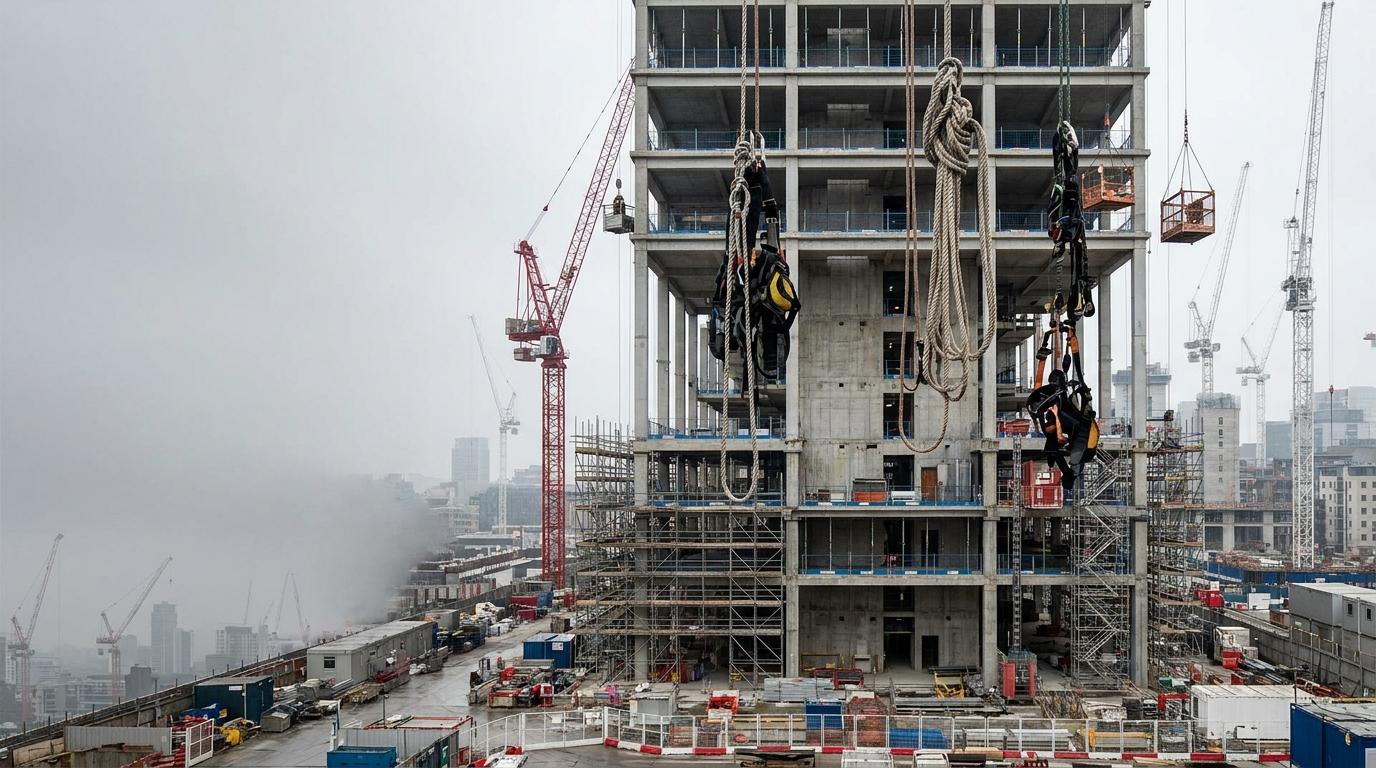
Work at Height on a Construction Site – How a Local Subcontractor Cuts Costs and Shortens the Schedule
A construction schedule rarely has room for weeks of waiting for a free slot with a subcontractor from the other end of the country, or for the extra cost of travel and accommodation for the crew. A local work-at-height subcontractor – familiar with local procedures, available at short notice, without the added logistics costs that distance generates – is often the difference between keeping the whole project on schedule and a costly slip that ripples through every following, interconnected stage of the build.
Where the Real Savings Come From With a Local Subcontractor
Response time – a local company can arrange a site visit within days, not weeks, and start work without a long mobilisation period. On jobs slotted into a tight construction schedule, where a delay in one stage pushes back the next, that time difference has a direct effect on the cost of the whole project.
No travel or accommodation costs – a crew from outside the region builds transport, overnight stays and per diems into the quote for the duration of the job. On longer contracts, these extra costs can make up a significant share of the total quoted amount, despite having nothing to do with the work itself or its quality – it’s pure logistics cost, one that a local company simply doesn’t generate.
Flexibility when the schedule shifts – a construction project rarely runs exactly to the original plan. A local subcontractor can adjust the execution date to shifts in the project’s overall schedule more easily than a company that has planned a trip and has to coordinate it with other jobs in distant locations.
Familiarity with local procedures and authorities – notifications to the building supervision authority, agreements with road managers when a traffic lane needs to be closed for the work, contact with the local emergency power service for work near overhead lines – a company that has operated in the area for years already has these contacts and procedures down in practice, instead of learning them by trial and error on your project specifically, which carries a real, concrete risk of delays caused purely by unfamiliar local red tape.
Shortening the Schedule – Not Just a Matter of Distance
Beyond location itself, rope access as a method shortens the schedule compared with scaffolding on its own – the crew starts work almost immediately, without weeks of waiting for a temporary structure to be erected and dismantled. For work at height limited to specific points rather than an entire facade or roof surface, that’s a difference of single days, not whole weeks spent waiting for scaffolding to be ready. We compared the costs and applications of the individual access methods in the article on scaffolding, aerial lifts and rope access.
On an active construction site, where successive crews come and go on a tightly set schedule, every day saved at one stage genuinely brings forward the completion date of the whole project. A subcontractor able to get on site within a few days of being contacted, rather than after a month in the queue behind companies from distant regions, becomes a real, practical tool for managing the schedule risk of the entire construction project.
What the First Contact With a Local Subcontractor Looks Like
A local company’s advantage isn’t just a shorter travel time, but also the speed with which you can go from the first enquiry to a concrete quote. A company from outside the region has to plan a site visit well in advance, usually combining it with other jobs in the area to justify the travel cost. A local subcontractor can turn up for a site visit practically from one day to the next, which for work requiring a quick response – for example a schedule correction caused by a delay in the previous construction stage – has a direct, measurable effect on whether the project’s original completion date can ultimately be held.
In practice, this also means communication during the job is simpler – the site manager can arrange a short on-site meeting instead of coordinating changes in scope by phone and email with a crew that is currently on the road or at another site several hundred kilometres away.
Long-Term Cooperation With a Local Subcontractor
General contractors carrying out successive projects in the same region gain extra value from working with a local work-at-height subcontractor, beyond any single contract. A company that knows the specifics of local buildings, local authority procedures and the region’s ground conditions doesn’t have to learn all of that again on the next project – which shortens onboarding time and reduces the risk of misunderstandings arising from unfamiliarity with local conditions.
Ongoing cooperation also makes budgeting for future projects easier – known rates, proven delivery times and an established way of communicating between teams reduce the uncertainty that inevitably comes with any new relationship with a previously unknown, unproven contractor.
Projects in Łódź and the Region
As a locally operating company, we carry out work-at-height projects in Łódź and the surrounding region, including for companies based in the Łódź Special Economic Zone, where a short response time and good knowledge of the specifics of local industrial facilities matter in a particular, practical way when planning every next project. You’ll find more detail on how a specific project actually runs and what exactly affects the price of such work in our article on work at height in Łódź, and on cooperation with companies operating in the Special Economic Zone – in a separate article on industrial rope access for companies in the Łódź Special Economic Zone.
Flexibility With Unforeseen Changes on Site
Construction sites rarely run exactly to the original schedule – delays in material deliveries, design changes introduced during execution, weather conditions affecting other stages of work. Any of these can mean the work-at-height crew’s start date has to shift, sometimes at very short notice. A company from outside the region that has planned travel and accommodation for a specific date has limited flexibility to respond to such changes – a shifted date means extra logistics costs for them, or the need to renegotiate the schedule with other clients.
A local subcontractor, for whom a given construction site is one of several parallel jobs in the same region, can usually adapt to such shifts more flexibly – reordering the sequence of tasks without incurring any additional costs tied to distance from the site. For a general contractor managing the whole project schedule, that subcontractor flexibility can be just as valuable as the price of the service itself, because it genuinely reduces the risk of a cascading delay through every following, interconnected stage of the build.
Hiring Workers as an Alternative to a Full Contract
A construction site doesn’t always need the full scope of a service with our own quote and our own supervision of the whole task – sometimes a general contractor or construction company simply needs extra, competent hands for a specific, short job: installing windows on upper floors, minor fixes after technical handovers, finishing work in spots that are hard to reach for a standard construction crew. In these situations, we offer our technicians for hire by the hour, together with rope access equipment and a vehicle, placed directly at the site manager’s disposal – they manage the worker on site day to day, and settlement is straightforward, based on actual hours worked, without the extra paperwork typical of separate contracts.
This solution works particularly well for short-term needs, where engaging a separate subcontractor with a full scope of service and its own contract would be disproportionate to the scale of the task itself – and the local advantage carries extra weight here, since a technician can reach a specific site the same day the need arises, instead of waiting for a date planned in advance. The construction company gains real flexibility – it can increase or reduce the number of people hired depending on the current stage of work, without having to renegotiate a separate contract for every, even minor, change in the need for extra hands at height.
When It’s Still Worth Considering a Company From Outside the Region
A local subcontractor isn’t always the optimal choice – for work requiring highly specialised, rare competencies (for example wind turbine blade inspections in a region without a developed wind energy sector), the narrower pool of companies with genuine experience in that scope can justify bringing in a crew from outside the region, despite the extra logistics costs. The same applies to very large, multi-month contracts covering multiple sites in different locations, where one large, nationwide company may offer better, centralised coordination of the whole than several independent local subcontractors operating separately in each region.
It’s worth treating locality as an important criterion, but not the only one – what always remains key is the actual, verifiable match between a company’s competencies and experience and the specific scope of work, covered in detail in the checklist for choosing a work-at-height subcontractor.
Frequently Asked Questions
Does a local subcontractor always offer a lower price than a company from outside the region?
Not always – the difference depends on the scale of the job and the distance an outside company would have to cover. For short, one-off jobs, though, the saving on travel and accommodation costs tends to be clear and easy to spot already at the stage of comparing quotes.
Is it worth having one permanent local subcontractor, or collecting quotes for every project?
Ongoing cooperation has the measurable advantages described above, but it’s worth periodically checking whether the chosen company’s rates and availability are still competitive against the market, rather than automatically continuing the relationship without that check.
Can a local company handle an unusual, complex job as well as a large nationwide company?
That depends on the specific company’s competencies, not on the sheer scale of its operations – it’s worth assessing this based on references and previous projects of a similar nature, rather than assuming from the outset that a smaller, local company has narrower capabilities.
How can you check whether a company actually operates locally, rather than just claiming to in its offer?
It’s worth asking for references from specific, recognisable sites in the region and checking the registered business address in the business register – a genuinely local company usually shares examples of nearby projects readily, since that’s its natural, easily verifiable competitive edge over companies from distant regions.
What to Look For When Choosing a Local Subcontractor
“Local” shouldn’t mean lower safety and formal standards – team certifications, current liability insurance and complete OHS documentation apply exactly the same way, regardless of the distance between the company’s registered office and the construction site. We’ve covered the full verification checklist for a work-at-height subcontractor in the article on choosing a work-at-height subcontractor.
Planning Work at Height on a Construction Site in the Łódź Region
Check out our full range of services or get in touch with us – we’ll discuss the scope of work, the schedule and the form of cooperation best suited to your project, whether you need a one-off, urgent job or ongoing support for successive projects across the whole Łódź region.
If you’re managing several construction projects in Łódź and the surrounding area at the same time, we’re also happy to discuss a permanent cooperation model, in which we learn the specifics of your standards and procedures once, and then get up to speed efficiently on every following project without repeating that process from scratch.
Author
Piotr Lankiewicz
Specialist in height work and rope access techniques. Owner of a company providing services in the most inaccessible locations nationwide. He prioritizes punctuality, strict health and safety standards, and solutions that save time and costs where the use of heavy machinery is impractical or not cost-effective.