The cost of preparing industrial machine surfaces – what drives the price of cleaning
The biggest difference between a durable protective coating and a quick colour refresh is decided before the paint can is even opened. It is the condition of the substrate and how it is prepared that determines the labour involved, the material used, and the risk of rework.
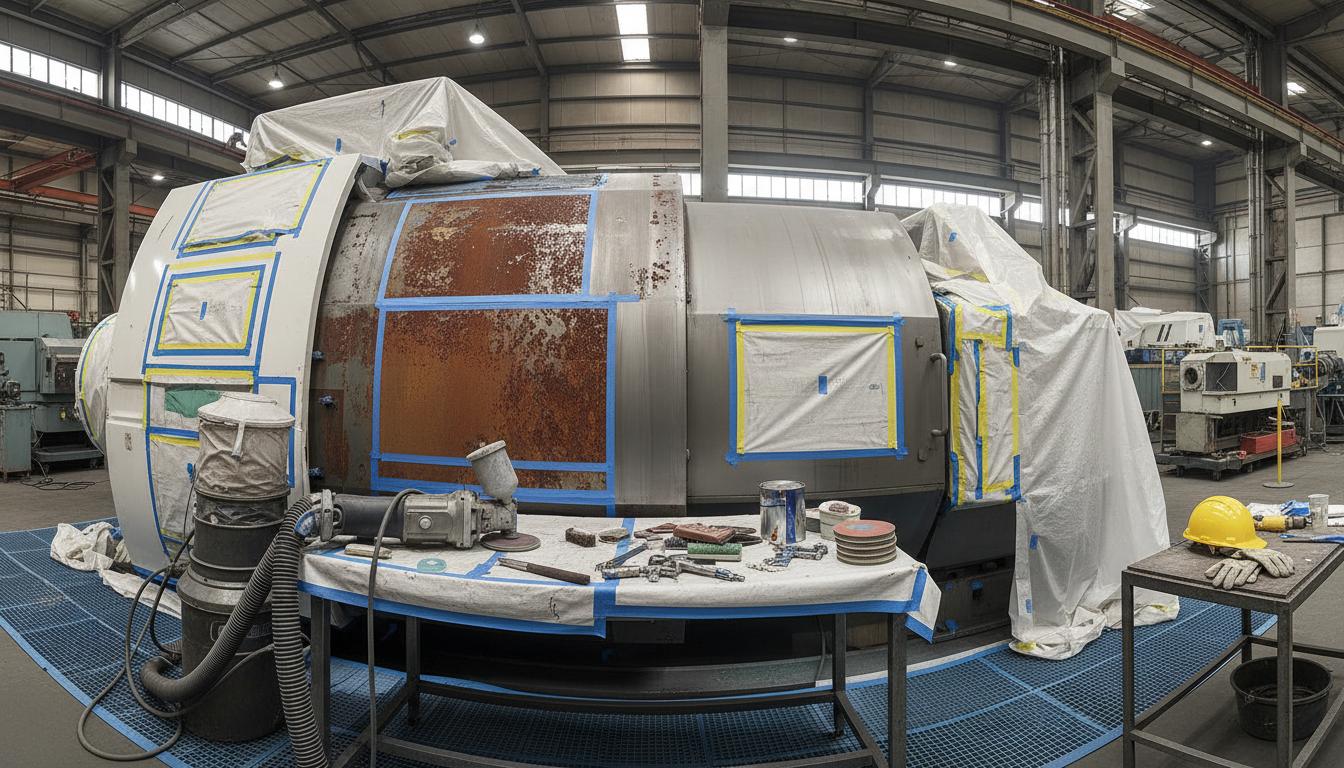
When pricing surface preparation for a machine, the main question is how much work is needed to bring the substrate to a state where the paint system can achieve proper adhesion. The cost of preparation does not come down to square metres alone. On industrial machines, time is consumed by edges, welds, ribs, greased areas, and spots hidden behind cables or covers. A decision is best based on data from the site itself, not on a simplified price list, a single photo, or an assumption carried over from another job.
Why surface preparation dominates the quote
The quote is shaped above all by an assessment of the old coating’s condition, the number of corrosion sites, the level of grease contamination, the amount of industrial dust, and access to edges and bolted connections. If this area is overlooked at the planning stage, work can stall not because of the technology itself, but due to lack of access, an unprepared zone, or a conflict with the plant’s operations. The schedule should account for preparation, the actual work, technological breaks, handover, and the ability to withdraw the crew safely.
The result is also affected by the share of tight rust, flaking coating, and previously repaired areas, as well as the geometry of the profiles and the number of details that need to be worked by hand. Only once this data is put together does it become clear whether the chosen method can realistically be carried out within the available time, without shifting undisclosed responsibilities onto the client.
Rope Tech standardly prepares surfaces mechanically as part of its wider cleaning of industrial objects and structures service, which makes it easier to control dust and carry out work in stages inside an operating plant. A reliable quote should separate preliminary cleaning, mechanical corrosion removal, dust removal, and degreasing into distinct line items. It is best to record these arrangements on a zone map or in a short protocol, so that the crew and the person accepting the work are working from the same breakdown of the object.
Mechanical cleaning as Rope Tech’s method
In practice, this means work with grinders and brushes that remove loose paint and corrosion, carried out locally, without scattering abrasive across the hall, which significantly simplifies organising work inside an operating plant. The most common mistake is choosing a solution that looks good on paper but does not match the conditions actually present at the site. The result is additional mobilisations, longer shutdowns, materials changed mid-job, or a reduced quality of surface preparation.
The real scope of this method only becomes clear on the actual site. What matters most is the amount of oil, grease, dust, and other operational contamination, and the required degree of old coating removal, since these factors affect the number of work stations, how they are secured, and the order in which individual zones are closed off.
Both stream methods, sandblasting and hydro-blasting, work well under specific site conditions, but Rope Tech treats them as a supplementary solution rather than the primary method of surface preparation. Each preparation stage carries a different workload, which is why they are best priced separately. If part of the data cannot be confirmed from photos, it is more honest to mark that scope as conditional than to write down a single figure that will later need correcting.
Preparatory work can naturally be combined with the high-level painting and anti-corrosion protection for industrial machines and structures service. The link leads to an overview of Rope Tech’s capabilities, but the details for a specific machine still require a separate quote and an assessment of the conditions on site.
Sandblasting and hydro-blasting as alternatives
These methods call for broader preparation of the surroundings – greater requirements around covers, waste management, moisture control, ventilation, and protecting neighbouring technological equipment. It is worth asking the contractor to describe the method, how it will be secured, the number of people involved, the access needed, who is responsible for preparing the site, and the acceptance criteria. The answers to these questions should be found in the offer or the agreement protocol – a general assurance that the team will manage does not replace a plan.
The method’s name alone is not enough to describe the scope of work. The offer should explain how the geometry of the profiles and the number of details worked by hand affect working time, and should also indicate the need to carry out work in stages, within short production windows. This kind of breakdown makes it easier to compare contractors and to distinguish the fixed scope from work that can only be confirmed once actual access has been obtained.
The most commonly used paint system is an epoxy primer combined with a polyurethane topcoat, unless the investor specifies their own coating system. If the substrate is assessed solely from a general photo, part of the cost has to be left as a conditional scope. In practice, the decision should also account for the point at which a stage can be safely halted, when weather, production, or the state of the surface make it impossible to continue.
How the geometry of the equipment changes working time
Lattice structures, welds, overlaps, cables, cabins, platforms, guide rails, and spots inaccessible to large-diameter tools extend working time far more than the flat surface area alone. These elements need to be translated into concrete questions asked during the site visit and the quoting process. The contractor should state which information is already certain, what cannot be assessed from photos, and which assumptions may only change the scope of work once the team is on site. This way the client is not comparing seemingly similar offers that in reality cover different work.
In this area, predictability comes above all from data on the required degree of old coating removal and on the share of tight rust, flaking coating, and previously repaired areas. Missing even one of these elements usually leads to an additional mobilisation, a schedule change, or a reduced scope once work has already begun.
Work can be planned for nights or weekends, when the machine is parked and the zone has been formally handed over to the crew. A good reference point is to designate a trial zone representative of the worst-affected section of the structure. A quote is clearer when it separates the actual task from mobilisation, protective measures, waiting for access, and work carried out by other parties.
How plant organisation affects cost
Production windows, night or weekend work, permits, fencing off areas, tarpaulins over production lines, and coordination with maintenance staff all translate directly into cost.
The choice of work organisation should lead to a concrete operational decision, not just to naming a technology. It needs to be established how far work in stages within short production windows is necessary, the amount of oil, grease, dust, and other operational contamination must be verified, and it must be recorded who approves a change in scope if conditions found on site differ from earlier assumptions.
Tarpaulins are used above active production lines, with a ground-based worker overseeing the zone and communication with the team working at height. This kind of organisation makes it possible to check the real pace of work and determine whether local repairs will suffice or whether more extensive removal of the old coating is needed. Handover is best planned before the prepared surface is covered or the access equipment is dismantled, since a later assessment may end up relying on photographs alone.
How to prepare data for a reliable quote
What matters most here are photos of the whole machine and its details, dimensions, height, access, the type of the old coating, the expected paint system, and information on whether production can be stopped for the duration of the work.
Before confirming the scope, it is worth checking the share of tight rust, flaking coating, and previously repaired areas, along with the geometry of the profiles and the number of details worked by hand. These two factors affect safety, working time, and the ability to sign off on a stage before a change of position or the equipment being restarted.
An operator holding UDT crane licences can reposition the equipment in line with the agreed work organisation. Underestimating the scope of preparation usually only comes to light once cleaning has begun, when further corrosion sites are exposed beneath the old coating. The assumptions should state not only what will be done, but also the boundaries of responsibility and the procedure for approving additional work.
Data needed to prepare a quote
A quote for preparing a machine’s surface should be based on material that allows access, scope of work, and organisational constraints on site to be assessed. The most useful data is gathered in a single message or form, supplemented with photos of the entire object and of the details in the worst condition.
- Photos of the entire machine and of the details in the worst condition.
- Height, geometry, width of access routes, and access constraints.
- Whether the equipment can be parked and the available night or weekend windows.
- The layout of production lines and how they are protected with tarpaulins.
- The required paint system or a specification provided by the client.
- The decision-maker on the plant’s side and the acceptance rules for each stage.
If the degree of rusting or the amount of grease is hard to assess without a site visit, the surface preparation quote should state the assumption made and how it will be settled if the substrate turns out to be different once uncovered. An offer prepared this way makes it possible to compare costs for the same scope of cleaning, rather than for different standards of preparation.
Course of execution and control points
The execution plan splits cleaning into stages that can be closed off before the crew moves on to the next zone of the machine. The sequence is not a matter of convenience – it determines the effectiveness of degreasing, the protection of the surroundings, and the ability to document the substrate, which will no longer be visible once the primer has been applied.
- Site visit and division of the equipment into clearly defined zones.
- Agreement on parking, lockouts, and communication with the operator or maintenance staff.
- Fencing off the area, protecting the lines, and setting up ground-level supervision.
- Mechanical corrosion removal, dust removal, and degreasing of the surface.
- Application of the epoxy primer and polyurethane topcoat, or the system specified by the client.
- Handover of the zone before the equipment changes position and production resumes.
The decision-maker on the plant’s side should be available for the handover of each cleaning stage and for every change to the preparation scope. If damage requiring work outside Rope Tech’s competencies is revealed beneath the old coating, the company can coordinate a subcontractor, but the documentation must clearly separate each participant’s responsibility.
Handover and documentation
Handover should correspond to the breakdown of the machine into cleaning zones agreed earlier in the offer. Photos of cleaned details alone are not enough if they cannot be linked to a specific zone, stage, and date. It is worth photographing the substrate before cleaning, right after degreasing, and before the primer is applied.
- Whether the zones completed match the map and the scope of the offer.
- Documented surface preparation before it is covered by the primer.
- Continuity of coverage on edges, welds, and underside surfaces.
- Cleanliness of lines, access routes, and equipment after protective measures are removed.
- A description of areas excluded from the scope and work carried out by other specialists.
The protocol should list zones with limited access and areas cleaned by other parties before the machine is handed over. This record makes it easier to plan future painting, use the warranty, and assess which sections will need re-preparation at the next intervention.
Most common mistakes and risks
The biggest problems in pricing machine surface preparation usually come from incomplete assessment of the site, not from using the wrong tool. A contractor facing an underestimated scope then has to choose between extra work or applying the system to a lower-quality substrate, which should never be accepted. The risks below are worth discussing before the crew is mobilised.
- Choosing an access method without first checking the equipment’s blind spots.
- No one available to approve moving or parking the equipment during the work.
- Overlooking grease, dust, and other operational contamination before painting.
- Assigning Rope Tech NDT testing or structural repairs that belong to a subcontractor.
- Starting too many zones at once, without being able to close them within the available time window.
The risks of underestimating surface preparation are limited by a site visit, a trial cleaning zone, and a precise description of the scope’s boundaries in the offer. Rope Tech does not carry out NDT testing or structural repairs requiring certifications the company does not hold, and coordinating a subcontractor does not mean performing their work itself.
Summary
A good decision on machine surface preparation brings together technology, access, plant organisation, and how the work is handed over. The lowest price is not an advantage if it leaves out preparation, protective measures, or tasks that only come to light once work has started on site.
Before signing the contract, it is worth confirming the scope of surface preparation, the order of the cleaning stages, who approves changes, and how the handover will be documented. This approach limits the risk of extra work being revealed only after the substrate is uncovered, and makes it possible to judge the result against criteria agreed in advance.
Author
Piotr Lankiewicz
Specialist in height work and rope access techniques. Owner of a company providing services in the most inaccessible locations nationwide. He prioritizes punctuality, strict health and safety standards, and solutions that save time and costs where the use of heavy machinery is impractical or not cost-effective.