Industrial Rope Access vs. Cherry Pickers – Which Pays Off More for Hall Cleaning?
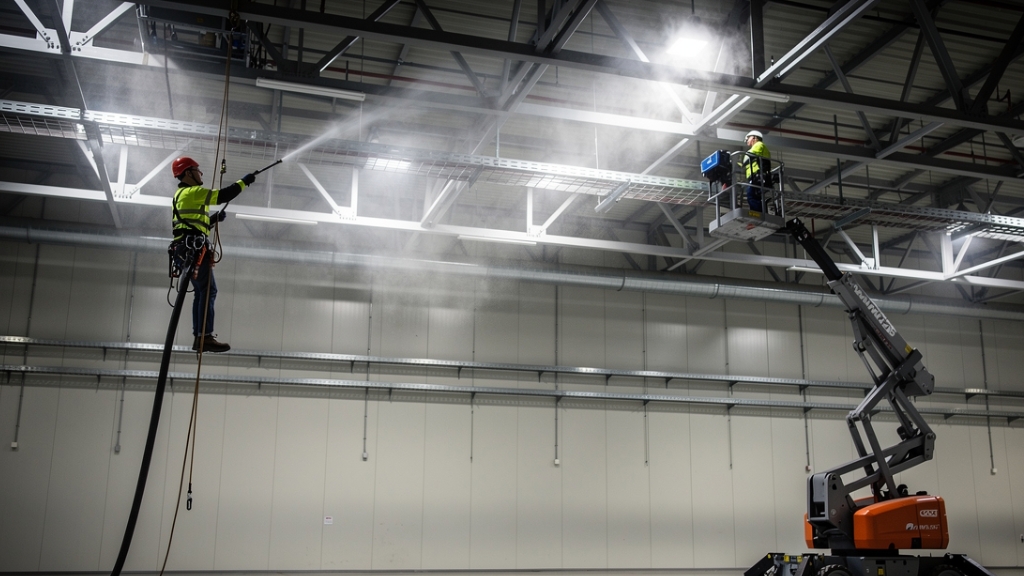
When the time comes to clean a hall (overhead structures, skylights, installations, beams, or high racks), in practice there are two ways to achieve the goal: a cherry picker (aerial lift) or rope access work. Both methods can be effective, but they differ in how much they “rearrange” the daily life of the hall and how much the entire operation costs, not just the man-hour itself.
Below you will find a comparison that will help you choose a solution based on the reality of the facility, not catalog theory.
Two Methods, One Goal: Safe and Thorough Cleaning at Height
Industrial Rope Access
This is work using rope techniques, harnesses, and anchor points. The operator reaches the dirty area directly, often from above, without the need to bring heavy equipment onto the hall floor.
Most common works in halls:
- removing cobwebs and dust from steel structures
- cleaning beams, trusses, traverses
- cleaning cable trays, pipes, ventilation ducts
- washing skylights, windows, glazing
- cleaning hard-to-reach corners and spaces above machines
Cherry Pickers (Aerial Lifts)
They provide a stable working platform and are convenient when you can drive freely up to the workplace. In halls, this usually means the necessity to ensure driveways, maneuvering space, and appropriate floor load capacity.
Most common applications:
- large, easily accessible surfaces
- work in open space without obstacles
- longer work in one point (without frequent repositioning)
Cleaning from a Lift or Ropes: What Actually Works Out Better?
The service cost is only part of the puzzle. The second part is logistics: do you have to shut down zones, stop traffic in aisles, move racks, move pallets, and sometimes even stop the process?
Where the Hall operates “Normally,” Ropes Often Win
If production, picking, forklift traffic, and people are active in the facility, rope access usually provides an organizational advantage.
Rope access advantages in hall cleaning:
- you don’t block aisles and communication routes for long
- lower risk of floor damage (no heavy equipment driving on the hall)
- easier to reach where there is “no access”: above machines, between installations, in narrow zones, under the truss
- work can be more spot-on (you clean what is needed, without “touring” the whole hall)
This is particularly important in high-bay warehouses and halls crowded with technological lines, where every meter of driveway matters.
Lifts Can Be More Cost-Effective When Conditions Are Simple and Space Is Free
A lift can be a great choice when:
- you have wide driveways and plenty of maneuvering space,
- the surface to be cleaned is easily accessible,
- work happens in one zone and does not require constant repositioning.
In such conditions, a working platform provides comfort and pace.
Differences That Most Affect the “Total” Cost
1) Downtime and Zone Shutdowns
A lift in a hall usually requires a larger safety zone and more often “eats up” operational space.
With ropes, the work zone is often narrower, and it is easier to plan the job so as not to stop traffic in key aisles.
2) Flooring and Damage Risk
Heavy equipment in a hall always raises questions: load capacity, expansion joints, resin floors, linear drains, thresholds, unevenness. Even careful driving does not change the fact that mass has an impact.
Rope access limits this risk because the equipment is lightweight, and the work takes place “in the air,” not on wheels.
3) Reaching Difficult Places
In practice, the basket loses when:
- something stands in the way (racks, machines, installations),
- it is tight,
- you have to work “between” elements, not “under” them.
Ropes give greater freedom of maneuver in unusual places.
How to Approach Pricing Without Surprises
If you are looking for a general price list, it is best to think of the quote like a set of building blocks: the more complicated the access and the more demanding the dirt, the more elements come into play.
What Most Often Affects the Hall Cleaning Quote
- height and access (where are the anchor points, do they need to be installed)
- type of dirt (dry dust is different from greasy technological deposits)
- scope (structure, installations, skylights, walls, racks)
- working conditions (active hall, night work, weekend work, service windows)
- H&S requirements and zone organization (signage, supervision, procedures)
How to Compare Offers to Compare “Apples to Apples”
Two quotes may look similar but cover different things. It is good to clarify:
- is zone protection and signage included in the price,
- are equipment and cleaning agents included,
- does the scope cover hard-to-reach places (that’s usually where the difference is),
- how does the contractor plan the work to limit shutdowns.
Quick Decision: When Ropes, When Lift?
Choose Ropes If:
- you don’t want to block aisles or stop logistics,
- you care about floor protection and minimal “equipment traffic,”
- you have many obstacles in the hall and hard-to-reach zones under the roof,
- you need to reach places where a basket simply won’t reach.
Choose a Lift If:
- the hall has plenty of free space and easy access,
- the work is in one place for a long time,
- you can fence off the zone without problems and it does not affect the process.
Author
Piotr Lankiewicz
Specialist in height work and rope access techniques. Owner of a company providing services in the most inaccessible locations nationwide. He prioritizes punctuality, strict health and safety standards, and solutions that save time and costs where the use of heavy machinery is impractical or not cost-effective.