

Working in Confined Spaces: Silos and Tanks. Procedures and Safety
A grain silo requires an inspection of the internal wall condition and cleaning after the season. The plant manager opens the hatch and looks inside. It is dark, deep, and tight. No plant employee should enter without proper preparation – and rightly so. The question is: who is allowed to enter, and what procedures must be followed for work inside to be legal and safe?
Working in confined spaces is one of the most regulated areas of occupational health and safety. It is also one of the most dangerous. Most accidents in such places have serious consequences because the hazards are not visible to the naked eye.
Definition of a Confined Space Under Occupational Health and Safety Regulations: When an Entry Permit Is Required
The regulation of the Minister of Labour and Social Policy on general occupational health and safety provisions defines a confined space as a space with restricted access, not intended for permanent human work, but where a hazardous atmosphere may exist.
Examples of confined spaces in industry include:
•grain and feed silos;
•liquid tanks, including water, wastewater, oils, and chemicals;
•reactors and process tanks;
•sewage and technological manholes;
•boiler and heat-exchanger chambers;
•technological tunnels.
An entry permit is required whenever the space meets at least one of the following conditions: there is a risk of a hazardous atmosphere, such as oxygen deficiency or the presence of toxic or flammable gases; there is a possibility that a person inside may become trapped or buried; or there is a risk of contact with liquids or bulk materials under pressure or flowing into the space.
In practice, every industrial silo and tank falls into this category.
Hazards in Confined Spaces: What Threatens People Entering Them
Hazards in confined spaces differ from hazards in standard working conditions. The key difference is that they are invisible and can appear suddenly.
Oxygen deficiency occurs when the oxygen level drops below 19.5%. In silos where grain or organic materials have been stored, biological processes consume oxygen. In closed tanks that have not been used for a long time, oxygen may also be naturally depleted through oxidation of the walls. A person entering without prior measurement may lose consciousness after only a few breaths, without any warning.
To prevent steel oxidation processes, specialist painting with coatings approved for contact with the stored medium is often recommended after the interior has been cleaned.
Toxic gases such as hydrogen sulphide (H₂S), ammonia (NH₃), carbon monoxide (CO), and methane may accumulate in tanks and wells. H₂S is particularly deceptive: above a certain concentration, it paralyses the sense of smell, so a person cannot detect its presence even when the concentration in the air is lethal.
Risk of engulfment occurs in silos where bulk materials, such as grain, granulate, or dust, can form an apparent “bridge” over an empty space, which collapses under pressure. A person who steps onto such a surface may be swallowed by the bulk material within seconds. This is one of the most common causes of death in silos.
Limited evacuation possibilities are another major risk. Extracting a person through a narrow hatch can take a long time, and rescuers themselves may be endangered if they respond incorrectly to an alarm. Entering the space without equipment is one of the most common causes of multiple casualties in a single incident.
Entry Permit Procedures: Step-by-Step Entry Into a Silo
The entry permit procedure for a confined space consists of precise steps that must not be skipped.
Risk identification and assessment are carried out by a designated supervisor, who evaluates hazards specific to the space, its usage history, contents, and current condition.
Isolation of the space involves cutting off all inflows of liquids, materials, vapours, and gases into the tank or silo. This may include mechanical valve lockout, installation of blinds, and neutralization of electrical installations inside.
Forced ventilation means supplying fresh air with a blower for a sufficiently long period before entry.
Atmosphere testing includes measuring oxygen concentration, with a target of 20.9% and a minimum of 19.5%; measuring flammable gas concentration, with the target below 10% of the lower explosive limit; and measuring toxic gas concentration. Testing is performed using calibrated instruments before anyone enters.
Issuing the entry permit means preparing a document containing the date, validity time, details of the people entering, measurement results, required equipment, and details of the entry attendant.
Appointing an entry attendant means assigning a person who remains outside the confined space for the entire time the team is inside. The attendant maintains visual or voice contact with the team, operates rescue equipment, and is responsible for raising the alarm if necessary.
Working with continuous atmosphere monitoring means that workers inside carry measuring instruments. If alarm thresholds are exceeded, the space must be evacuated immediately.
Closing the permit takes place after the work is completed. The team leaves the space, and the permit is cancelled and archived.
This procedure must be documented. The entry permit document is stored in the plant’s occupational health and safety records.
Certifications and Qualifications Required from the Rope Access Team
Working in confined spaces requires specialist competence combining industrial rope access techniques, such as entry, positioning, and rope extraction, with safety procedures for chemically and physically hazardous environments.
Required competencies and certifications include:
•IRATA certification, level II or III for technicians working in confined spaces, confirming competence in rope techniques in industrial environments;
•confined space work training, covering hazard identification, operation of measuring equipment, entry permit procedures, and rescue techniques;
•authorization to operate rescue equipment, including rescue tripods, evacuation winches, and supplied-air or breathing apparatus;
•first aid training, with at least one team member holding a first aid certificate, preferably covering industrial environments.
A team performing work in confined spaces should be able to present documents confirming its qualifications on request. This is not a formality. In the event of an accident, the lack of documented qualifications is one of the first issues examined by the labour inspectorate and the prosecutor’s office.
Equipment Required for Work in Silos and Tanks
In addition to rope access equipment, work in confined spaces requires specialist equipment, including:
•a multi-gas detector with alarms for O₂, LEL, CO, and H₂S;
•a rescue tripod with a winch, enabling evacuation of an injured person from a vertical space without a rescuer entering inside;
•self-contained breathing apparatus or filter masks appropriate to the atmospheric hazards;
•communication equipment, such as two-way radios or intercom systems, between the team inside and the attendant outside;
•intrinsically safe ATEX lighting when working in zones where flammable gases may be present.
If you need work carried out in silos, tanks, or other confined spaces, ask about our scope of services. We work in accordance with entry permit procedures, with a certified team and full equipment for work and evacuation in hazardous environments.
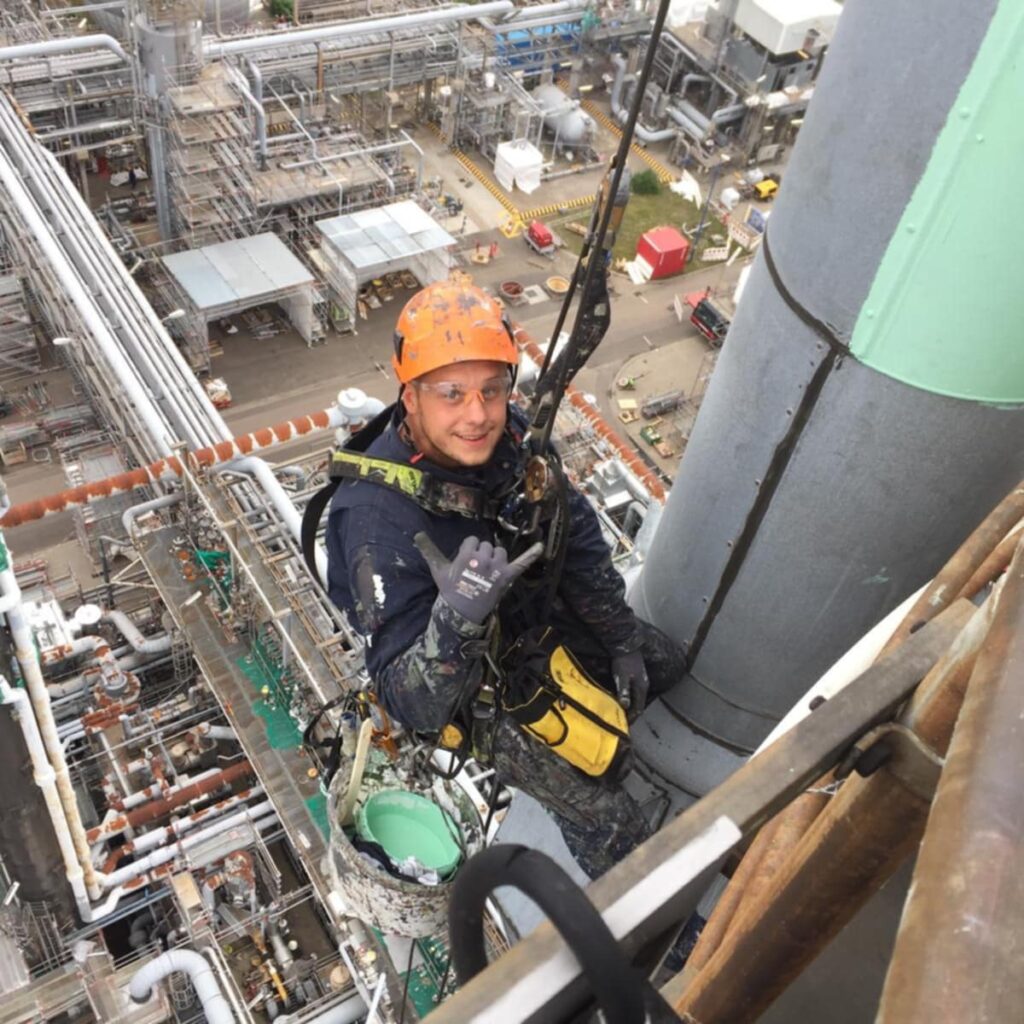
Author
Piotr Lankiewicz
Specialist in height work and rope access techniques. Owner of a company providing services in the most inaccessible locations nationwide. He prioritizes punctuality, strict health and safety standards, and solutions that save time and costs where the use of heavy machinery is impractical or not cost-effective.