
Who Is Responsible for Cleaning and Painting the Façade in a Housing Cooperative?
The community meeting ended three months ago. The list of tasks to be completed included renovating the façades of two apartment blocks. Since then, the administrator has received several calls from residents asking when the work will begin. One written request has reached the supervisory board. The question that comes up at every cooperative board meeting is always the same: who is responsible for the façade, and what are the consequences if we do nothing about it?
This question has a specific legal and operational answer, and it is better to know it before a building supervision inspection than during one.
Legal Basis: Who Owns the Façade and Who Maintains It?
In a housing cooperative, the façade is a common part of the building. It does not belong to any individual apartment owner. It is an element of the shared property, for which the cooperative or the housing community board is responsible, depending on the form of building management.
The obligation to maintain a property in proper technical condition follows from the Construction Law. Article 61 of this act requires the owner or manager of a building to use it in accordance with its intended purpose and to maintain it in proper technical, aesthetic, and sanitary condition. This obligation includes the façade, both in terms of safety, such as flaking plaster or cracks, and aesthetics, such as streaks, biological growth, and discoloration.
The Act on Ownership of Premises specifies that the costs of maintaining common property are borne by apartment owners in proportion to their ownership shares. This means that a decision to clean or paint the façade requires a resolution of the housing community or a decision of the cooperative in accordance with its statute.
In practice, operational responsibility lies with the property manager: the cooperative or the administrator appointed by the housing community.
What Are the Risks of a Neglected Façade? Legal and Financial Consequences
A neglected façade is not only an aesthetic issue. It has specific legal and financial consequences that may affect the cooperative board or the administrator.
An order from the District Building Supervision Inspectorate. The District Building Supervision Inspectorate has the right to order renovation or maintenance work on a building if neglect is identified during an inspection or following a report from residents or third parties. The order may specify a deadline for completing the work. Failure to comply may result in a fine or administrative proceedings.
Liability for damage to third parties. If a fragment of plaster or decorative element falls from a neglected façade and damages a car or injures a passer-by, the owner or manager of the building bears liability for compensation. In civil proceedings, the key issue is whether the manager carried out regular inspections and maintenance. A lack of documentation is an argument against the manager.
Claims from residents. An apartment owner who believes that a neglected façade causes dampness in their apartment or reduces the value of the property may pursue claims against the manager. In cases where moisture penetrated through an unsealed or fungus-contaminated façade, courts have awarded compensation.
Higher renovation costs in the future. Dirt and biological growth left on the façade for several years penetrate the render and damage its structure. Removing deep contamination and treating a biologically affected surface is much more expensive than preventive cleaning every few years.
How to Prepare a Work Order for an External Company
Commissioning work at height on a multi-family residential building requires several documents and arrangements that protect both the cooperative and the contractor.
•Resolution on the scope of work: a document confirming that the board or housing community has authorized the expenditure on façade works.
•Scope specification: a list of walls, surfaces, and types of work, such as cleaning, painting, plaster repair, or joint sealing.
•Information about trees and infrastructure: trees, power lines, and fences near the building that may obstruct access.
•Schedule taking residents into account: work on residential buildings requires residents to be informed in advance about the planned date, especially if the team will be working near apartment windows.
•Documentation requirements: a handover and acceptance protocol, before-and-after photos, certificates, and qualifications of the working team.
A reliable company will inspect the façade before preparing a quote. It will check the condition of the render, the presence of biological growth, and the condition of sheet-metal flashings and guttering. This allows the scope of work to be priced accurately and helps avoid surprises during implementation.
Example Façade Maintenance Schedule for a Multi-Family Building
Regular façade maintenance is cheaper than repeated major renovations. Below is an indicative schedule that can be adapted to the specific characteristics of the building.
| Timeframe | Scope of Work | Notes |
| Every year, in spring | Visual inspection of the façade, including cracks, flaking, and the condition of sheet-metal flashings. | This can be carried out as part of the annual building inspection. |
| Every 3–4 years | Pressure or chemical cleaning of the façade to remove dirt, biological growth, and streaks. | Before or after the autumn-winter season. |
| Every 8–12 years | Painting the façade with priming and possible plaster repair. | The timing depends on the type of paint and the façade’s exposure to weather conditions. |
| As needed | Sealing cracks, repairing plaster chips, and interventions after mechanical damage. | As soon as possible after damage is identified, because every delay increases the scope of repair. |
It is worth including the schedule in the building management documentation and monitoring its implementation. In the event of an inspection by the building supervision authority or a dispute with residents, systematic documentation serves as proof of proper property management.
Rope Access in Residential Construction: Why It Is Worth Considering
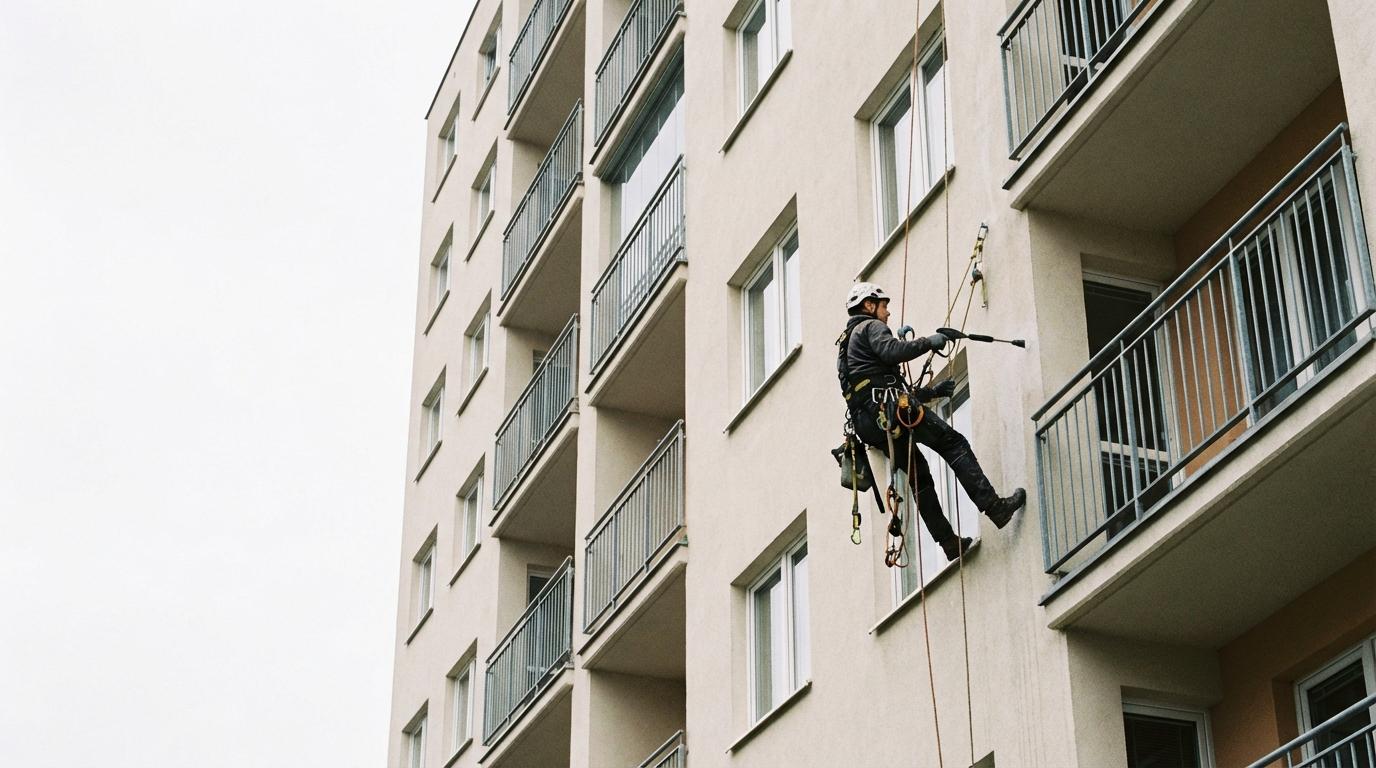
Cooperatives and housing communities have often associated façade work with scaffolding that occupies pavements for several weeks. Rope access changes this picture. The technician works from ropes anchored on the roof. No scaffolding stands next to the wall, the pavement remains accessible to pedestrians, and the parking space beneath the wall is occupied only by warning tape.
For the manager of a residential building, this means fewer complaints from tenants, less interference with the everyday life of the building, and a shorter completion time. In a multi-entrance apartment block, rope access allows one section to be cleaned or painted after another without occupying the entire area around the building at once.
If you are planning façade work and want to know what scope and timing are appropriate for your building, request a free quote. We will assess the condition of the façade, propose a method, and prepare a schedule that can be included in the cooperative’s renovation plan.

Author
Piotr Lankiewicz
Specialist in height work and rope access techniques. Owner of a company providing services in the most inaccessible locations nationwide. He prioritizes punctuality, strict health and safety standards, and solutions that save time and costs where the use of heavy machinery is impractical or not cost-effective.