
Who Is Liable for a Subcontractor’s Accident on Your Site?
An external company comes to your facility to carry out work at height: a roof inspection, façade cleaning, installation servicing, or work on a tower. You have a contract, the company is entered in the register, and it has a REGON and NIP number. Then suddenly an accident occurs. A technician slips, the right equipment is missing, something goes wrong. Does your role in this incident end at the moment you sign the contract with the subcontractor?
The answer that labour law and case law have been giving for years is clear: no. A person or entity commissioning work to an external company on its own premises has specific obligations, regardless of whether it is the direct employer of the injured person. It is worth understanding the scope of this responsibility before an incident occurs, not during the investigation.
Labour Code Article 304: Obligations of the Ordering Party Towards External Companies
Article 304 of the Polish Labour Code is a provision that many facility managers know by name, but rarely read in full. It imposes occupational health and safety obligations not only towards one’s own employees, but towards every person performing work on the premises of the managed facility, regardless of the legal basis of their employment.
In practice, this means:
•the obligation to provide safe and hygienic working conditions applies to the facility manager towards the subcontractor’s employees to the same extent as towards its own employees, within the scope resulting from the nature of the business and the site where the work is performed;
•the obligation to inform about hazards existing on the site, including the specific nature of zones, dangerous installations, substances, and active production processes that may pose a risk to external personnel;
•the obligation to organize work safely: if several entities are working on the same site at the same time, the facility manager must ensure coordination of occupational health and safety activities.
It is therefore not enough to say: “they have their own company, they have their own insurance, it is their responsibility.” The law clearly states that the site is under your responsibility, and everyone working there has the right to expect that they will be informed about risks and that the working environment meets minimum safety requirements.
When the Facility Manager Is Liable for a Subcontractor’s Accident: The Case Law Approach
Polish courts have repeatedly ruled on cases involving accidents suffered by employees of external companies on clients’ premises. The case law in this area is consistent, and it is worth knowing its key conclusions.
Civil liability under Article 415 of the Civil Code, or tort liability, may be attributed to the facility manager if negligence on the part of the ordering party contributed to the accident. This may include failure to remove identified hazards, failure to provide information about dangerous zones, or allowing work to take place in conditions that clearly fail to meet occupational health and safety requirements. In such a case, the injured person or their family may claim compensation not only from the employer, meaning the external company, but also directly from the facility manager.
Criminal liability of the facility manager may arise under Article 220 of the Polish Criminal Code if the accident occurred as a result of intentionally or unintentionally exposing an employee to an immediate danger. This provision does not require the injured person to be the perpetrator’s own employee. It is sufficient that the perpetrator was responsible for the state of safety in the place where the accident occurred.
Proceedings before ZUS, the Polish Social Insurance Institution, may also be relevant. If the external company conducts an accident investigation, ZUS may examine the circumstances of the event. The accident report may indicate shared responsibility of the facility manager, which matters both for the injured person’s claims and for possible recourse claims.
Recourse liability of the insurer is another risk. After paying compensation, the external company and its third-party liability insurer may seek reimbursement from entities that contributed to the incident. If negligence on the part of the facility manager was the cause or a contributing cause of the accident, a recourse claim is legally possible.
What Is an OHS Coordinator and When Is One Required for Work at Height?
The provisions of the Polish Labour Code, specifically Article 208, introduce the obligation to appoint an OHS coordinator when more than one employer performs work in the same place and at the same time. This applies directly to situations where both your own maintenance personnel and an external company carrying out work at height are operating on your premises.
An OHS coordinator is a person who:
•coordinates activities related to occupational safety and health when work is performed simultaneously by several employers or entities;
•supervises occupational safety and health for all employees working in the same place;
•ensures that procedures are in place in the event of an accident or sudden health hazard.
Appointing an OHS coordinator does not release employers from responsibility for the health and safety of their own employees. However, the mere failure to appoint a coordinator when there was a legal obligation to do so may be an aggravating circumstance for the facility manager in an investigation.
For work at height, including façade inspections, chimney cleaning, rope access work such as wind turbine inspection and servicing, or roof servicing, the obligation to appoint a coordinator arises whenever parallel activities are carried out by different entities in the same work area or in its immediate vicinity. This should be taken into account already at the work scheduling stage.
How to Protect Yourself Legally: Proper Contractor Selection and Documentation
A proper procedure before commissioning work to an external company, especially work at height, is not a bureaucratic formality. It is real protection for you as the manager, for the facility, and for the workers carrying out the tasks.
Contractor Verification Before Commissioning Work
Minimum verification should include:
•qualifications for work at height, such as IRATA certificates or other recognized technical qualifications held by the technicians performing the work. The mere fact that a company has “work at height” listed in its business activity codes is not sufficient confirmation of operational competence;
•third-party liability insurance appropriate to the risks, meaning a current insurance policy with a coverage amount proportionate to the scope of the work being commissioned. It is worth asking for the document, not only for a declaration;
•OHS documents for technicians, including current OHS training, medical certificates confirming no contraindications to work at height, and certificates for specialist training;
•a safe work method statement, known in Poland as IBWR, or a BIOZ health and safety plan. For more complex work, this document should be prepared by the contractor and accepted by the facility manager before work begins.
Site Handover Documentation
Before work begins, a site or workplace handover protocol should be prepared. This document confirms that:
•the facility manager informed the contractor about hazards present on the site;
•the contractor became familiar with the OHS conditions at the facility;
•the scope of work, work zone, and any restrictions were agreed;
•in the case of parallel work, an OHS coordinator was appointed.
A signed handover protocol is a document that, in the event of an investigation or court proceedings, confirms that the facility manager fulfilled their information obligations. The absence of such a document, or the lack of documented transfer of information about risks, is a gap that may be interpreted unfavourably for the facility manager during proceedings.
Verification During Work
Commissioning work to an external company does not mean completely transferring responsibility and “forgetting” about the work being carried out. The facility manager should appoint a person who is available during the work, can answer the contractor’s questions about the facility, and, if necessary, respond to unforeseen situations. This is not about supervising the technical method of work, which is the contractor’s role, but about being an available host of the site.
Post-Completion Documentation
After the work is completed, it is worth collecting post-completion documentation: a work acceptance protocol, the contractor’s statement that the work was carried out in accordance with OHS rules, and photographic documentation of the scope of work. This documentation has both operational value, as part of the facility’s service history, and formal value, confirming that the work was commissioned, completed, and accepted.
Check What We Offer in Terms of Safety and Documentation
Rope-Tech carries out work at height in accordance with IRATA standards, with full third-party liability insurance and documentation at every stage: from the site handover protocol, through inspection reports, to post-completion documentation. We provide our clients with a complete set of documents that are ready for any potential inspection or investigation.
If you are planning to commission work at height and want to know what our safety and documentation procedure looks like, contact us. We can discuss the scope of work and answer questions about organizing work at your facility.
Author
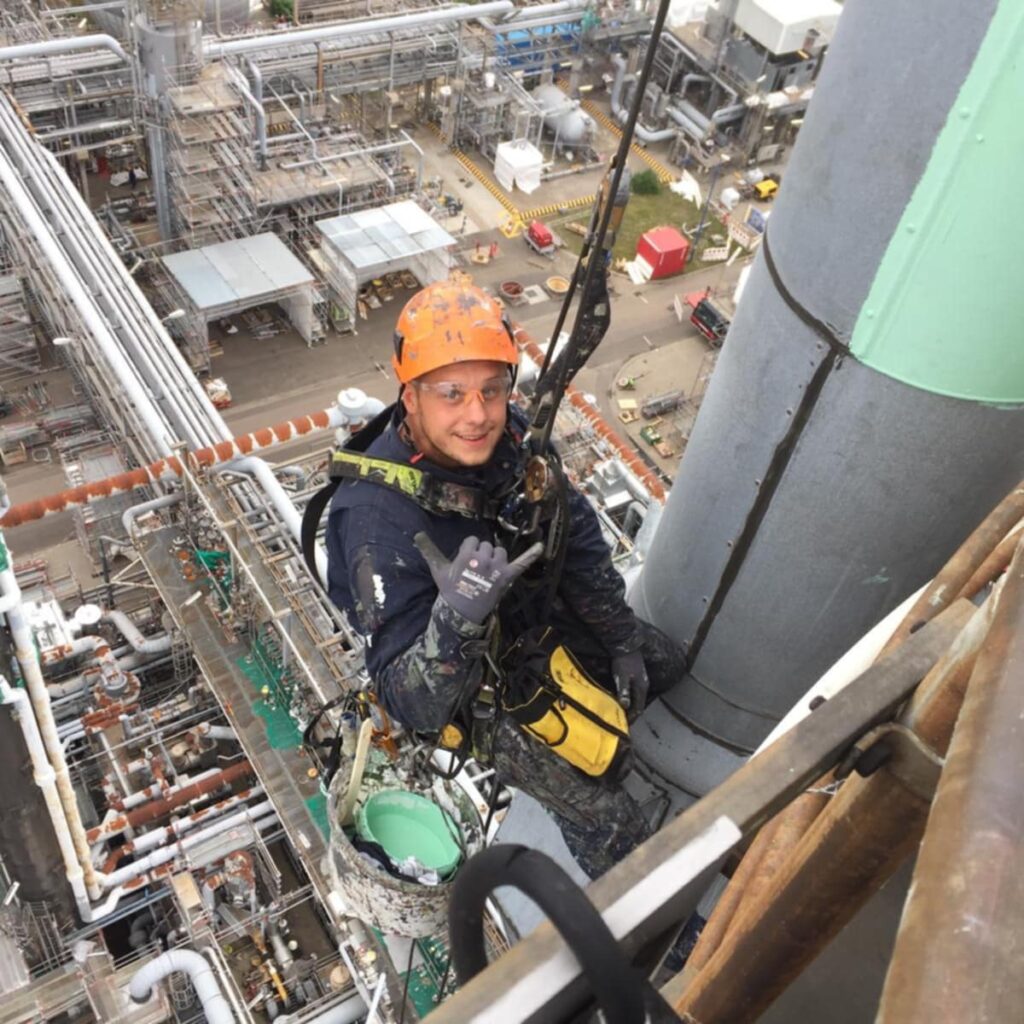
Piotr Lankiewicz
Specialist in height work and rope access techniques. Owner of a company providing services in the most inaccessible locations nationwide. He prioritizes punctuality, strict health and safety standards, and solutions that save time and costs where the use of heavy machinery is impractical or not cost-effective.