

Post-Construction Cleaning Before Handover: What the Inspector Checks and How to Prepare
Construction has come to an end. The crew has left the site, the construction manager has issued the handover schedule, and the investor has arranged a date with the supervision inspector. What remains on site is what always remains after construction: mortar marks on the façade, cement laitance on windows, construction dust on curtain wall glazing and glass façades, and lime streaks on the floor near the entrance. This is standard, and the construction team was supposed to deal with it. But they either did not, or they only did so partially.
The handover is in three days. It is time for post-construction cleaning.
Typical Construction Dirt: What Is the Hardest to Remove
Not all post-construction dirt looks the same, and not all of it is removed in the same way. Distinguishing between different types of contamination is important because the wrong method can damage surfaces that the construction site itself did not damage.
Masonry mortar and render on the façade include hardened mortar stains on clinker brick, textured render, or façade panels. They are removed mechanically, using a scraper or wire brush, or chemically, using hydrochloric acid-based products diluted to the appropriate concentration. Caution is required because hydrochloric acid damages sensitive materials such as aluminium, some types of stone, and painted coatings.
Cement laitance on glass appears as a white, matte film on the surface of panes after rainfall has washed cement from the walls. Once it dries and reacts with the glass surface, it forms a deposit that is difficult to remove. If fresh, an acidic glass-cleaning agent is usually sufficient. If old or baked on, mechanical intervention with glass scrapers is required, without scratching the surface.
Cement and construction dust on curtain wall glazing consists of fine dust that settles into micro-scratches in glass and profiles. Ordinary water washing does not remove it. Once wet, the dust turns into a paste that penetrates deeper. Cleaning with detergents that have a dispersing effect is required.
Lime and paint streaks are vertical, light-colored marks on dark façades. Rainwater may have flowed over a freshly painted surface or through leaking gutters during construction, leaving deposits behind.
Protective films and tape residue are common on windows and façades. If construction films are left on for too long, they stick to the surface under the influence of heat and UV radiation. Removing them without residue requires adhesive-dissolving agents and a careful approach to avoid scratching the window profile.
What the Inspector Checks During Building Handover
During handover, the investor’s supervision inspector or the developer’s representative pays attention to the technical cleanliness of the building. This is not only an aesthetic assessment. The level of post-construction cleanliness reflects the diligence of the construction crew and may affect the final settlement.
The elements most commonly checked during handover include the following:
•Glass and window joinery: whether the glass is clean, free from cement laitance and scratches, and whether window and door profiles are free from protective film or adhesive residue.
•Façade: the condition of external render, panels, and plinth surfaces, with no mortar stains, streaks, or construction-related surface damage.
•Entrances and transition zones: cleanliness of floors near entrances, absence of construction sand and debris on staircases, and elevators free from construction waste.
•Roofs and sheet-metal flashings: no construction materials left on the roof, clean roof drains, and no streaks caused by unfinished flashings.
•Curtain wall glazing and glass façades: clean surfaces without streaks, properly shaped profiles, and no scratches.
Any non-compliance will be entered on the list of comments in the handover protocol, and removing these issues may be a condition for considering the handover complete.
Stages of Post-Construction Cleaning
Professional post-construction cleaning is carried out in stages, from heavy contamination to delicate cleaning, and from the outside to the inside.
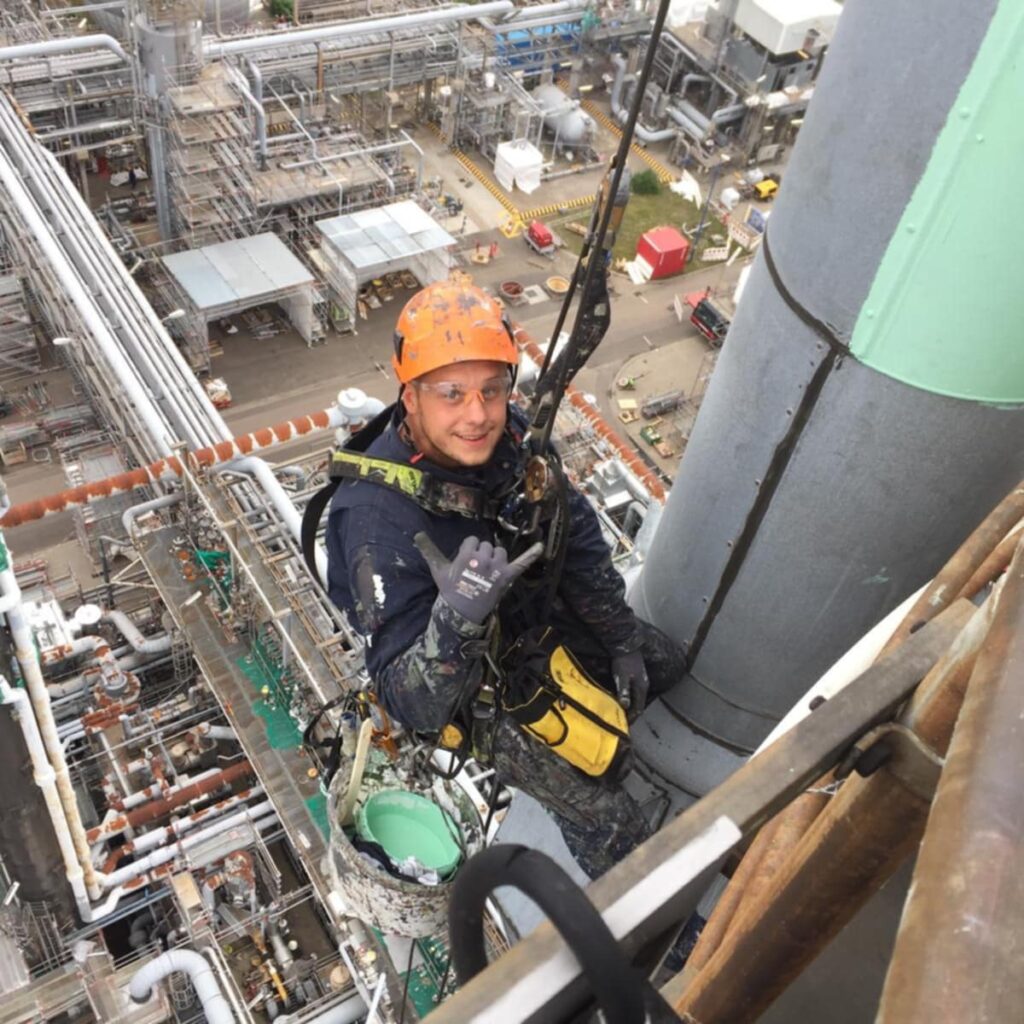
Removal of heavy mechanical contamination includes mortar, debris, films, and tapes. The team works on the façade and roofs, removing everything left over from the construction site. At this stage, scrapers, brushes, and dissolving agents are used. Rope access makes it possible to reach every wall and roof element without scaffolding.
Façade cleaning involves pressure washing with suitable chemicals, removing lime and mortar streaks, and preparing the render surface for acceptance. For natural stone or clinker façades, specialist acidic agents with neutralization are used. For silicone renders, gentle agents that do not damage the texture are required.
Window and glazing cleaning is carried out from both the outside and the inside. At heights above 3–4 meters, rope access or an aerial lift is required. Post-construction glass requires specialist agents for removing cement laitance and deposits. Standard window-cleaning liquid is not enough.
Final interior cleaning covers staircases, elevators, the entrance hall, floors, and radiators. At this stage, an internal cleaning team works without industrial rope access.
Final inspection and documentation include a walkthrough of the entire building, verification of the list of comments, and a handover and acceptance protocol with photos showing the condition after cleaning.
Why Rope Access Is Faster Than Scaffolding for Post-Construction Cleaning
Time is a crucial factor in post-construction cleaning because the handover date has already been set and is fixed. Scaffolding requires several days of assembly and the same amount of time for dismantling. Each floor and section may require a separate setup if the scaffolding did not cover the entire building during construction.
Rope access does not have this problem. The team anchors the ropes on the finished roof and starts working on the façade the same day. They can move freely across the entire façade, from corner to corner and from the roof to the ground floor. There are no assembly stages and no delays caused by scaffolding logistics.
For buildings with several storeys and a scheduled handover, this can mean a difference of several days, which may determine whether the handover takes place on time.
What Must Be Included in the Cleaning Completion Protocol
The proper completion of post-construction cleaning should be documented. The protocol is useful for the investor as proof of completion, for the construction team during final settlement, and for the building manager as a baseline for future maintenance.
The protocol should include:
•the date and scope of work;
•a list of the chemicals used, together with safety data sheets;
•before-and-after photos for each element of the building;
•information about access methods and equipment used;
•details of the team and confirmation of rope-access qualifications.
If you have a handover deadline and the building requires external post-construction cleaning, contact us. We will assess the scope, price the work, and propose a completion date adapted to your schedule.
Author
Piotr Lankiewicz
Specialist in height work and rope access techniques. Owner of a company providing services in the most inaccessible locations nationwide. He prioritizes punctuality, strict health and safety standards, and solutions that save time and costs where the use of heavy machinery is impractical or not cost-effective.