How to Remove Difficult Technical Dirt in a Hall Without Downtime
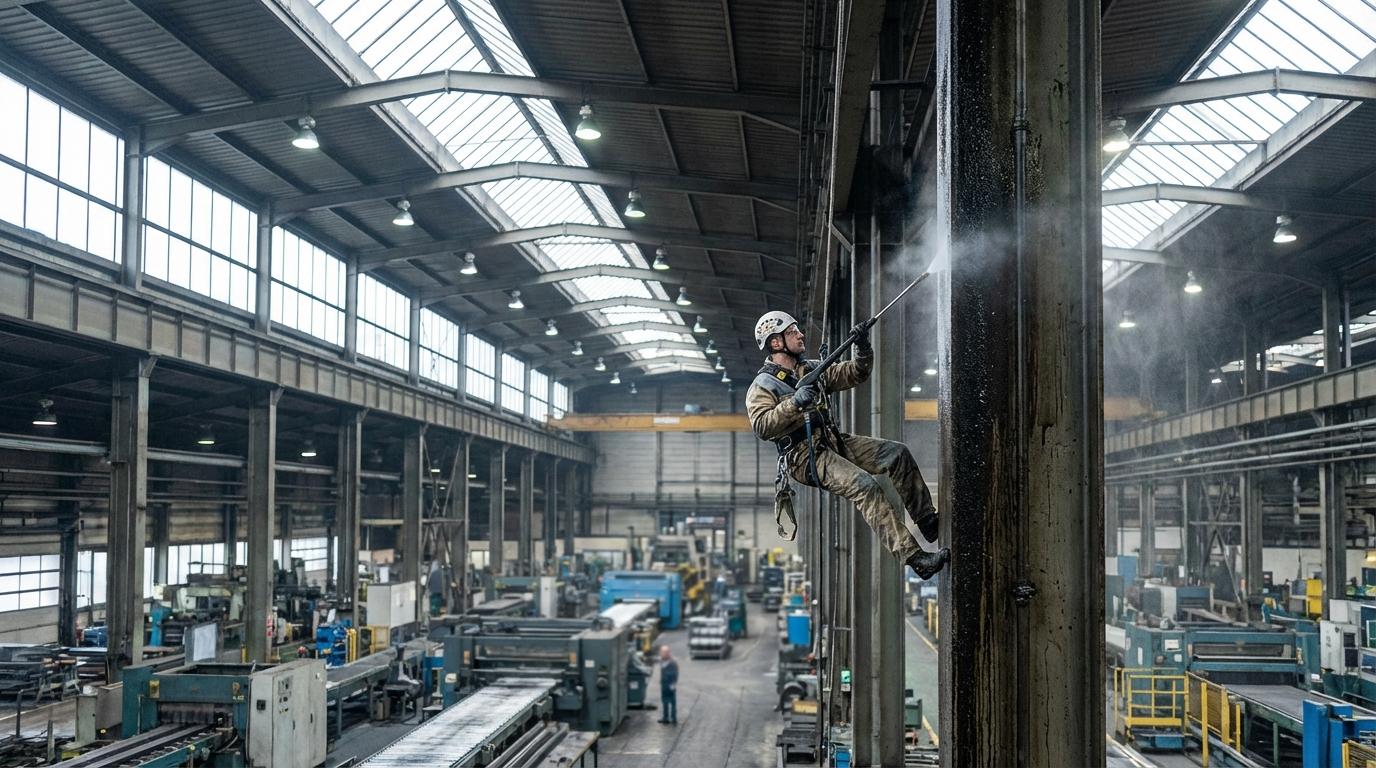
The maintenance manager walks through the hall before a GMP audit. The floors are clean because the cleaning company takes care of them regularly. But then the eyes move upward: the girder beams are covered with a layer of dark residue, exhaust fans are coated with greasy dirt, and a black substance that is difficult to identify is visible on the cable trays under the ceiling. The standard cleaning team says this is not within their scope. And they are right – they do not have the equipment to reach those areas.
Difficult technical dirt in industrial halls is a separate category from ordinary cleaning and maintenance. Removing it requires specialist knowledge, appropriate agents, and access to zones that neither a mop nor a standard industrial vacuum cleaner can reach.
Types of Difficult Technical Dirt in Halls
Before choosing a method, it is worth knowing what you are dealing with. Technical dirt in halls differs in composition, adhesion, and removal method.
Machine greases and oils settle on beams, cables, and overhead installations as a brown-black, sticky deposit. The cause may be vapors from lubricated bearings and gearboxes, oil mist from CNC machines, or leaks from tanks and hydraulic systems. Machine fats are difficult to dissolve with water and require an emulsifier or industrial solvent.
Coal and graphite dust is typical in plants where graphite is used as a lubricant or where composite materials are machined. This black, deeply penetrating dust settles on every horizontal surface. When exposed to moisture, it forms a paste that is difficult to remove without dispersing agents.
Technical fats from food-processing operations accumulate on ceilings and installations in meat, fish, and dairy processing halls in the form of condensed fats and proteins. At temperatures below 10°C, they harden and stick to metal. Removing them requires alkaline agents, such as NaOH or KOH in the correct concentration, and high temperature, usually industrial steam.
Production dust mixed with oil is created when dust from cutting, grinding, or material processing combines with oil from installations, forming a stable emulsion that adheres to vertical and horizontal structural surfaces. Pressure water alone will not break down this emulsion. Surfactants are needed.
Corrosion and corrosion products appear on steel structures in humid environments. They are not dirt in the traditional sense, but their removal is often part of maintenance work combined with cleaning.
Phase Cleaning: Sector-by-Sector Cleaning Without Stopping Production
The key organizational method for cleaning production halls without downtime is a phased approach. Instead of cleaning the entire hall at once, the facility is divided into sectors and the work is carried out one section after another.
The process works as follows.
Dividing the hall into sectors should take into account the layout of production lines, machines, and critical zones. Each sector should be possible to isolate from the rest of the hall, for example with foil partitions or a physical safety zone.
Planning a time window for each sector means determining when the line in a given sector is stopped or when its downtime is acceptable, such as during a night break, weekend break, or planned technical shutdown.
Carrying out the work in the sector involves the high-access team entering the area, vacuuming or washing the overhead structure, while a cleaning technician handles the floor and machines. Adjacent sectors continue operating normally.
Accepting the sector means preparing the protocol, photos, and confirmation that the line is ready to restart.
After that, the team moves to the next sector.
For a hall of 3,000–5,000 m², this approach allows comprehensive technical cleaning to be completed over several weeks without a single full-day shutdown. However, it requires precise coordination with the production planner and prior agreement on the schedule.
Selecting Chemicals That Are Safe in a Production Environment
The choice of cleaning agents cannot be random. Production halls are subject to restrictions resulting from the type of production, occupational health and safety regulations, and audit requirements.
In food-production halls, only agents approved for use in the food industry are permitted, such as products with HACCP authorization, PZH certification, or equivalent approvals. Agents containing organochlorine residues, strong acids, or alkalis in concentrations aggressive to production materials are unacceptable.
In halls with CNC machines and electronics, cleaning agents must not contain substances that corrode stainless metals or damage seals and electrical cables. Water-based emulsions with corrosion inhibitors are used.
In halls involving technical chemicals, agents must be compatible with ventilation systems and must not react with substances used in the production process. Before each job, it is worth providing the contractor with information about the production profile. This is the basis for selecting the right chemistry.
A reliable company presents safety data sheets for the agents used before starting work. These are documents required by occupational health and safety regulations for chemical substances brought onto the plant premises.
Documentation After Cleaning: What the Health and Safety Department and Maintenance Manager Should Receive
The result of technical cleaning in a hall should be documented for the plant’s internal use. Documentation has two purposes: managerial, confirming that the work has been completed, and evidentiary, useful during audits, State Fire Service inspections, health and safety checks, or quality inspections.
The minimum content of a post-cleaning technical protocol should include:
•the date of the work and a list of hall sections or zones covered by cleaning;
•a description of the working method, such as rope access, aerial lift, or washing equipment, and the agents used, including trade names and safety data sheets as attachments;
•before-and-after photos for each section, with at least 3–4 photos from different sides;
•details of the working team and the contractor’s civil liability insurance policy number;
•certificates confirming work-at-height qualifications, such as IRATA or equivalent certificates;
•signatures of the responsible person on the plant side and the contractor side.
This documentation allows the maintenance manager to enter the date and scope of the work into the maintenance register, while the health and safety department can attach it to the facility’s inspection records.
How Often Should a Hall with Difficult Technical Dirt Be Cleaned?
There is no single answer. The frequency depends on the intensity of contamination emissions in the production process, audit requirements, and the specific nature of the hazards. As a general rule:
•food-production halls with fatty processes should have overhead zones cleaned every six months to one year;
•mechanical processing halls with dust and oil should have overhead zones cleaned once a year, and machines and the immediate surroundings of production lines cleaned more frequently;
•warehouses without contamination emissions should be cleaned every two to three years, depending on the condition observed during annual inspections.
Regularity directly affects the unit cost. A hall cleaned every year requires less work than one tackled after five years of neglect.
Do you want to know how your hall can be cleaned in stages without stopping production? Schedule a free site visit. We will assess the condition of the hall, propose the scope, and prepare a schedule adapted to your working rhythm.
Author
Piotr Lankiewicz
Specialist in height work and rope access techniques. Owner of a company providing services in the most inaccessible locations nationwide. He prioritizes punctuality, strict health and safety standards, and solutions that save time and costs where the use of heavy machinery is impractical or not cost-effective.