How to Clean a Production Plant Facade Without Downtime
A technical inspection of the facility is scheduled for next month. The inspector from headquarters will ask about the condition of the façade, because it was last washed three years ago and, during the last visit, a client visibly reacted to the dark streaks under the gutters. The maintenance manager noted it down. Now something needs to be done, but the plant operates in a three-shift system and no one can imagine an aerial lift blocking the entrance gate for two weeks.
This is a specific scenario that appears regularly in industrial facilities. Washing a façade in a production environment is not the same as refreshing an office building or an apartment block. Everything is different: the schedule, access method, occupational health and safety requirements, coordination with the technical department, and the impact on daily operations.
The Specific Nature of Industrial Facilities: Why This Is a Different Type of Job
A production plant is a facility that generates revenue with every hour of operation. Downtime, even partial downtime, has a measurable cost. In such locations, the façade is exposed to specific types of dirt: industrial emissions, deposits from cooling towers, greasy technical dust, oil streaks from ventilation systems, and biological growth in damp and shaded areas. These are different contaminants than urban smog on an office building, and removing them requires different chemicals and a different approach.
At the same time, a plant imposes restrictions that do not usually occur in commercial construction:
•zones with increased occupational health and safety requirements, such as explosion risk areas, noise, and forklift traffic;
•restrictions on working near open production lines during operating hours;
•limited availability of space around the building, including maneuvering yards, internal roads, and ground-level installations;
•the need for arrangements with the health and safety department and often with the insurer.
Properly planned washing takes these restrictions into account from the quotation stage, rather than discovering them during the work.
Scheduling the Work: Night Shifts, Weekend Work, and Dividing the Site into Zones
The first decision to make before commissioning the work is the time window. In most production plants, there are three possible options.
Night work is most commonly used in plants operating in a three-shift system. Between shifts or during night hours, traffic outside the facility is reduced. This requires good work lighting and clear marking of the work zone. The hourly labor cost is higher, but daytime logistics remain unaffected.
Weekend work is optimal for plants that carry out maintenance breaks every two weeks or operate on a five-day schedule. A weekend can sometimes provide two full days of continuous work without interfering with production.
Zone-by-zone staging is used for large facilities or plants with no downtime window. The façade is divided into sectors, and each sector is washed independently over the following weeks. This requires a precise site map and a schedule agreed in advance.
Which solution should be used depends on the geometry of the building, the shift structure, and the plant’s priorities. There is no single model that fits every facility.
Rope Access vs. Aerial Lift: Which Method Disrupts Plant Traffic Less?
This question appears in virtually every request for a quote. The answer depends on the specific site conditions, but several general principles apply.
An aerial work platform requires stable, hardened ground and maneuvering space, usually at least several meters from the wall, depending on the required reach height and the equipment model. In practice, this means occupying an internal road or maneuvering yard for the duration of the operation. In plants with heavy forklift traffic and trucks entering loading halls, an aerial lift may simply be impossible to position without stopping logistics.
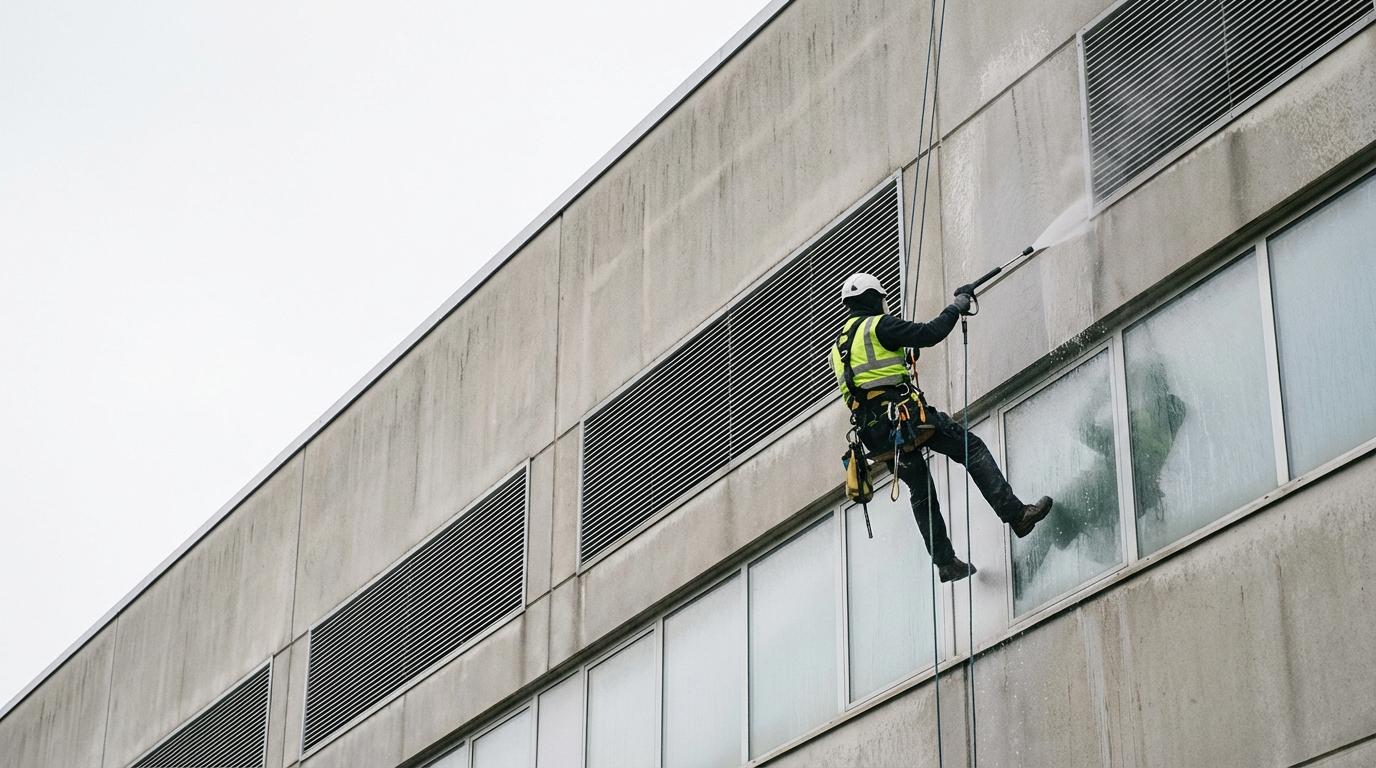
Rope access does not require any equipment on the ground. Technicians work from ropes anchored on the roof or to dedicated anchor points on the façade. The entire area next to the wall remains accessible. Forklifts, trucks, and pedestrians can move as usual, while maintaining a safety zone directly beneath the working team.
In industrial facilities with limited space, rope access usually wins when it comes to minimizing disruption. The exception is when the façade has complex architecture with protruding elements that prevent the free use of ropes. In such cases, combined methods, such as an aerial lift plus rope access, are the better solution.
Coordination with the Maintenance Manager: What to Agree Before Starting
Proper preparation for the work requires specific arrangements with the person responsible for the facility on the plant’s side. In practice, this is usually the maintenance manager or a person appointed by management. The list of topics to discuss before signing the order includes:
•a map of the building and hazard zones, including where EX zones are located, where forklifts operate, and where suppliers enter;
•roof access, including existing anchor points, the condition of roof hatches, and certification of anchor points;
•electrical power supply, including whether electricity can be drawn from external sockets for pressure washing equipment or whether the team must provide its own generator;
•zones where work is prohibited at specific times, such as side façades near production lines or areas where noise could interfere with quality measurements;
•occupational health and safety procedures in force at the plant, including induction training for external workers, access cards, and vehicle registration;
•an operational contact during the work, meaning the person on the plant’s side who can make decisions if a problem arises during execution.
The more of these points are agreed before work begins, the lower the risk of stopping the job halfway through and having to renegotiate the terms.
Cleaning Agents and the Production Environment
The choice of chemicals for washing the façade of a production plant cannot be random. Near production halls, raw material warehouses, ventilation systems, or water treatment stations, the use of aggressive surfactants may contaminate the working environment or interfere with the production technology.
Cleaning agents selected by a high-access cleaning company should be:
•certified for use near food or pharmaceutical lines, if the facility requires it;
•biodegradable, if runoff from the façade may enter stormwater drainage or the ground;
•compatible with the type of render or façade coating, because not all agents are suitable for ETICS systems and not all are suitable for composite panels.
Before the work begins, the company should provide safety data sheets for the agents used. This is a standard procedure in facilities with a health and safety department.
Documentation After the Work Is Completed
A professional project ends with a handover and acceptance protocol. For a production plant, such a document should include the date and scope of work, a list of the agents used together with safety data sheets, before-and-after photos, information about the access method and equipment, and the details of the working team together with confirmation of their qualifications. This is not a formality. It is a document that may be needed during an audit, an insurance claim, or a facility inspection.
When to Schedule Façade Washing at a Plant
The optimal times are spring, after winter and before the inspection season, and early autumn, before biological growth becomes fixed by moisture. In the case of food, pharmaceutical, and cosmetics plants, dates are often dictated by audit schedules, such as BRC, IFS, or HACCP. In such cases, it is worth planning the work at least four to six weeks in advance to allow time for any corrections and to issue documentation before the inspection.
Plants that clean their façades regularly, every two to three years, incur lower unit costs. Dirt is not so deeply embedded, the work takes less time, and less cleaning agent is used. Dirt left for eight or ten years may require sandblasting or abrasive methods, which are significantly more expensive and may damage the coating.
If you want to check how the work can be planned without affecting your plant’s operations, schedule a free site visit. We will come to your facility, assess the condition of the façade, and propose a method and schedule adapted to your working rhythm.
Author
Piotr Lankiewicz
Specialist in height work and rope access techniques. Owner of a company providing services in the most inaccessible locations nationwide. He prioritizes punctuality, strict health and safety standards, and solutions that save time and costs where the use of heavy machinery is impractical or not cost-effective.