How Much Energy Can You Save by Cleaning Roof Skylights?
A production hall has 18 polycarbonate roof skylights. Over the years, dust, algae, rainwater streaks, and debris from the surrounding area have accumulated on them. Artificial lighting runs at full power from early morning because the hall is too dark. Electricity bills are rising. Employees at assembly stations complain about insufficient lighting in the zones near the roof windows. The plant’s technical manager knows that the skylights are dirty, but does not realize that this is the main cause of these problems.
Dirty roof skylights are one of those cases where a one-off cost of work at height pays for itself through lower electricity bills. Let us look at what this means in numbers.
How Dirty Skylights Affect Hall Illumination: Light Transmission
Roof skylights made of solid or multiwall polycarbonate are designed to transmit as much natural light as possible into the interior of the hall. A new polycarbonate panel typically transmits 80–90% of visible light, depending on the type of material and UV coatings.
Over time, under the influence of external factors, the transmission coefficient decreases.
Dust and atmospheric deposits settle on the horizontal or slightly inclined surface of the skylight, especially in industrial areas or near expressways, forming a filtering layer. Dried deposits that have not been washed away by rain create a coating with constant light transmission reduced by several to several dozen percent.
Biological growth such as algae and moss on polycarbonate physically blocks light. A green layer of algae can reduce transmission by another several dozen percent compared with dust alone.
UV degradation causes older polycarbonate without a UV coating to yellow, reducing transmission independently of dirt. This effect is irreversible, and cleaning will not undo it.
In practice, a dirty skylight in an older industrial hall may transmit only 40–60% of the original amount of light. This means that the level of daylighting originally planned by the designers is now being achieved at only half strength, or less.
Conversion: Increased Transmission After Cleaning and Reduced Electric Lighting Costs
The relationship between light transmission and electricity consumption for lighting is not linear. It depends on the lighting control system, the arrangement of luminaires, and the work zones. However, the general rule is simple: when nature does the job for free by providing more light, artificial lighting works less.
In halls equipped with light intensity sensors, such as DALI or BMS systems, increased natural daylight automatically results in dimming or switching off electric luminaires in zones near skylights. In halls without automation, the effect depends on working culture and procedures, but a regularly reported outcome is a reduction in the operating time of artificial lighting during daylight hours.
Cleaning skylights restores their original or near-original light transmission. The effects depend on the level of dirt and material degradation. In facilities where the problem has been neglected for several years, the increase in transmission after cleaning can reach 20–40 percentage points.
Example ROI Calculation for a 3,000 m² Hall
Let us assume a typical scenario: a production hall with an area of 3,000 m², 24 roof skylights measuring 3 m × 2 m each, dirty for several years. Electric lighting operates during the day for 10 hours, 250 working days per year. The LED luminaires have a combined power of 60 kW.
We assume electricity costs within the range of current industrial rates without giving a specific price per kWh, because this differs depending on the tariff and contract. For estimation purposes, 60 kW operating for 10 hours per day over 250 days equals 150,000 kWh per year for working lighting alone.
If, after cleaning the skylights, the lighting system reduces operating time in naturally lit zones by 20%, through a BMS system or a simple zone-based schedule, the saving is 30,000 kWh per year. At industrial electricity rates of several hundred Polish złoty per MWh, this represents savings of several to several dozen thousand Polish złoty per year.
The cost of cleaning skylights in such a hall, using rope access or a service platform if the hall has a system-based suspended walkway, is usually a one-off amount of several thousand Polish złoty. The ROI is therefore less than one year.
This is, of course, an estimate. The specific figure depends on the current condition of the skylights, the plant’s energy tariff, and the lighting control system. But the direction is always the same: investment in cleaning pays back faster than most energy-efficiency projects.
Additional Benefits Beyond the Electricity Bill
Clean skylights affect more than energy costs.
Work comfort improves because natural light supports concentration and employee well-being, especially at workstations requiring visual precision.
Fewer quality-control errors may occur because visual inspection zones need appropriate lighting. Dirty skylights above QC stations create a real risk of defects being overlooked.
Material durability also improves because biological contamination degrades polycarbonate faster. Regular cleaning extends the service life of the skylight and postpones panel replacement, which is much more expensive than cleaning itself.
How Rope Access Solves the Problem of Cleaning Roof Skylights
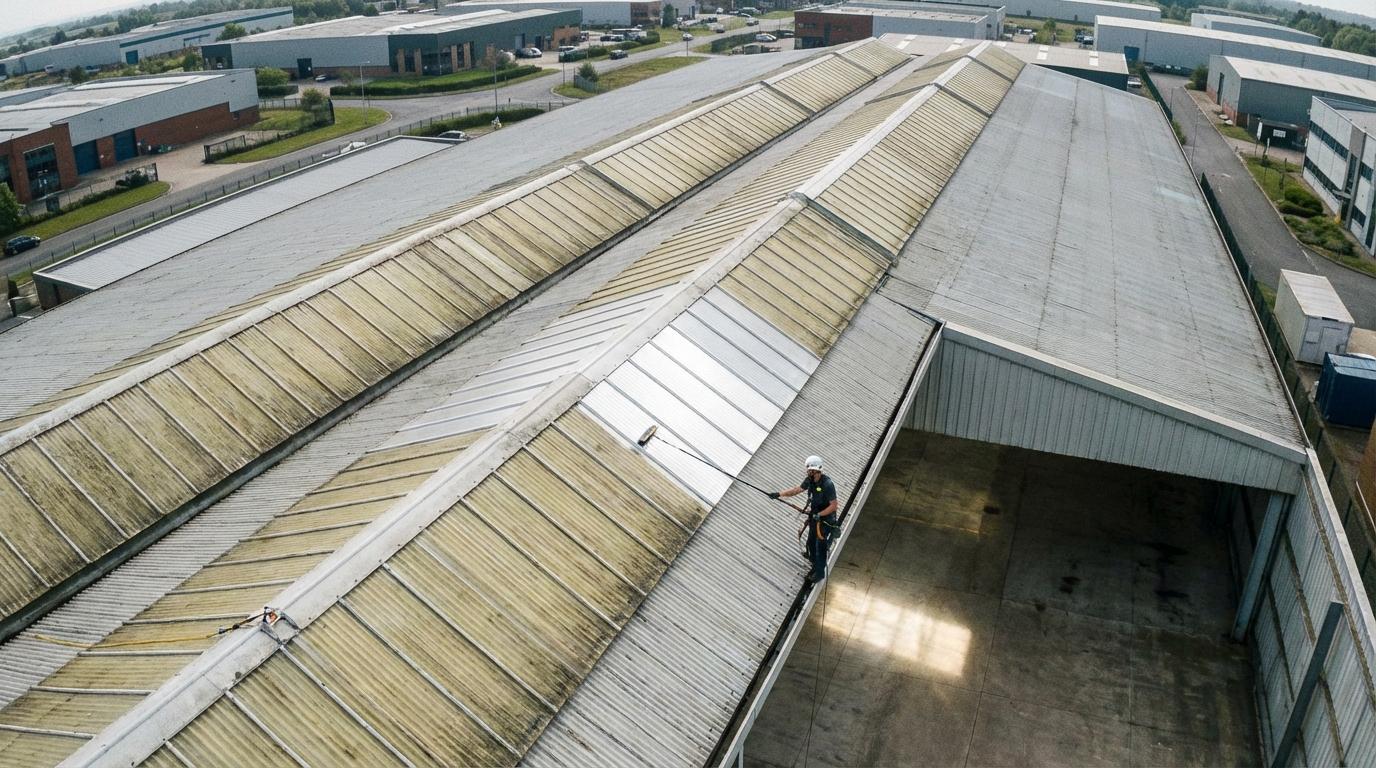
Roof skylights are a typical example of a building element for which regular servicing is often not included in the standard maintenance schedule. No pressure washer from ground level can reach them. A ladder may provide access to the roof, but working on slippery, inclined polycarbonate without protection is extremely dangerous.
Rope access solves this problem safely and efficiently. The technician works from ropes anchored to fixed points on the roof or to dedicated service points. They can move along the row of skylights, clean them sequentially, apply chemicals to remove algae and deposits, and then rinse with water at an appropriate pressure without damaging the material itself.
In halls with glazed roof sections, such as roof glass façades or continuous strip skylights, rope access is often the only safe cleaning method that does not risk damaging the structure or the glazing itself.
When Cleaning Is Not Enough: Panel Replacement
If the skylights are made of degraded polycarbonate without a UV coating, if they are yellowed, cracked, or deformed, cleaning will improve their appearance but will not restore full light transmission. In such a case, after cleaning it is worth assessing whether the panels should be replaced. New panels will restore transmission to the design level and allow electric lighting to be optimized from the beginning.
An industrial rope access technician carrying out the cleaning can also assess the mechanical and visual condition of each panel. This is valuable information for planning the renovation budget.
Check how much your hall is losing because of dirty skylights. Order a cleaning quote and an assessment of the roof panel condition. No obligation, with a concrete result.
Author
Piotr Lankiewicz
Specialist in height work and rope access techniques. Owner of a company providing services in the most inaccessible locations nationwide. He prioritizes punctuality, strict health and safety standards, and solutions that save time and costs where the use of heavy machinery is impractical or not cost-effective.