

How Do Wind Turbine Blade Defects Affect Efficiency and Profits?
From the outside, a wind turbine blade looks like a monolithic, indestructible structure. For most of the year it rotates without alarms and without visible signs of a problem. Meanwhile, changes may be progressing inside the laminate, quietly taking away several or even more than a dozen percent of the turbine’s production capacity. The problem rarely appears as a spectacular failure. Much more often, it develops slowly and just as slowly, but systematically, translates into losses.
If you are responsible for wind farm operation, manage an O&M contract, supervise professional wind turbine inspection and servicing, or analyse production results, this article shows how specific types of blade damage affect turbine operation and why the inspection cycle should not be treated as a formality.
Types of Wind Turbine Blade Damage
Wind turbine blades operate in extreme conditions. They rotate with blade tip speeds reaching several hundred kilometres per hour, are exposed to impacts from rain, ice, sand, and insects, variable mechanical loads, and long-term UV radiation. As a result, several characteristic types of damage occur.
Leading Edge Erosion
The leading edge is the front part of the blade that first strikes the airflow. This is where the greatest erosive load is concentrated. Under the impact of water particles, especially during rain at high tip speeds, fine mineral particles, and insects, the protective coating gradually degrades. The process begins with loss of gloss and smoothness, progresses through microcracking of the gelcoat layer, and in the next stage exposes the structural material: glass-epoxy or carbon laminate.
Leading edge erosion is the most common and, at the same time, one of the most deceptive types of damage. It progresses for years before becoming visible to the naked eye from the ground or from the nacelle. Meanwhile, even relatively minor surface damage is enough to disturb the airflow along the blade.
Delamination
A turbine blade is a layered structure, a laminate made of fabric layers reinforced with epoxy resin. Delamination is the separation of successive material layers from one another. It may be caused by manufacturing defects, such as uneven resin saturation or air bubbles in the laminate, by material fatigue under cyclic stress, or by water penetrating the structure through leaks in the outer coating.
Delamination is particularly dangerous because it is invisible without specialist testing. An internal void in the laminate does not produce external symptoms until the damage grows to a size that affects structural stiffness. Only regular tap testing or ultrasonic testing makes it possible to detect delamination at an early stage.
Cracks
Cracks in the blade structure may vary in type and location. The most common include:
Cracks in the outer coating: superficial cracks, often resulting from advanced erosion or impact by a foreign object, such as a bird, large insect, or hail. In themselves, they do not threaten the structure, but they create a path for water to enter the laminate.
Cracks along the trailing edge: the rear edge of the blade is the joint zone between the two shell halves. This area is prone to seam separation under cyclic stress. Cracks along the trailing edge may develop quickly and lead to serious structural damage.
Cracks near the spars: the blade’s load-bearing elements, or spars, carry the main mechanical loads. Damage in their vicinity requires immediate assessment by an engineer and usually qualifies the blade for urgent repair or replacement.
How Blade Damage Translates Into Energy Production
A wind turbine blade is essentially an aerodynamic profile, a wing that converts the kinetic energy of wind into torque. Any disturbance in the geometry of the blade surface affects airflow and therefore the efficiency of energy conversion.
Leading edge erosion increases turbulence in the boundary layer of air flowing around the blade. Instead of laminar flow, which enables efficient lift generation, the air begins to separate earlier. The blade loses part of its ability to generate torque, especially at moderate wind speeds, which are the most frequent and most important operating conditions at most locations.
Delamination and cracks affect another aspect of turbine operation. A change in the mass and stiffness distribution of the blade disrupts the balance of the rotating system. The turbine begins to operate with vibrations that are transmitted to the shaft, bearings, and nacelle. Turbine control systems respond to these changes. In extreme cases, automatic safety systems limit power or stop the machine until diagnostics are performed.
It is also important to understand where the greatest losses occur within the wind speed profile. A wind turbine does not operate only during storms. Most annual energy production comes from hours with wind speeds around and above the nominal speed for a given location, but below cut-out speed. This is precisely the speed range that is most sensitive to aerodynamic deterioration. A turbine with damaged blades does not see this as a failure. It operates, rotates, reports an “OK” status, but its actual production systematically deviates from the forecast.
Production losses caused by erosion and blade damage accumulate over time. A blade that has not been inspected and repaired for several seasons may have a damaged leading edge along a significant length. The impact on annual production is real and measurable. With appropriate data from the turbine’s SCADA system, the power curve before and after blade repair can be directly compared.
Why Regular Inspections Are an Investment, Not an Operating Cost
Wind farm managers often treat blade inspection as an item on a checklist, something that has to be done once every few years to meet the requirements of a service contract. In practice, this approach costs more than regular prevention.
Consider the issue through three scenarios.
Scenario A: No Regular Inspections
The turbine operates without regular blade condition assessment. Leading edge erosion progresses over subsequent seasons. At some point, the SCADA system or a routine inspection reveals significant damage. A complex repair is required: a larger area to prepare and laminate, longer rope access working time, and higher material costs. In extreme cases, the extent of damage qualifies the blade for dismantling and workshop repair or replacement.
Scenario B: Inspection Without Repair
An inspection is carried out, and the report shows early leading edge damage and local delamination. The repair decision is postponed because of budget or schedule constraints. In the following season, the damage expands. The erosion zone is enlarged by winter icing, rain, and thousands of additional operating hours. The repair scope and cost increase disproportionately compared with the savings from postponing the decision.
Scenario C: Cyclical Inspections With Preventive Repair
Inspections are carried out regularly, before the season or annually. Minor leading edge damage is repaired on an ongoing basis: defects are filled and a leading edge protection system, or LEP, is applied. Delamination is detected before it grows to structural dimensions. The blades operate in optimal aerodynamic condition. The cost of a single visit is significantly lower than a complex repair, and the turbine generates its full forecast energy volume.
In addition to direct repair costs, there is also the issue of responsibility. If a blade with undiagnosed structural damage fails, composite fragments may fall from a height of more than one hundred metres. Responsibility for the technical condition of the turbine rests with the wind farm operator. Regular, documented inspection is proof of due diligence, which is important both in relations with the insurer and in any possible investigation.
Blade inspections using rope access do not require the turbine to be stopped for a long time. An experienced team of rope access technicians can carry out a full visual, tap, and documentation inspection of one turbine within one working day. This is significantly less than the downtime associated with repairing serious damage.
Book an Inspection Before the Season
The optimal time for blade inspection is before the peak wind season, in spring or early autumn, before the machine enters an intensive operating cycle. Any necessary repairs can then be planned within a weather window without time pressure, and the turbine enters the season with its technical condition documented.
If your turbines were not inspected last season or the scheduled periodic inspection is approaching, it is worth arranging a site visit and blade condition assessment before the decision is forced by the SCADA system or a service alarm.
Ask about an inspection of your turbines before the season.
Author
Piotr Lankiewicz
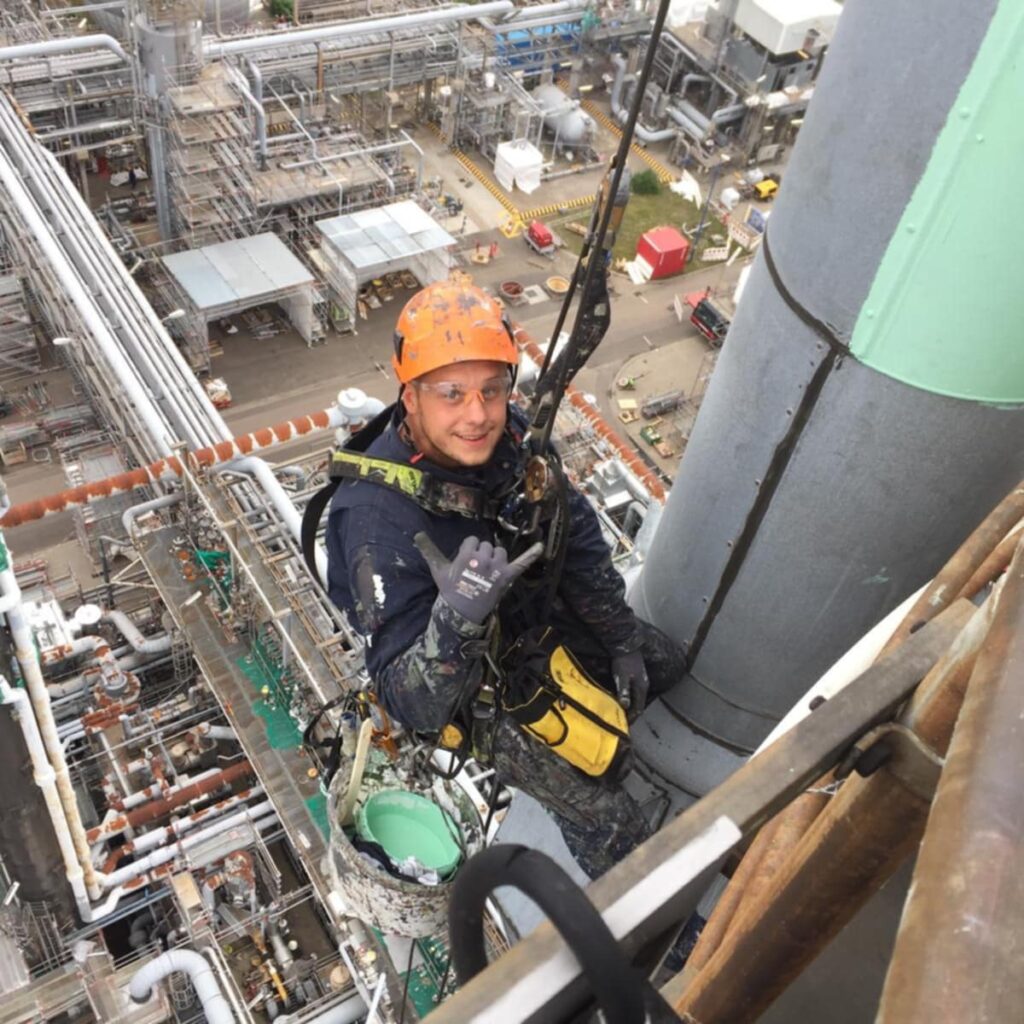
Specialist in height work and rope access techniques. Owner of a company providing services in the most inaccessible locations nationwide. He prioritizes punctuality, strict health and safety standards, and solutions that save time and costs where the use of heavy machinery is impractical or not cost-effective.