High-Bay Warehouse Cleanliness Checklist Before an Audit
The auditor is arriving in three weeks. The warehouse manager has received an email with the central schedule for the ISO 9001 inspection. The list of items to be reviewed includes: “cleanliness of warehouse surfaces, including areas inaccessible to standard cleaning methods.” A question mark appears next to this item. The last comprehensive cleanliness inspection of high-level areas? That is a good question.
An ISO, GMP, or BRC audit in a high-bay warehouse is not only a document inspection. The auditor walks through the hall, looks up, checks behind racks, and inspects corridors near ventilation systems. If they find a thick layer of dust on the roof truss or dirty sprinkler heads, it goes onto the list of non-conformities.
What an ISO Auditor Checks in a Warehouse: Critical Zones
A quality management system auditor does not only assess whether the floor is clean. They assess whether cleanliness management is systematic, meaning whether it covers all zones, including those that are difficult to access. This distinction is crucial.
The most commonly assessed elements in high-level zones include:
•Steel structures and high-bay racking: upper beams, crossbars, and the upper sections of upright frames.
•Sprinkler systems: sprinkler heads and pipework must be free of dust that could interfere with activation in the event of a fire.
•Ventilation and air-conditioning systems: grilles, exhaust ducts, and filters. Visible dirt indicates neglect in the maintenance system.
•Ceiling lighting: luminaires covered with a layer of dust signal to the auditor that the overhead zone is not serviced regularly.
•Upper shelves of high-bay racks: especially where products or packaging materials are stored, as contamination from above may fall onto the goods.
•Walls and columns in the upper zone: streaks, moisture stains, and signs of roof leaks.
•Gates and loading docks in upper areas: sectional door windows, guide rails, and ceiling seals.
The absence of a procedure for comprehensive cleaning of facilities and structures, or the absence of documentation confirming that such a procedure has been carried out, is a potential non-conformity in any quality management system audit.
20-Point Checklist: Ready-to-Use Cleanliness Inspection Sheet for a High-Bay Warehouse
The checklist below can be used as an internal inspection sheet before an external audit or as a tool for recurring internal reviews. Each item should be assessed as: OK / Needs Correction / Requires Work at Height.
| No. | Item to Check | Access Level |
| 1 | Cleanliness of roof beams and bracing – no dust or grease deposits. | High, above 5 m |
| 2 | Sprinkler heads – free from dust and cobwebs, with no mechanical damage. | High |
| 3 | Sprinkler system pipework – no deposits or corrosion on visible surfaces. | High |
| 4 | Supply and exhaust ventilation grilles – clear airflow and no visible dirt. | High |
| 5 | Ventilation ducts – external surfaces free from deposits. | High |
| 6 | Lighting fixtures – diffuser surfaces without a thick layer of dust, as this affects lighting efficiency. | High |
| 7 | Upper sections of high-bay racks – shelves clean, with no waste or unused equipment. | High |
| 8 | Cable trays and cable routes – surfaces free from excessive deposits. | High |
| 9 | Ceilings, roof panels, and roof lining – no discoloration, leak marks, or dirt. | High |
| 10 | Warehouse walls in the upper zone, above 3 m – render condition, no cracks or moisture marks. | High |
| 11 | Structural columns and pillars – full height checked, no damage or excessive dirt. | Mixed |
| 12 | Sectional doors – cleanliness of windows, guide rails, and seals across the full height. | Mixed |
| 13 | Loading docks – surface condition, sealing strips, and no packaging waste in the upper zone. | Standard |
| 14 | Floor and drainage channels – clean, unobstructed, with no oil or damage. | Standard |
| 15 | Lower rack sections – no expired products, damaged packaging, or dust at rack bases. | Standard |
| 16 | Picking area – operational cleanliness, designated waste zones, and clean conveyors. | Standard |
| 17 | Documentation of high-level cleaning work – protocols from the last 12 months available. | Documentation |
| 18 | High-level zone cleaning schedule entered in the facility maintenance register. | Documentation |
| 19 | Certificates and qualifications of the work-at-height contractor kept in the documentation. | Documentation |
| 20 | Current risk assessment protocol for work in high-level warehouse zones. | Documentation |
Items 1–16 assess the physical condition of the warehouse. Items 17–20 assess the management system, and these are often the points that generate non-conformities when the warehouse looks acceptable physically, but there is no documentation confirming systematic maintenance.
Why Standard Cleaning Companies Cannot Reach Everywhere
A standard cleaning company operates in a warehouse at floor level and, at most, a few meters above it. It handles floors, lower rack zones, sanitary facilities, and offices. This is logical because its equipment, such as mops, carts, and industrial vacuum cleaners, is designed for work in areas accessible without specialist qualifications or equipment.
Zones above 4–5 meters are a different environment. Reaching sprinkler heads at a height of 10–12 meters without scaffolding or an aerial lift cannot be done safely. Vacuuming a roof truss at a height of 8 meters requires a technician qualified for work at height and equipped with proper fall protection.
Scaffolding in a high-bay warehouse is often impossible to use without stopping operations, because racks occupy the entire space and forklifts must continue working. An aerial work platform can enter the hall only if the aisles between racks are wide enough. In narrow-aisle warehouses, with aisles of 1.5–2 meters, this is impossible.
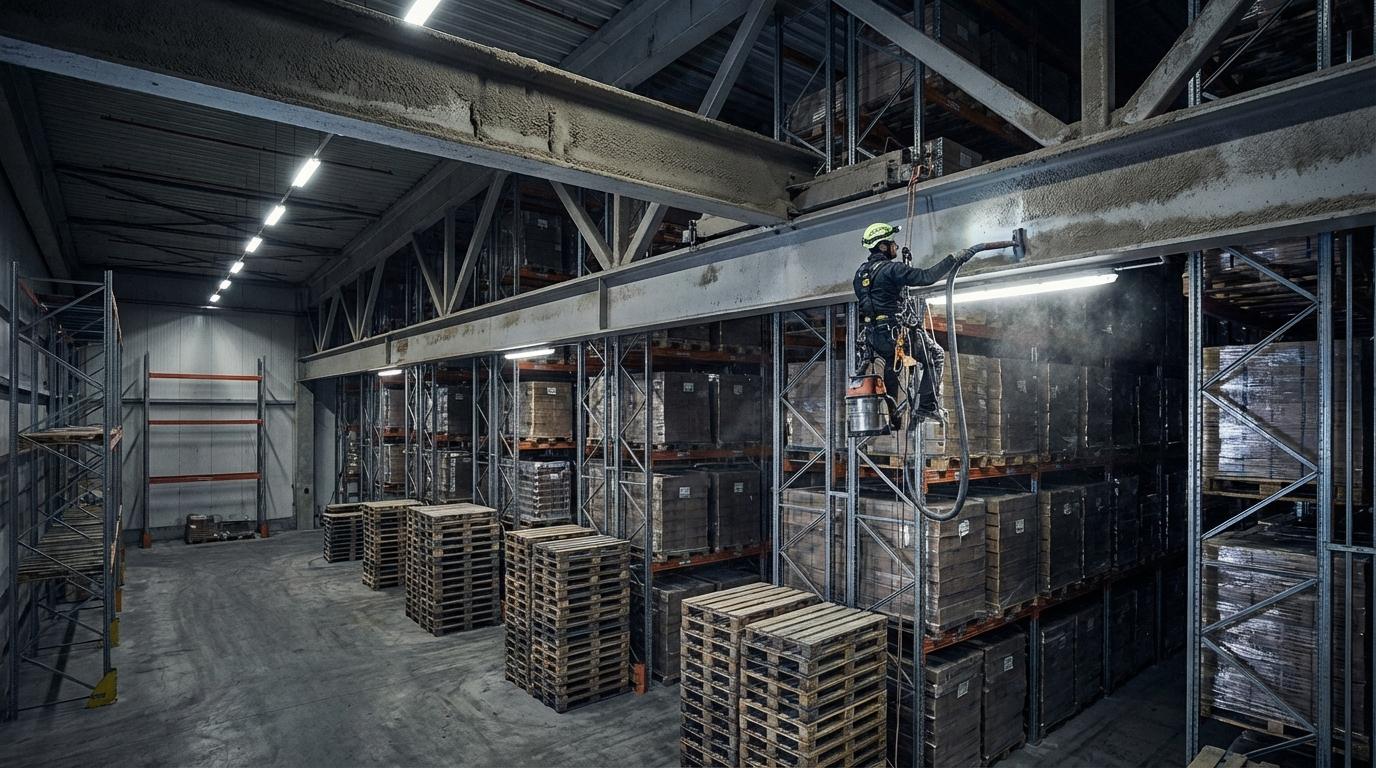
Rope access solves this problem. A technician anchors ropes to the roof structure or designated points and moves along the rack aisles, working on every overhead element without occupying warehouse space at floor level. Forklifts can continue operating, while the section directly beneath the technician is marked with warning tape and temporarily excluded from traffic.
How to Plan Work at Height Before an Audit: Timing and Documentation
Planning cleaning work before an audit requires sufficient lead time. The optimal schedule looks as follows.
6–8 weeks before the audit: contact a high-access company, arrange a site visit, and agree on the scope and schedule of work.
4–5 weeks before the audit: carry out the work in high-level zones. This leaves time for possible corrections and additions if, during the work, it turns out that the scope is broader than initially assumed.
2–3 weeks before the audit: accept the work, collect full documentation, including protocols, photos, and team certificates, and enter the work into the facility maintenance register.
One week before the audit: conduct an internal review using the checklist and verify that standard cleaning work has complemented the results of the work at height.
Documentation collected after work at height should be ready to present to the auditor without having to search for it. Ideally, it should be kept as a separate file in the facility maintenance register.
Regular Maintenance of High-Level Zones: How to Stop Operating in Firefighting Mode
Many warehouses operate according to the same pattern: inspection before an audit, urgent work, acceptance, then forgetting about the issue for another two years, followed by another rush before the next audit. This is an expensive and stressful model.
The alternative is an annual or biennial schedule of inspections and cleaning of high-level zones, included in the facility maintenance agreement and carried out systematically. The unit cost of such an inspection is lower, the scope of work is smaller because dirt does not build up for years, and documentation is maintained on an ongoing basis.
Contact us before your audit. We will assess the condition of the high-level zones in your warehouse, propose the scope and timing of the work, and fit it into your inspection schedule without a last-minute rush.
Author
Piotr Lankiewicz
Specialist in height work and rope access techniques. Owner of a company providing services in the most inaccessible locations nationwide. He prioritizes punctuality, strict health and safety standards, and solutions that save time and costs where the use of heavy machinery is impractical or not cost-effective.